
Milli769.pdf (application/pdf Object) How to get to grips with Plan B. By Max Mckeown Friday, 30 March 2012 Only one thing is certain in life: that there will be uncertainty.

Events will overtake your plans, while the actions of others will demand adaptation. What if your beautiful strategy is failing to cope with reality? ‘We didn’t adapt fast enough’ is a common enough explanation for poor performance and disastrous leadership. It’s been used by leaders to explain opportunities lost through years of inflexibility and lack of imagination. 'There is no alternative' has become a popular rallying call. The most successful adaptors are curious. Twitter was a Plan B produced by a struggling software company during an ad-hoc brainstorm in a playground near to their office. Managers are taught the value of being (or looking) organised. How do you embrace the notion of a Plan B? Blockbuster believed in Plan A and kept on renting out videos.
Any fool can produce a plan. The Folly of Stretch Goals - Daniel Markovitz. By Daniel Markovitz | 1:39 PM April 20, 2012 Let’s dispense, once and for all, with the managerial absurdity known as “stretch goals.”
While it’s true that renowned psychologists Edwin Locke and Gary Latham described goal setting as “the most effective managerial tool available,” it’s also true that no less a thinker than W.E. Deming insisted that companies, “Eliminate management by objective.” In my opinion, there can be no such debate over the lack of usefulness of stretch goals. Here’s why. Stretch goals can be terribly demotivating.
In his classic article, “Small Wins,” psychologist Karl Weick argued that people often become overwhelmed and discouraged when faced with massive and complex problems. In their recent book, The Progress Principle, Teresa Amabile and Steven Kramer build on the same argument and clearly demonstrate how even the smallest, most mundane steps forward — for example, achieving clear consensus in a meeting — can motivate and inspire workers. The CliffsNotes Version - Gary Hamel’s Management 2.0. By Gary Hamel I don’t know if I’ll write another book.

Truth is, I’m too busy right now—and even if I found the time to churn one out, you’d probably be too busy to read it. After all, how many business books have you managed to read this year, cover to cover? According to my friends at Harvard Business School publishing, about 22 million business books were sold in 2008. If we assume the market for such books comprises 20% of the US population, or 62 million people, that means that each potential customer bought roughly 1/3 of a book last year.
I’m looking at my own bookshelf. Not that my temporary vow of book-writing abstinence is likely to rob you of any incisive insights. There’s probably no organizational attribute that’s more important today than adaptability. In contrast to market share or product differentiation, adaptability is an abstract concept. An adaptable company is one that captures more than its fair share of new opportunities. Chapter 1: Anticipation. The Death—and Reinvention—of Management: Part 1. I have prepared a synthesis of the thinking in a whole host of recent management books that propose the reinvention of management, including: Reinventing Management by Julian Birkinshaw, Reorganize for Resilience by Ranjay Gulati, The Power of Pull by John Hagel, John Seely Brown and Lang Davison, Delivering Happiness by Tony Hsieh, Peak by Chip Conley, Employees First, Customers Second by Vineet Nayar, Drive by Dan Pink, The Design of Business by Roger Martin, The Dragonfly Effect by Jennifer Aaker and Andy Smith, Empowered by Josh Bernoff and Ted Schadler, Open Leadership by Charlene Li, Enterprise 2.0 by Andrew McAfee, Succeeding with Agile by Mike Cohn, Buy-In and A Sense of Urgency by John Kotter, as well as my own book, The Leader’s Guide to Radical Management.
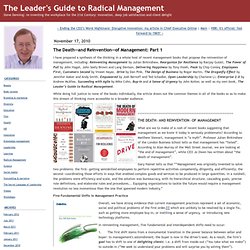
While doing full justice to none of the books individually, the article draws out the common themes in all of the books so as to make this stream of thinking more accessible to a broader audience. 1. 2. 3. The Best-Kept Management Secret On The Planet: Agile. Innovation: Applying "Inspect & Adapt" To The Agile Manifesto. Six Common Mistakes That Salesforce.com Didn't Make. Scrum Is A Major Management Discovery. How Marc Benioff of Salesforce.com Became The Most Valuable CEO Of All.