
Http URL Connection. Simple HTTP Url Connection example. I’ve been a little lax in posting lately.
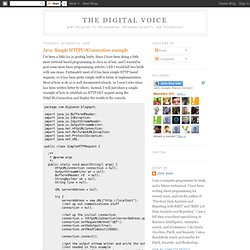
Since I have been doing a little more network based programming in Java as of late, and I wanted to post some more basic programming articles, I felt I would kill two birds with one stone. Fortunately most of it has been simple HTTP based requests, so it has been pretty simple stuff in terms of implementation. Most of how to do so is well documented already, so I won’t echo what has been written better by others. Instead, I will just share a simple example of how to establish an HTTP GET request using the HttpURLConnection and display the results to the console. package com.digiassn.blogspot; How to open and read a url. On this blog I’ve shown a variety of ways to use Java to open a URL connection, and then read data from that connection, including my How to open and read from a URL with the Java URL and URLConnection classes tutorial.
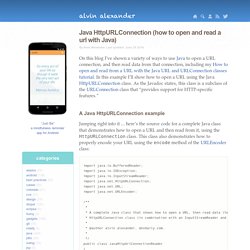
In this example I’ll show how to open a URL using the Java HttpURLConnection class. As the Javadoc states, this class is a subclass of the URLConnection class that “provides support for HTTP-specific features.” A Java HttpURLConnection example Jumping right into it ... here’s the source code for a complete Java class that demonstrates how to open a URL and then read from it, using the HttpURLConnection class. DB2 Database for Linux, UNIX, and Windows. Access MySQL Database: open connection, create table, insert and.
Synchronized Methods. The Java programming language provides two basic synchronization idioms: synchronized methods and synchronized statements.
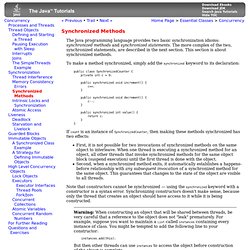
The more complex of the two, synchronized statements, are described in the next section. This section is about synchronized methods.