
BigTable. BigTable is a compressed, high performance, and proprietary data storage system built on Google File System, Chubby Lock Service, SSTable (log-structured storage like LevelDB) and a few other Google technologies.
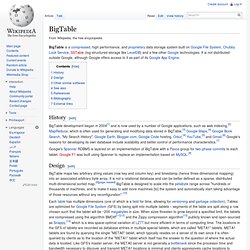
It is not distributed outside Google, although Google offers access to it as part of its Google App Engine. History[edit] BigTable development began in 2004[1] and is now used by a number of Google applications, such as web indexing,[2] MapReduce, which is often used for generating and modifying data stored in BigTable, Google Maps,[4] Google Book Search, "My Search History", Google Earth, Blogger.com, Google Code hosting, Orkut,[4] YouTube,[5] and Gmail.[6] Google's reasons for developing its own database include scalability and better control of performance characteristics.
Design[edit] BigTable maps two arbitrary string values (row key and column key) and timestamp (hence three-dimensional mapping) into an associated arbitrary byte array. Other similar software[edit] s640x480 (640×444) Google's BigTable - Andrew’s Website. Today Jeff Dean gave a talk at the University of Washington about BigTable - their system for storing large amounts of data in a semi-structured manner.

I was unable to find much info about BigTable on the internet, so I decided to take notes and write about it myself. First an overview. BigTable has been in development since early 2004 and has been in active use for about eight months (about February 2005). There are currently around 100 cells for services such as Print, Search History, Maps, and Orkut. Following Google's philosophy, BigTable was an in-house development designed to run on commodity hardware. Each table is a multi-dimensional sparse map. In order to make each manage the huge tables, the tables are split at row boundaries and saved as tablets. Tablets are stored on systems as immutable SSTables and a tail of logs (one log per machine). Back to columns. There is a lot of redundant data in their system (especially through time), so they make heavy use of compression. OSDI '06 Paper. Pp. 205–218 of the Proceedings.

BigTable. Updated Apr 13, 2009 1:49 pm | 3,629 views.

What database does Google use. Understanding HBase and BigTable - Jimbojw.com. From Jimbojw.com The hardest part about learning HBase (the open source implementation of Google's BigTable), is just wrapping your mind around the concept of what it actually is.
I find it rather unfortunate that these two great systems contain the words table and base in their names, which tend to cause confusion among RDBMS indoctrinated individuals (like myself). This article aims to describe these distributed data storage systems from a conceptual standpoint. After reading it, you should be better able to make an educated decision regarding when you might want to use HBase vs when you'd be better off with a "traditional" database. It's all in the terminology Fortunately, Google's BigTable Paper clearly explains what BigTable actually is. A Bigtable is a sparse, distributed, persistent multidimensional sorted map.
Note: At this juncture I like to give readers the opportunity to collect any brain matter which may have left their skulls upon reading that last line. map persistent. UW CSE Speaker Abstract. Jeff Dean (Google)Host: ZahorjanBigTable: A Distributed Structured Storage SystemColloquiumTuesday, October 18, 20053:30 pm, EE-105Maps and directions Abstract BigTable is a system for storing and managing very large amounts of structured data.

Data is organized into tables with rows and columns, but unlike a traditional database system, the row/column space can be sparse. Row keys and values are arbitrary strings, and the system allows each row/column cell to store not just a single value but a set of values with associated timestamps, simplifying analyses that examine how values have changed over time. Data in a single table is internally broken at arbitrary row boundaries to form contiguous regions of data called tablets. In this talk, I'll discuss the basic design of BigTable and its implementation, provide some performance measurements, and outline some current applications of the system. Archives: