
Java - Maximum value of long number. Convert an int to a byte array [java] Primitive Data Types. The Java programming language is statically-typed, which means that all variables must first be declared before they can be used.
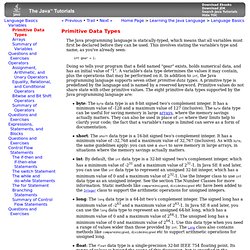
This involves stating the variable's type and name, as you've already seen: Doing so tells your program that a field named "gear" exists, holds numerical data, and has an initial value of "1". A variable's data type determines the values it may contain, plus the operations that may be performed on it. In addition to int, the Java programming language supports seven other primitive data types. A primitive type is predefined by the language and is named by a reserved keyword.
Byte: The byte data type is an 8-bit signed two's complement integer. In addition to the eight primitive data types listed above, the Java programming language also provides special support for character strings via the java.lang.String class. Default Values It's not always necessary to assign a value when a field is declared. Literals Integer Literals Floating-Point Literals. Array. Java.lang.Object org.json.JSONArray public class JSONArrayextends java.lang.Object A JSONArray is an ordered sequence of values.

Its external text form is a string wrapped in square brackets with commas separating the values. The internal form is an object having get and opt methods for accessing the values by index, and put methods for adding or replacing values. The constructor can convert a JSON text into a Java object. A get method returns a value if one can be found, and throws an exception if one cannot be found. The generic get() and opt() methods return an object which you can cast or query for type. The texts produced by the toString methods strictly conform to JSON syntax rules. An extra , (comma) may appear just before the closing bracket. Version: Author: JSON.org JSONArray public JSONArray() La classe String et la gestion des chaînes de caractères en Java.
Date de publication : 01/10/2004 , Date de mise à jour : 01/10/2004 Par Jean-Claude Armici (home) Résumé concernant l'utilisation des chaînes de caractères en Java (initialement écrit pour Java 1.4).

I. Introduction II. La classe String II.1. Les chaînes de caractères (que nous appellerons "strings" par la suite) sont souvent utilisées en programmation. Dans beaucoup de langages un string n'est autre qu'un tableau de caractères, alors qu'en Java un string est un objet . En fait, Java propose 3 classes apparentées aux chaînes de caractères : La classe String (chaîne de caractères non modifiables) La classe StringBuffer (chaîne de caractères modifiables à volonté) La classe StringTokenizer (séparation d'une chaîne en plusieurs entités) Dans la plupart des cas il convient d'utiliser String pour créer, stocker et gérer des chaînes de caractères. Cette classe dispose de 11 constructeurs et plus de 40 méthodes pour examiner les caractères d'une chaîne, comparer, chercher, extraire, etc. Javascript - L'objet String. Pattern « Regular Expressions.