
ASA VPN - Cisco asa vpn Configuration. CCNA LAB - VPN. LAB 4-8: Virtual Private Network (VPN) – IPsec (Site-to-Site) You are the Network Administrator at Ranet Branch Office, and have to newly configure the Ranet-Br router to let your own host connect to the internet and connect to the hosts in Headquarter (192.168.0.0/24) via Site-to-Site IPsec VPN as below: (configure via console terminal for Ranet-BR router) 1.

Enable LAN interface on Ranet-BR and set IP address to be the first assignable IP of 192.168.1.0/28 network. 2. Configure remote access vpn on a router. As network engineers, many of us spend lots of time on the road.

On nights not spent working on the install, a quiet hotel room can be a great place to study. In a previous post, you learned how to configure your Cisco router for dynamic DNS. This post will show you how to configure remote access vpn on a Cisco router to access your home lab remotely. Basic Cisco VPN Client Configuration The first part covers the basic remote access vpn configuration. 4peg Template username josh password blindhog1@ NSTX (IP-over-DNS) HOWTO. Problem The information presented here is obsolete.

Take a look at Iodine. You're sitting in an airport or in a cafe, and people want your money for Internet access. They do allow DNS traffic, though. If the ISP allows DNS traffic to any DNS server (and not just their own), you might consider running OpenVPN on UDP port 53 (thanks to Norman Rasmussen for this suggestion). Once you've followed these instructions, you basically have a remote proxy, providing you with access to the Internet.
If DNS traffic does not work, but ICMP traffic (i.e., ping) works, try ICMPTX: IP-over-ICMP. Keywords nstx, ip-over-DNS, tunnel, firewall piercing, ifconfig, route, tun/tap, tun0. Solution You need several things to get going: GRE tun. Example uses[edit] In conjunction with PPTP to create VPNs.In conjunction with IPsec VPNs to allow passing of routing information between connected networks.In Mobility protocols.In A8/A10 interfaces to encapsulate IP data to/from Packet Control Function (PCF).Linux and BSD can establish ad-hoc IP over GRE tunnels which are interoperable with Cisco equipment.Aruba Access Points use GRE tunnels to establish a connection with their respective Aruba Mobility Controller.
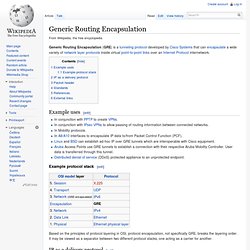
User data is transferred through this tunnel.Distributed denial of service (DDoS) protected appliance to an unprotected endpoint. Example protocol stack[edit] Based on the principles of protocol layering in OSI, protocol encapsulation, not specifically GRE, breaks the layering order. It may be viewed as a separator between two different protocol stacks, one acting as a carrier for another. Tout sur le tunnel Ipsec. Cet article présente le fonctionnement du protocole IPsec, qui permet de créer des réseaux privés virtuels de manière conforme aux spécifications de l’IETF.
Les services offerts par IPsec et leurs limitations y sont détaillés, de même que les problèmes d’interopérabilité, tant avec d’autres protocoles qu’entre applications différentes. Enfin, quelques implémentations sont présentées, et un rapide aperçu de leur conformité aux standards est donné. 1 – Introduction au protocole IPSec. ISAKMP. ISAKMP (Internet Security Association and Key Management Protocol) is a protocol defined by RFC 2408 for establishing Security Associations (SA) and cryptographic keys in an Internet environment.

ISAKMP only provides a framework for authentication and key exchange and is designed to be key exchange independent; protocols such as Internet Key Exchange and Kerberized Internet Negotiation of Keys provide authenticated keying material for use with ISAKMP.[1] Overview[edit] ISAKMP defines the procedures for authenticating a communicating peer, creation and management of Security Associations, key generation techniques and threat mitigation (e.g. denial of service and replay attacks).
IKE (Internet Key Exchange) In computing, Internet Key Exchange (IKE or IKEv2) is the protocol used to set up a security association (SA) in the IPsec protocol suite.

IKE builds upon the Oakley protocol and ISAKMP.[1] IKE uses X.509 certificates for authentication - either pre-shared or distributed using DNS (preferably with DNSSEC) and a Diffie–Hellman key exchange - to set up a shared session secret from which cryptographic keys are derived.[2][3] In addition, a security policy for every peer which will connect must be manually maintained.[2] History[edit] The Internet Engineering Task Force (IETF) originally defined IKE in November 1998 in a series of publications (Request for Comments) known as RFC 2407, RFC 2408 and RFC 2409:
What is the ISAKMP policy and how does it impact IPsec VPN router configuration? OpenVPN : HOWTO français OpenVPN. NBS System fait aussi des offres professionnelles avec des boitiers VPN pour les points de ventes, vous pouvez consulter la plaquette ici. Attention, cet article n’a pas été mis à jour depuis des années, il contient encore une majorité de choses exactes mais peut être en retard ou contenir des erreurs. Serveur. Passerelle VPN : OpenVPN Matthieu Vogelweith 13 août 2009 OpenVPN [1] sous Debian Lenny [2] ...

Ce document a été rédigé en LaTeX en utilisant l’excellent Vim sous Debian GNU/Linux. Il est disponible aux formats XHTML et PDF. Copyright ©2009 Matthieu VOGELWEITH <matthieu@vogelweith.com>. Vous avez le droit de copier, distribuer et/ou modifier ce document selon les termes de la GNU Free Documentation License, Version 1.3 ou ultérieure publiée par la Free Software Foundation ; avec aucune section inaltérable, aucun texte de première page de couverture, et aucun texte de dernière page de couverture.