
Alien Life May Not Survive on Planets With Uranus-Like Tilts. If you think summer is too hot or winter unbearably cold, take solace that in the distant past seasons on our planet might have been much harsher.
However, the advent of milder seasons did more than offer comfort, some scientists suggest. Subdued seasonality might be linked to the emergence of complex life on Earth around 600 million years ago. On alien worlds, extreme seasonal spikes and plunges in temperature could likewise determine whether life teems, scrapes by, or dies. Seasons arise when the axis of a planet's spin is tilted relative to the plane of the planet's orbit. Recent research has suggested that a loss of axial tilt and its attendant seasonality, which helps moderate global temperatures, could doom extraterrestrial creatures. "Axial tilt, or obliquity, is a crucial parameter for climate and the possible habitability of a planet," said René Heller, a postdoctoral research associate at the Leibniz Institute for Astrophysics in Potsdam, Germany. Seasonally maladjusted.
Earthshine holds clues to exoplanet aliens - space - 29 February 2012. IS IT possible to tell whether a planet hosts life just from its glow?

A new analysis of Earthshine, sunlight reflected off Earth then bounced back by the moon, suggests this is a viable way to seek life on exoplanets. Life co-exists with certain chemicals that leave their imprint on the light Earth reflects, while plants reflect light differently to rocks. The trouble is that exoplanets are too faint compared with their host stars for such distinctions to be detected. So Michael Sterzik of the European Southern Observatory in Santiago, Chile, and colleagues used a spectrograph mounted on the Very Large Telescope to examine polarised Earthshine, its light waves aligned in one plane.
What is Reality. Fundamental Particles. Dark Energy: The Biggest Mystery in the Universe. Cosmic Variance. In honor of the Nobel Prize, here are some questions that are frequently asked about dark energy, or should be.

What is dark energy? It’s what makes the universe accelerate, if indeed there is a “thing” that does that. (See below.) So I guess I should be asking… what does it mean to say the universe is “accelerating”? First, the universe is expanding: as shown by Hubble, distant galaxies are moving away from us with velocities that are roughly proportional to their distance. But that’s so down-to-Earth and concrete. The relative distance between far-flung galaxies can be summed up in a single quantity called the “scale factor,” often written a(t) or R(t). Does that mean the Hubble constant, which measures the expansion rate, is increasing? No. The Story Of Dark Energy, In A Nutshell : 13.7: Cosmos And Culture. Sometimes nature just throws you a loop.
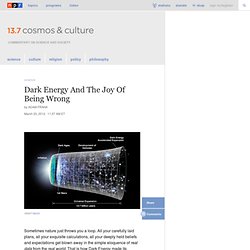
All your carefully laid plans, all your exquisite calculations, all your deeply held beliefs and expectations get blown away in the simple eloquence of real data from the real world. That is how Dark Energy made its appearance into the world of cosmology. Its not just that folks weren't expecting it. They were, in fact, expecting the very opposite. Clocking galaxy clusters to gauge dark energy - space - 29 March 2012. The universe's oldest light and its largest objects could provide a new way to study dark energy, the mysterious entity believed to be pushing the universe apart at an ever-faster rate.
The discovery of the universe's accelerating expansion earned three physicists a Nobel prize last year, but no one knows its source. "What's causing the acceleration? " asks Rachel Bean of Cornell University in Ithaca, New York. "We really don't have a clue. " The leading explanation holds that there is a set amount of repulsive energy, represented by the cosmological constant, in every spot in space – as the cosmos expands, more space is created, leading to ever-faster expansion. To do so, researchers need to determine the expansion rate of the universe at different cosmic eras by looking further into space. Galaxy clusters Now Nick Hand at the University of California, Berkeley, and colleagues are the first to use the motion of galaxy clusters to gauge cosmic expansion. Dark matter particles may be heavyweights after all - space - 29 November 2011.
By Lisa Grossman Dark matter is slowly running out of places to hide.

Two new looks at the gamma-ray sky suggest that if the mysterious matter is a particle, it is heavier than 40 gigaelectronvolts, about 44 times the mass of a proton. That contradicts hints from three experiments on Earth that pointed to a lightweight dark matter particle weighing just a quarter as much, although some researchers say such featherweights are still in the running. Largest dark matter map holds clues to dark energy - space - 11 January 2012. By Lisa Grossman We may not know what dark matter is, but we can still put it to work.
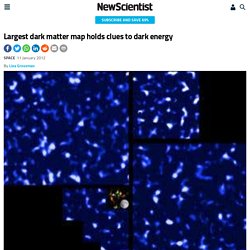
The largest map of dark matter ever made (pictured) is one of several new ones that will help to nail the properties of the equally mysterious dark energy, which is thought to drive the universe’s accelerating expansion. A group led by Catherine Heymans of the University of Edinburgh, UK, and Ludo Van Waerbeke of the University of British Columbia, Vancouver, Canada, presented the huge map at the American Astronomical Society (AAS) meeting in Austin, Texas, this week. Dark matter mysteries: a true game of shadows - 09 January 2012. By Stuart Clark Editorial: “No more eureka moments“ IT’S a troubling time to be looking for the universe’s missing matter.

On the face of it, it shouldn’t be. Is Dark Matter a Glimpse of a Deeper Level of Reality? Two years ago several of my Sci Am colleagues and I had an intense email exchange over a period of weeks, trying to figure out what to make of a new paper by string theorist Erik Verlinde.
I don’t think I’ve ever been so flummoxed by physicists’ reactions to a paper. Mathematically it could hardly have been simpler—the level of middle-school algebra for the most part. Logically and physically, it was a head-hurter. I couldn’t decide whether it was profound or trite. The theorists we consulted said they couldn’t follow it, which we took as a polite way of saying that their colleague had gone off the deep end.
For those who know Verlinde, that label hardly fits. Finding Out What Dark Matter Is – And Isn’t. Want to stay on top of all the space news?
Follow @universetoday on Twitter. The Whole Story on Dark Matter : Starts With A Bang. “Science progresses best when observations force us to alter our preconceptions.” -Vera Rubin I want you to think about the Universe. The whole thing; about everything that physically exists, both visible and invisible, about the laws of nature that they obey, and about your place in it. It’s a daunting, terrifying, and simultaneously beautiful and wondrous thing, isn’t it? Biggest Map Yet of Universe's Invisible Dark Matter Unveiled.
AUSTIN, Texas — The hidden side of the universe is now a bit more illuminated thanks to the largest map yet of dark matter, the strange substance thought to inhabit much of space. Scientists have created the largest scale rendering of dark matter across the universe, revealing a picture of the invisible stuff thought to represent 98 percent of all matter in the universe. Dark matter has never been directly detected, but its presence is felt through its gravitational pull on normal matter. Dark Matter Search Turns Up Empty. Newly Discovered Satellite Galaxies: Another Blow Against Dark Matter? Want to stay on top of all the space news? Follow @universetoday on Twitter. Closing in on Dark Matter: Another “Tentative” Step. A galaxy cluster with the distribution of dark matter marked by purple overlay.
Credit: NASA, ESA, E. Julio (JPL/LAM), P. Natarajan (Yale) and J-P. Kneib (LAM). When physicists and mathematicians want to get an idea into circulation before going through all the hoo-hah of peer-reviewed publication, they often post a paper on the arXiv server, where anyone who is curious can go and read it. Dark matter underpinnings of cosmic web found - space - 04 July 2012. Nearby dark-matter-free zone poses cosmic conundrum - space - 20 April 2012. Read full article Continue reading page |1|2. Dark Matter Hits the Average Human Once a Minute? Dark matter is an invisible form of material that's thought to exist because scientists have observed its apparent gravitational effects on galaxies and galaxy clusters . Humble DNA could help decipher dark matter - physics-math - 02 July 2012. Eso1217 - Serious Blow to Dark Matter Theories? Eso1217 — Science Release. Blame dark matter underdog for mystery missing lithium - space - 23 February 2012.
Could ‘Mirror Neutrons’ Account for Unobservable Dark Matter? Earth has little to fear from a black hole attack - space - 30 March 2012. We can all rest easy. Small black holes that may be roaming space undetected would leave Earth unscathed if they hit us. Various models suggest matter may have collapsed into black holes soon after the big bang. A Galactic Challenge: How Would You Teach Left from Right to an Alien Civilization? The concept of handedness—of left and right, say, or of clockwise and anti-clockwise—is deceptively simple. In fact, I think it is among the most subtle in all of science and mathematics. In this post I will pose a challenge that I hope intrigue my readers. How the Modern Physics was invented in the 17th century, part 1: The Needham Question.
How the Modern Physics was invented in the 17th century, part 3: Why Galileo didn’t discover universal gravitation? How the Modern Physics was invented in the 17th century, part 2: source of fundamental laws. Plutonium signature captured after 50 years of trying - physics-math - 17 May 2012. Existence special: Cosmic mysteries, human questions. Does infinity exist? Symmetry: A ‘Key to Nature’s Secrets’ by Steven Weinberg. In A Squeeze. Water Not So Squishy Under Pressure. Dancing Droplets Reveal Physics At Work. NASA satellite tastes atoms from beyond the solar system. ExoMars co-operation between Nasa and Esa near collapse.
Project Icarus: Laying the Plans for Interstellar Travel - Ross Andersen - Technology. Controversy Surrounds Russia's Claim that Cosmic Rays Caused Mars Mission Failure. Deflecting Asteroids. What If There Were No Gravity? The Mystery of Gravity : The Astronomy Cafe : Dr. Sten Odenwald. Gravity Probe B: Testing Einstein's Universe. Alien Superfluids That Can Climb Upwards Detected at Core of Supernova Neutron Star. NASA finds space buckyballs in solid form. Astrophile: Glimpse elusive matter in shattering star - space - 13 January 2012. Hydrogen Takes A New Form. Cosmic race ends in a tie. New Data Find a Silver Lining of Cosmic Radiation. Radio Array Starts Work to Detect Whispers from Universe. View the Universe in different wavelengths. Early Stars Created A Sight Yet Unseen. Habitable Zones in Other Galaxies. Search for Extraterrestrial Life in the Solar System.
What Will We Find in Extraterrestrial Caves? Alien Life May Not Be So Alien – If It Exists At All. How Do The Biggest Telescopes Work? Is Space Digital? How to Survive the End of the Universe. The Quantum Physics of Free Will. How Quantum Suicide Works". Teleportation record heralds secure global network - physics-math - 15 May 2012. Quantum Teleportation Leaps Forward.