
'Cher Red: CONNECTIVISM, A LEARNING THEORY OR A NECESSARY SKILL FOR MODERN LEARNING? #CCK12. Connectivism has been proposed as an alternative learning theory particularly in the age of modern digital technology.

As discussed by Robertson in a video lecture (2007), it is true that most of the prior learning theories such as constructivism and cognitism were proposed before our major leaps into the internet revolution happened, and therefore, the possibility of needing a new theory to explain how we learn may be timely. But is CONNECTIVISM, as described by its two main proponents, Siemens and Downes, it? Siemens, in his 2005 paper “Connectivism: a learning theory for the digital age,” claims that learning occurs in “nebulous environments, and that it can “occur outside of individuals.”
He is also of the opinion that learning can occur outside of human appliance. Conclusion: Although I concur with Siemens (2005) when he said that “Our ability to learn what we need for tomorrow is more important than what we know today.” References: Siemens G. Cobb J. Robertson I. Munications & Society: The Least to Say about Connectivism, #cck12.
I said earlier that a definition is about the least that we can say about anything—teacups, for instance.

This does not mean that we shouldn't say the least that we can say. What it means is that this is the barest of starting points. This is the point at which we begin picking ourselves up by our bootstraps to create meaning out of almost nothing. This is the DNA—the arrangement of "discrete units, empty of meaning (like phonemes or letters of the alphabet), combining into complex units, carriers of meaning (like words)" (On Complexity, 13). As Morin says of information: "Information is not an end-of-the-line concept, but rather, a point-of-departure concept" (14). So what is the least that we can say about Connectivism or Rhizomatics?
Learning and knowledge require diversity of opinions to present the whole … and to permit selection of best approach.Learning is a network formation process of connecting specialized nodes or information sources. Connectivism. Connectivism_Week1. Trabajo en equipo y conformismo. La gran estafa del trabajo en equipo. Insights: Connectivism explained by Freire? Why does information flow in networks? People like Barry Wellman and Caroline Haythornthwaite have contributed significantly to advancing the analysis of the impact of networks on society.

Well before Barabasi, Watts, and Strogatz arrived on the network scene, sociologists (and social psychologists) such as Granovetter, Wellman, and Milgram were developing models to understand how people connect. As a result of this work, terms like “six degrees” and “strong/weak ties” and “networked communities” have become mainstream. With an understanding of how people are connected we can also gain insight into how information flows through a network.
I’m sure you’ve seen analysis of the social networks of board of directors at different companies. Valdis Krebs addresses this in Overlapping Networks: It is usually beneficial to be connected to those who have a good view of what is going on. Basically, our position in a network, and the overlap with other networks, influences the type of information and people that we can access. 2. 3.
Conectivismo: Una Teoría Del Aprendizaje Para La Era Digital - Que Es Y Que Lo Hace Tan Especial. ¿Qué es Conectivismo?
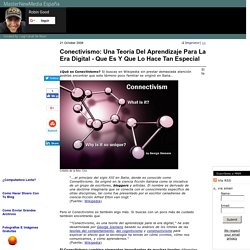
Si buscas en Wikipedia sin prestar demasiada atención podrías encontrar que este término poco familiar se originó en Italia.. Crédito de la foto: Clix "...al principio del siglo XXI en Italia, donde es conocido como Connettivismo. Se originó en la ciencia ficción italiana como la iniciativa de un grupo de escritores, bloggers y artistas.
El nombre es derivado de una doctrina imaginaria que se conecta con el conocimiento específico de otras disciplinas, tal como fue presentado por el escritor canadiense de ciencia-ficción Alfred Elton van Vogt. " Pero el Conectivismo es también algo más. ""Conectivismo, es una teoría del aprendizaje para la era digital," ha sido desarrollada por George Siemens basado su análisis de los limites de las teorías del comportamiento, del cognitivismo y constructivismo para explicar el efecto que la tecnología ha tenido en cómo vivimos, cómo nos comunicamos, y cómo aprendemos. " Webquest Argentina: Necesario análisis de la teoría conectivista del aprendizaje, pilar actual del funcionamiento de las redes postuladas para educación.
Frente al auge de la teoría del conectivismo, no se puede permanecer ajeno a ello, por lo cual presentamos algunas reflexiones que pueden ser útiles para profundizar su aplicación a la educación con TIC.

Conectivismo: conceptualización y críticas Conceptualización El conectivismo presenta la tesis que el conocimiento es distribuido a través de una red de conexiones, y de este modo, el aprendizaje consiste en la habilidad de construir mas redes al atravesarlas .Se relaciona con aquellas propuestas que dicen que el conocimiento no se adquiere como si fuera una cosa. También niega que el conocimiento sea de carácter proposicional, como lo acepta el 'cognitivismo', que entiende que la generación de conocimiento y la formación de creencias, y el aprendizaje, se dan por el lenguaje y la lógica, a través de sentencias y conceptos que se adquieren y almacenan. Por el contrario, el conectivismo es 'conexionismo'.