
Publications. Dynamic-link library. Background for DLL[edit] The first versions of Microsoft Windows ran programs together in a single address space.
Every program was meant to co-operate by yielding the CPU to other programs so that the graphical user interface (GUI) could multitask and be maximally responsive. All operating system level operations were provided by the underlying operating system: MS-DOS. All higher level services were provided by Windows Libraries "Dynamic Link Library. " The Drawing API, GDI, was implemented in a DLL called GDI.EXE, the user interface in USER.EXE.
The same architectural concept that allowed GDI to load different device drivers is that which allowed the Windows shell to load different Windows programs, and for these programs to invoke API calls from the shared USER and GDI libraries. Hacking toolkit publishes DLL hijacking exploit - Windows, software, security, operating systems, Microsoft - Techworld. News August 23, 2010 05:34 PM ET Computerworld - The appearance Monday of exploit code for the DLL loading issue that reportedly affects hundreds of Windows applications means hackers will probably start hammering on PCs shortly, security experts argued.
"Once it makes it into Metasploit, it doesn't take much more to execute an attack," said Andrew Storms, director of security operations for nCircle Security. "The hard part has already been done for [hackers]. " Storms was referring to the release earlier today of exploit code by HD Moore, the creator of the Metasploit open-source hacking toolkit. Moore also issued an auditing tool that records vulnerable applications, information which can then be used to launch the exploit code that Moore crafted and added to Metasploit. Update: 40 Windows apps contain critical bug, says researcher. News August 19, 2010 12:51 PM ET Computerworld - About 40 different Windows applications contain a critical flaw that can be used by attackers to hijack PCs and infect them with malware, a security researcher said Wednesday. The bug was patched by Apple in its iTunes software for Windows four months ago, but remains in more than three dozen other Windows programs, said HD Moore, chief security officer at Rapid7 and creator of the open-source Metasploit penetration-testing toolkit.
Moore did not reveal the names of the vulnerable applications or their makers, however. Each affected program will have to be patched separately. Moore first hinted at the widespread bug in a message on Twitter on Wednesday. That advisory detailed a vulnerability in iTunes for Windows that hackers could exploit by persuading users to download and open a malformed media file, or by duping them into visiting a malicious Web site, where they would fall prey to a drive-by attack.
Windows API List. This documentation is archived and is not being maintained.
The following is a list of the reference content for the Windows application programming interface (API) for desktop and server applications. Using the Windows API, you can develop applications that run successfully on all versions of Windows while taking advantage of the features and capabilities unique to each version. (Note that this was formerly called the Win32 API. Servers and Enterprise Development. .NET Framework 4. Ferramentas.NET Framework. Network Programming Samples. Networking Samples for .NET v4.0 - Release: .NET 4.0 Code Samples. ECMA C# and Common Language Infrastructure Standards. ECMA C# and Common Language Infrastructure Standards In June 2005, the General Assembly of the international standardization organization Ecma approved edition 3 of the C# Language and the Common Language Infrastructure (CLI) specifications, as updated Ecma-334 and Ecma-335, respectively (see press release).
The updated technical report on the CLI, Ecma TR-84, and a new technical report on the CLI, Ecma TR-89, were also ratified. In July 2005, Ecma submitted the Standards and TRs to ISO/IEC JTC 1 via the ISO Fast-Track process. The Standards were adopted in April 2006 as ISO/IEC 23270:2006 (C#), ISO/IEC 23270:2006 (CLI), ISO/IEC TR 23272:2006 (CLI, XML Libraries) and ISO ISO/IEC TR 25438:2006 (CLI, Common Generics). Virtual Execution System. The Virtual Execution System (VES) is a run-time system of the Common Language Infrastructure CLI which provides an environment for executing managed code.
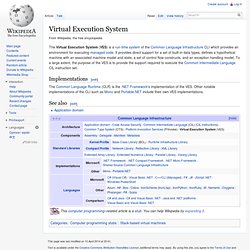
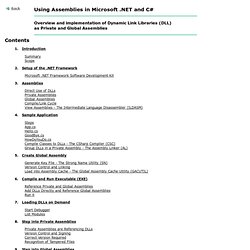
It provides direct support for a set of built-in data types, defines a hypothetical machine with an associated machine model and state, a set of control flow constructs, and an exception handling model. To a large extent, the purpose of the VES is to provide the support required to execute the Common Intermediate Language CIL instruction set. Implementations[edit] See also[edit] Application domain. Using Assemblies in Microsoft .NET and C# Summary Scope Microsoft .NET Framework Software Development Kit Reference Private and Global Assemblies Add DLLs Directly and Reference Global Assemblies Run it Start Debugger List Modules Private Assemblies are Referencing DLLs Version Control and Signing Correct Version Required Recognition of Tampered Files.
.NET Framework Samples. MSDN Library .NET Framework Samples .NET Framework 4.5 Other Versions The .NET Framework documentation includes code examples that you can copy directly from topics and paste into your own projects.
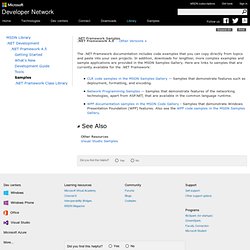
In addition, downloads for lengthier, more complex examples and sample applications are provided in the MSDN Samples Gallery. See Also Other Resources. Exemplos do .NET Framework.