
Un problème apparait lors d'un submit de formulaire avec JQuery. jQuery validate add method with ajax. Php - .post inside jQuery.validator.addMethod always returns false. Return errors from PHP run via. AJAX. Checking username availability with ajax using jQuery. Checking username availability with ajax using jQuery The time when username availability is checked after the page is normaly processed is long way behind us.
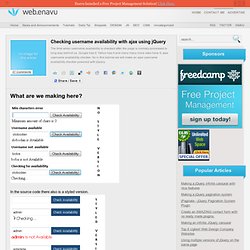
Google has it, Yahoo has it and many many more sites have it, ajax username availability checker. So in this tutorial we will make an ajax username availability checker powered with jQuery. What are we making here? In the source code there also is a styled version. Source Notice: The source includes both styled and non-styled version. Uniform - Sexy forms with jQuery. How to Add a Calendar Date Picker to a Form with jQuery. Buuuut, aren’t exactly supported yet One of the best features coming to HTML5 forms is the built in feature of a ‘date picker’.
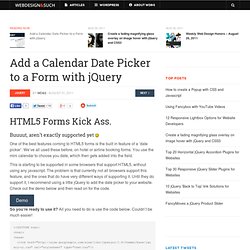
We’ve all used these before, on hotel or airline booking forms. You use the mini calendar to choose you date, which then gets added into the field. This is starting to be supported in some browsers that support HTML5, without using any javascript. The problem is that currently not all browsers support this feature, and the ones that do have very different ways of supporting it.
An Example of Using the jQuery Validation Plug-in. Introduction This article presents an example of using the jQuery validation plug-in.
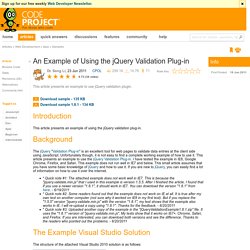
Background The jQuery "Validation Plug-in" is an excellent tool for web pages to validate data entries at the client side using JavaScript. Unfortunately though, it is not easy to find a complete working example of how to use it. This article presents an example to use the jQuery Validation Plug-in. . * Quick note #1: The attached example does not work well in IE7. The Example Visual Studio Solution The structure of the attached Visual Studio 2010 solution is as follows: Www.willjessup.com/sandbox/jquery/form_validator/form_validate.html. JQuery Validation : Comment afficher le conteneur d'erreur uniquement lors de la soumission ? 10 Useful jQuery Form Validation Techniques and Tutorials. The purpose of web form validation is to ensure that the user is provided with the necessary information and help so that they can fill out and complete an online form with the minimum amount of fuss and time.
Easier said than done! Validation, for many years has been a major source of debate within professional web design circles, it is such a broad and diverse subject, resulting in far too many varying, and sometimes conflicting, techniques and ideas. Starting With jQuery - How to Write Custom Validation Rules. This series of posts on using jQuery with no prior knowledge comes to its fifth iteration.
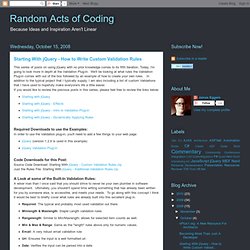
Today, I'm going to look more in depth at the Validation Plug-in. We'll be looking at what rules the Validation Plug-in comes with out of the box followed by an example of how to create your own rules. In addition to the typical project that I typically supply, I am also including a list of custom Validations that I have used to hopefully make everyone's life a little easier. Abrahm Coffman » jQuery Birthday Picker Form Plugin. I recently had a need to create a form where somebody entered their birthday and decided it would be a good idea to explore various ways of solving this.
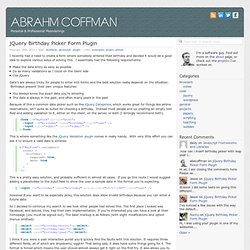
I essentially had the following requirements: Make the data entry as easy as possibleDo as many validations as I could on the client sideUse jQuery Date’s are always tricky for people to enter into forms and the best solution really depends on the situation. Birthdays present their own unique features: Form validation with jQuery and CodeIgniter. Plugins/Validation. "But doesn't jQuery make it easy to write your own validation plugin?
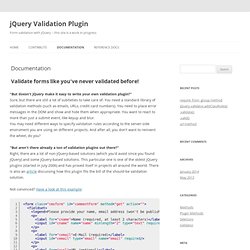
" Sure, but there are still a lot of subtleties to take care of: You need a standard library of validation methods (such as emails, URLs, credit card numbers). You need to place error messages in the DOM and show and hide them when appropriate. You want to react to more than just a submit event, like keyup and blur. You may need different ways to specify validation rules according to the server-side enviroment you are using on different projects. And after all, you don't want to reinvent the wheel, do you? "But aren't there already a ton of validation plugins out there? " Not convinced? ¶Isn't that nice and easy? A single line of jQuery to select the form and apply the validation plugin, plus a few annotations on each element to specify the validation rules. Of course that isn't the only way to specify rules. ¶A few things to look out for when playing around with the demo You're probably looking for If not, read on.
.submit. Description: Bind an event handler to the "submit" JavaScript event, or trigger that event on an element.
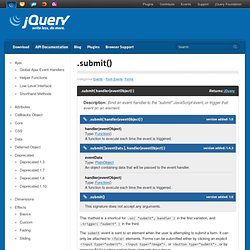
This method is a shortcut for .on( "submit", handler ) in the first variation, and .trigger( "submit" ) in the third. Plugins/Validation/validate. Description: Validates the selected form.
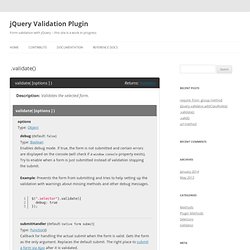
This method sets up event handlers for submit, focus, keyup, blur and click to trigger validation of the entire form or individual elements. Each one can be disabled, see the onxxx options (onsubmit, onfocusout, onkeyup, onclick). focusInvalid focuses elements when submitting an invalid form. Use the debug option to ease setting up validation rules, it always prevents the default submit, even when script errors occur.