
Quantum mechanics. Wavefunctions of the electron in a hydrogen atom at different energy levels.
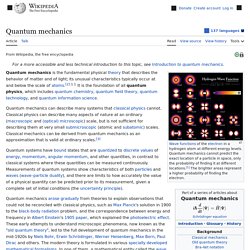
Quantum mechanics cannot predict the exact location of a particle in space, only the probability of finding it at different locations.[1] The brighter areas represent a higher probability of finding the electron. Quantum mechanics (QM; also known as quantum physics, quantum theory, the wave mechanical model, or matrix mechanics), including quantum field theory, is a fundamental theory in physics which describes nature at the smallest scales of atoms and subatomic particles.[2] Quantum mechanics gradually arose from theories to explain observations which could not be reconciled with classical physics, such as Max Planck's solution in 1900 to the black-body radiation problem, and from the correspondence between energy and frequency in Albert Einstein's 1905 paper which explained the photoelectric effect.
History[edit] In 1838, Michael Faraday discovered cathode rays. Where h is Planck's constant. Coulomb potential. Schrödinger equation. In quantum mechanics, the Schrödinger equation is a partial differential equation that describes how the quantum state of some physical system changes with time.
It was formulated in late 1925, and published in 1926, by the Austrian physicist Erwin Schrödinger.[1] In classical mechanics, the equation of motion is Newton's second law, and equivalent formulations are the Euler–Lagrange equations and Hamilton's equations. All of these formulations are used to solve for the motion of a mechanical system and mathematically predict what the system will do at any time beyond the initial settings and configuration of the system. In quantum mechanics, the analogue of Newton's law is Schrödinger's equation for a quantum system (usually atoms, molecules, and subatomic particles whether free, bound, or localized). It is not a simple algebraic equation, but (in general) a linear partial differential equation. The concept of a state vector is a fundamental postulate of quantum mechanics.
Mathematics. Geometry. Differential Geometry. Topology. Linear Algebra. Tensor Analysis. Calculus. Complex Analysis. Complex number. A complex number can be visually represented as a pair of numbers (a, b) forming a vector on a diagram called an Argand diagram, representing the complex plane.

"Re" is the real axis, "Im" is the imaginary axis, and i is the imaginary unit which satisfies i2 = −1. A complex number is a number that can be expressed in the form a + bi, where a and b are real numbers and i is the imaginary unit, that satisfies the equation x2 = −1, that is, i2 = −1.[1] In this expression, a is the real part and b is the imaginary part of the complex number. Complex numbers extend the concept of the one-dimensional number line to the two-dimensional complex plane (also called Argand plane) by using the horizontal axis for the real part and the vertical axis for the imaginary part.
The complex number a + bi can be identified with the point (a, b) in the complex plane. Overview[edit] Complex numbers allow for solutions to certain equations that have no solutions in real numbers. Definition[edit] . Or or z*. and . Abstract Algebra. Classical & Soundtrack music. Beethoven.