
Why does a trade deficit weaken the currency? (10/1999) To answer this question recall that the trade deficit means that the United States is buying more goods and services than it sells abroad (imports exceed exports).

Just like an individual or a firm needs credit to spend more than its income, the trade deficit requires financing by foreigners. Foreigners finance the trade deficit by lending to Americans or by investing in the United States (buying property or businesses). However, at some future date, the trade deficit must turn into surplus, so that the foreigners get paid back. For the trade deficit to turn into a surplus, imports must fall and exports must rise. One way this adjustment can take place is if the dollar depreciates, making imports more expensive for Americans and exports cheaper for foreigners. The U.S. economy has been doing very well for many years now, making it an attractive place for foreigners to invest in.
Download PDF (pdf, 5.4 kb) Download PDF (pdf, 4.43 kb) Follow the money: Bailout tracker - CNNMoney.com. CNNMoney.com is tracking developments in the economic rescue as they happen.
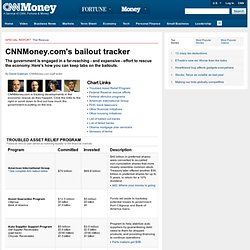
Click the links to the right or scroll down to find out how much the government is putting on the line. Troubled ASSET RELIEF PROGRAM Financial rescue plan aimed at restoring liquidity to the financial markets Financial rescue plan aimed at restoring liquidity to the financial markets. Federal stimulus programs Programs designed to save or create jobs and jumpstart the economy from recession.
American International Group Multifaceted bailout to help insurer through restructuring, minimize the need to post collateral and get rid of toxic assets FDIC bank takeovers Cost to FDIC fund that insures losses depositors suffer when a bank fails. Other financial initiatives Other programs designed to rescue the financial sector Other housing initiatives Other programs designed to rescue the housing market and prevent foreclosures.
U.S. Bailout, Stimulus Pledges Total $11.6 Trillion (Table) Feb. 24 (Bloomberg) -- The following table details how the U.S. government has pledged more than $11.6 trillion on behalf of American taxpayers over the past 19 months, according to data compiled by Bloomberg.

Changes from the previous table, published Feb. 9, include a $787 billion economic stimulus package. The Federal Reserve has new lending commitments totaling $1.8 trillion. It expanded the Term Asset-Backed Lending Facility, or TALF, by $800 billion to $1 trillion and announced a $1 trillion Public-Private Investment Fund to buy troubled assets from banks. The U.S. Treasury also added $200 billion to its support commitment for Fannie Mae and Freddie Mac, the country’s two largest mortgage-finance companies. To contact the reporters on this story: Mark Pittman in New York at mpittman@bloomberg.net; Bob Ivry in New York at bivry@bloomberg.net. To contact the editor responsible for this story: William Glasgall at wglasgall@bloomberg.net. Inflation, Deficit Spending and the 2011 U.S. Budget - Two things happened the week before president Obama released his proposed 2011 budget today.

First, in his State of Union address, Obama promised a three-year freeze on domestic spending. Almost simultaneously, the U.S. Congress raised the national debt ceiling by $1.9 trillion to $14.29 trillion. When it comes to politicians, investors would be wise to watch what they do and pay no attention to what they say. There is no reason to believe that the U.S. spending orgy that was ratcheted up with the Credit Crisis is going to be controlled now, next year, the year after or the year after that. To be fair, President Obama only promised to control a small amount of the domestic spending part of the U.S. budget.
The 2010 budget is also being affected by Obama's revised spending agenda. The U.S. national debt was an already huge at $8.95 trillion by the end of 2007, when the Credit Crisis began to unfold. Impressed by this author? Follow and be the first to know when they publish.