
The Constant e. What is e?

"e" is a numerical constant that is equal to 2.71828. Just as pi (3.14159) is a numerical constant that occurs whenever the circumference of a circle is divided by its diameter. The value of "e" is found in many mathematical formulas such as those describing a nonlinear increase or decrease such as growth or decay (including compound interest), the statistical "bell curve," the shape of a hanging cable or a standing arch. "e" also shows up in some problems of probability, some counting problems, and even the study of the distribution of prime numbers.
In the field of nondestructive evaluation it is found in formulas such as those used to describe ultrasound attenuation in a material. E is usually defined by the following equation: Its value is approximately 2.718 and has been calculated to 869,894,101 decimal places by Sebastian Wedeniwski. E = 1/0! As an example, here is the computation of e to 22 decimal places: Reference: The mathforum.org. APS Physics. Occam's razor. The sun, moon and other solar system planets can be described as revolving around the Earth.
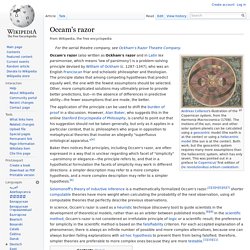
However that explanation's ideological and complex assumptions are completely unfounded compared to the modern consensus that all solar system planets revolve around the Sun. Ockham's razor (also written as Occam's razor and in Latin lex parsimoniae) is a principle of parsimony, economy, or succinctness used in problem-solving devised by William of Ockham (c. 1287 - 1347). It states that among competing hypotheses, the one with the fewest assumptions should be selected. Other, more complicated solutions may ultimately prove correct, but—in the absence of certainty—the fewer assumptions that are made, the better. Solomonoff's theory of inductive inference is a mathematically formalized Occam's Razor:[2][3][4][5][6][7] shorter computable theories have more weight when calculating the probability of the next observation, using all computable theories which perfectly describe previous observations.
Binary Universe Theory. The Speed of Gravity: Einstein Was Right! Gravitational force, or gravity, is the mutual attraction between all masses in the universe.

Most scientists assume that gravity travels at the speed of light, which is actually the propagation speed of electromagnetic waves (such as light) in a vacuum. The speed of light is a physical constant equal to exactly 299,792.458 kilometers per second (km/s), or about 186,471 miles per second. The assumption that gravity also travels at this speed is implicit in Einstein's general theory of relativity, formulated in 1915, which recognizes the universal character of the propagation speed of light and the consequent dependence of space, time, and other mechanical measurements on the motion of the observer performing the measurements.
Although this is still our best working theory of space-time, the concept that gravity travels at the speed of light is an assumption, and, until recently, has never been tested. A Reworking of General Relativity and a Breakthrough However, there are problems.