
Ancient 'air-conditioning' cools building sustainably. Built in the arid suburbs of Jaipur, Rajasthan, The Pearl Academy of Fashion combines modern exterior styling with ancient Rajasthani architecture -- designed to keep temperatures down without artificial cooling systems.

The entire building is raised above the ground and a pool of water -- integrated into a recreation and exhibition space -- keeps temperatures low through evaporative cooling. As architect Manit Rastogi says, "When water evaporates in heat, it immediately brings down the temperature of the space around it. " This method was employed over 1,500 years ago by local Rajasthanis, who built "baoli" or stepwells -- bodies of water surrounded by a descending set of steps, helping to create a microclimate in the surrounding structure.
The building is protected from the environment by a double skin which is derived from a traditional building element called the "jaali" which is prevalent in Rajasthani architecture. Solar-powered 'supertrees' breathe life into Singapore's urban oasis. Singapore's 250-acre green development, Gardens by the Bay, is part of Singapore's redevelopment and new downtown area at Marina Bay.

It features three waterfront gardens -- Bay East, Bay Central and Bay South, which opens to the public on June 29. In contrast to the dense urban environment of skyscrapers and high-rise buildings in Singapore, Gardens by the Bay is part of the government's overall strategy to transform Singapore into a "city in a garden. " Smog-eating tiles gobble up air pollution. U.S. company Boral Roofing has introduced a line of roof tiles that it says have pollution-busting properties.
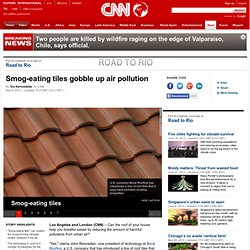
The company says chemicals in its smog-eating tiles react with nitrogen oxides released by vehicles, extracting them from the air and cleaning up the atmosphere, as this cartoon shows. The tiles are coated with titanium dioxide, a photocatalyst, activated by daylight, which reacts with nitrogen oxides in the air turning them into harmless calcium nitrates, as this cartoon shows. When it rains the calcium nitrate -- a regular garden fertilizer -- is washes off the roof, as this cartoon shows. Los Angeles has the highest levels of ozone pollution of any U.S. city, according to 2012 rankings by the American Lung Association.