
Wikipedia. Television program. A television program (television programme in the United Kingdom), also called television series, is a segment of content intended for broadcast on television.

It may be a one-time production or part of a periodically recurring series. A one-time broadcast may be called a "special", or particularly in the UK a "special episode". A television film ("made-for-TV movie" or television movie), is a film that is initially broadcast on television rather than released in theaters or direct-to-video, although many successful TV movies are later released on DVD.
A program can be either recorded, as on video tape or other various electronic media forms, or considered live television. Formats[edit] The Big Bang Theory. Over time, supporting characters have been promoted to starring roles: Leslie Winkle, a physicist colleague at Caltech and, at different times, a lover of both Leonard and Howard; Bernadette Rostenkowski, Howard's girlfriend (later his wife), a microbiologist and former part-time waitress alongside Penny; neuroscientist Amy Farrah Fowler, who joins the group after being matched to Sheldon on a dating website (and later becomes Sheldon's girlfriend), and Stuart Bloom, the cash-strapped owner of the comic book store the characters often visit.

In February 2014, CBS CEO Les Moonves confirmed an eighth season, when announcing the first half of the new season would air on a different night, due to CBS acquiring the rights to Thursday Night Football games. The show will return to its Thursday slot it has held for the past few seasons once the football games end.[9] In March 2014, CBS once again renewed the show for three additional years, through the 2016–17 television season.[10] Production. Gossip Girl (TV series) The success of Gossip Girl led to adaptations outside the United States.

The show has received numerous award nominations, winning 18 Teen Choice Awards. Cecily von Ziegesar. Biography[edit] Early life and education[edit] Cecily von Ziegesar was born in New York City in a family with origins in the German nobility.

Her childhood dream was to grow up to be a ballerina; she began lessons at age 3 and auditioned for the School of American Ballet at age 8, but was rejected.[3] As a teenager, she commuted to Manhattan at 6 a.m. to attend The Nightingale-Bamford School.[4] After graduating from Nightingale, Von Ziegesar attended Colby College.
Then she spent a year in Budapest working for a local radio station. She then returned to the United States to study creative writing at the University of Arizona, only to drop out shortly thereafter.[4] Gossip Girl[edit] Book series[edit] The Constance Billard [sic] School for Girls is based on an exaggerated version of her alma mater, Nightingale. In October 2011, von Ziegesar released a spin-off of the first novel: Psycho Killer. The Nightingale-Bamford School: Academics. Leisure. Intellectual. Entertainment. Watchers of a roadside television being entertained by a live cricket match between India and Pakistan (2003)

Tompkins Square Park Central Knoll.jpg - Wikipedia, the fre. Hobby. In the 18th-century novel The Life and Opinions of Tristram Shandy, Gentleman, the characters' hobby-horses, or particular obsessions, are discussed in detail. Here, Uncle Toby's obsession with the military leads to him and Trim—who gets caught up in Toby's enthusiasm—to begin acting out military actions. Illustration by George Cruikshank. Writing articles for Wikipedia is a hobby for some people. Literature. Literature, in its broadest sense, is any written work; etymologically the term derives from Latin literatura/litteratura "writing formed with letters", although some definitions include spoken or sung texts.
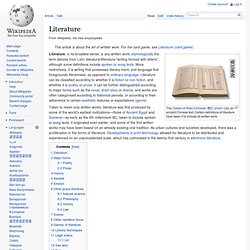
More restrictively, it is writing that possesses literary merit, and language that foregrounds literariness, as opposed to ordinary language. Literature can be classified according to whether it is fiction or non-fiction, and whether it is poetry or prose; it can be further distinguished according to major forms such as the novel, short story or drama; and works are often categorised according to historical periods, or according to their adherence to certain aesthetic features or expectations (genre). Definition[edit] There have been various attempts to define "literature".[1] Simon and Delyse Ryan begin their attempt to answer the question "What is Literature? " with the observation: Major forms[edit] Poetry[edit] Outdoor activity. The two primary purposes for outdoor recreation are beneficial use and pleasurable appreciation.[1][2] Pleasurable appreciation encourages experiences of being "let in on nature's show".[2] Enhancement of inner perceptual and/or spiritual life may be experienced through outdoor activities and outdoor-related activities such as nature study, aesthetic contemplation, meditation, painting, photography, archeological or historical research, and indigenous culture among others.

These activities may also be physically rewarding. Many people in modern civilizations believe that the value of nature is found only in its "utilitarian value" (beneficial use). They would discount the inner perceptual and/or spiritual benefits of the "intrinsic value of nature" that may be experienced during pleasurable appreciation. Human. Humans began to practice sedentary agriculture about 12,000 years ago, domesticating plants and animals which allowed for the growth of civilization. Humans subsequently established various forms of government, religion, and culture around the world, unifying people within a region and leading to the development of states and empires. The rapid advancement of scientific and medical understanding in the 19th and 20th centuries led to the development of fuel-driven technologies and improved health, causing the human population to rise exponentially.
By 2012 the global human population was estimated to be around 7 billion.[10][11] Etymology and definition In common usage, the word "human" generally refers to the only extant species of the genus Homo — anatomically and behaviorally modern Homo sapiens. In scientific terms, the definition of "human" has changed with the discovery and study of the fossil ancestors of modern humans. History.