
Typo. I Love Typography.com. The design of a signage typeface. The story begins in 2006 with a trip down Route 66.

Day in, day out, I looked at U.S. traffic signs that were either set in the old, somewhat clumsy “FHWA font series” or the new Clearview HWY typeface. Approaching the signs, I would often test myself: which typeface works best from a distance, and which of its features or details might be responsible for its performance. I had so many more questions than answers. Surely every professional type designer has at least an inkling of how a signage typeface should look: Probably it sports a rather clean sans serif design, open counters and a rather large x-height. But which x-height works best, and why? Studying Existing Road Signs I was unable to fully answer those questions, but felt that I must find the answers, no matter what the cost.
I was surprised by the sheer variety of type styles I discovered on my journey. Top-left: Germany. Creating Wayfinding Sans Pro. Gay type. The Week in Type Hard to believe that 2011 is coming to a close.

Autumn is showing its face, and before you know it, we’ll be Christmas shopping. Some inspiring stuff in this week’s The Week in Type. Sit back and enjoy. Hipster Hummingbirds. The week in type Let’s start with some fantastic news: Issue #2 of Codex magazine is now available for pre-order.
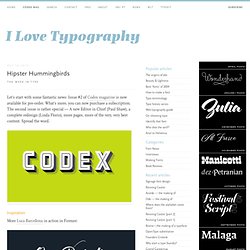
What’s more, you can now purchase a subscription. The second issue is rather special — A new Editor in Chief (Paul Shaw), a complete redesign (Linda Florio), more pages, more of the very, very best content. Spread the word. A Pocket Cathedral. There are two different interpretations of the concept of the private press.

There is an approach that takes the term in a very wide sense. The hallmark of the private press is that the profit making principle is non-existent. Financial gain is not part of the process. The printer produces a book purely for personal satisfaction or for the pleasure of a circle of friends — the ‘book for book’s sake’. Those involved created books by traditional printing and binding methods, with an emphasis on the book as a work of art and manual skill. Poems by Morris friend Dante Gabriel Rossetti (Special Collections Amsterdam) Others limit the development of the private press in stricter chronological terms. Beauty and Ugliness in Type design. Peter Biľak on the process of designing his newly released Karloff typeface, demonstrating just how closely related beauty and ugliness are.

Karloff explores the idea of irreconcilable differences — how two extremes could be combined into a coherent whole. In 2010 I was invited to a design conference in Copenhagen to speak on the subject of conceptual type. The organisers were interested in examples of typefaces whose principal design feature was not related to aesthetic considerations or legibility, but rather some underlying non-typographical idea. Type Camp India. Night and Day Modes The day before leaving for India I had a client photo-shoot — pretty simple, no lighting — to show that choosing your bike over your car is good for the world and is also safer.

And then I got on a airplane, pretty much setting an entire gas station on fire to study typography at Type Camp in India. The Vancouver airport is safe-looking and Canadian; I shopped with Martha Stewart (it’s true!) In the over-ripe consumerism of the HK airport; and then the Chennai airport: it was really filthy. Suddenly in India, stepping out of the impossible tube of an aircraft fuselage, everything seemed extremely difficult. 1. A very young man — a boy really — offered to drive us to our hotel in his Ambassador. Karbon type. The Week in Type I’m struggling to keep up with all that’s new in type.

Exciting times. Lots of great new releases, and some very novel and creative uses of type and lettering. ‘Dreams’, ‘Stars’ & ‘So Much To Do’ 3 new limited edition prints by Seb Lester I released three new limited edition prints today, ‘Dreams’, ‘Stars’, and ‘So Much To Do’. Space: The Initial Frontier. Book review — Inside Paragraphs I have long admired Cyrus Highsmith, both for his type design (Benton Sans, Prensa, Zócalo, & many besides) and his wonderfully unique style of illustration and lettering.

The origins of abc. Where does our alphabet come from?
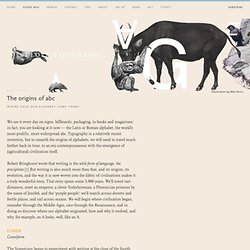
We see it every day on signs, billboards, packaging, in books and magazines; in fact, you are looking at it now — the Latin or Roman alphabet, the world’s most prolific, most widespread abc. Typography is a relatively recent invention, but to unearth the origins of alphabets, we will need to travel much farther back in time, to an era contemporaneous with the emergence of (agricultural) civilisation itself. Robert Bringhurst wrote that writing is the solid form of language, the precipitate.[1] But writing is also much more than that, and its origins, its evolution, and the way it is now woven into the fabric of civilisations makes it a truly wonderful story. Atipo — Home.