More Links

TwitterFacebook
Get flash to fully experience Pearltrees

EU institutions structure

http://europa.eu/about-eu/institutions-bodies/index_en.htm The European Council sets the EU's overall political direction – but has no powers to pass laws. Led by its President – currently Herman Van Rompuy – and comprising national heads of state or government and the President of the Commission, it meets for a few days at a time at least every 6 months. the Council of the European Union , which represents the governments of the individual member countries. The Presidency of the Council is shared by the member states on a rotating basis.
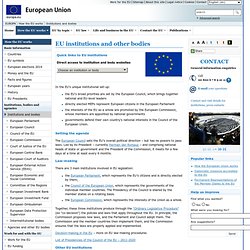
Agencies and decentralised bodies - Agencies of the EU

http://europa.eu/agencies/index_en.htm A number of specialised and decentralised EU agencies have been established to support the EU Member States and their citizens. These agencies are an answer to a desire for geographical devolution and the need to cope with new tasks of a legal, technical and/or scientific nature. The regulatory agencies and bodies include:
http://europa.eu/index_en.htm 23/03/2012 Strengthening the rules on ship recycling The Commission proposes tighter laws to ensure ships are only recycled in environmentally sound facilities that are safe for workers. The aim is to reduce accident rates, health risks and pollution.

EUROPEAN COMMISSION