
DEB - Funding - Assembling the Tree of Life. Genealogy of Life (GoLife) Solicitation 14-527 Full Proposal Deadline Date: March 25, 2015 Fourth Wednesday in March, Annually Thereafter Fourth Wednesday in March All of comparative biology depends on knowledge of the evolutionary relationships (phylogeny) of living and extinct organisms.

The ultimate vision of this program is an open access, universal Genealogy of Life that will provide the comparative framework necessary for testing questions in systematics, evolutionary biology, ecology, and other fields. Projects submitted to this program should emphasize increased efficiency in contributing to a complete Genealogy of Life and integration of various types of organismal data with phylogenies. This program also seeks to broadly train next generation, integrative phylogenetic biologists, creating the human resource infrastructure and workforce needed to tackle emerging research questions in comparative biology. Systematics and Biodiversity Science Advances in Biological Informatics News.
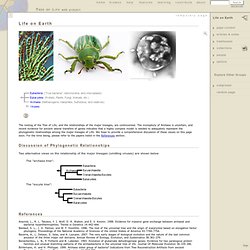
Life on Earth. References Aravind, L., R.
L. Tatusov, Y. I. Wolf, D. Baldauf, S. Becerra, A., L. Benachenhou, L. Brinkmann, H. and H. Brocks, J. Brown, J. Brown, J. Brown, J. Caetano-Anolles, G. 2002. Cammarano, P., P. Cammarano, P., R. Cavalier-Smith, T. 2002. How to Build a Better Tree of Life. Illustration: Tyler Lang Organizing the world’s species into branches on a phylogenetic tree is a major goal of biologists trying to understand how life evolved.
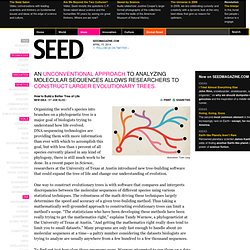
DNA-sequencing technologies are providing them with more information than ever with which to accomplish this goal, but with less than 1 percent of all species currently placed in any kind of phylogeny, there is still much work to be done. In a recent paper in Science, researchers at the University of Texas at Austin introduced new tree-building software that could expand the tree of life and change our understanding of evolution. One way to construct evolutionary trees is with software that compares and interprets discrepancies between the molecular sequences of different species using various statistical techniques. The robustness of the math driving these techniques largely determines the speed and accuracy of a given tree-building method. SATé solves another problem common among tree-building programs. Tree of Life Web Project. The Tree of Life Web Project (ToL) is a collaborative effort of biologists and nature enthusiasts from around the world.
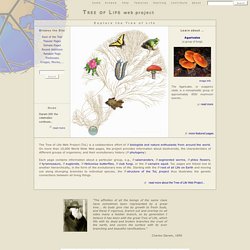
On more than 10,000 World Wide Web pages, the project provides information about biodiversity, the characteristics of different groups of organisms, and their evolutionary history (phylogeny). Each page contains information about a particular group, e.g., salamanders, segmented worms, phlox flowers, tyrannosaurs, euglenids, Heliconius butterflies, club fungi, or the vampire squid. ToL pages are linked one to another hierarchically, in the form of the evolutionary tree of life.
Starting with the root of all Life on Earth and moving out along diverging branches to individual species, the structure of the ToL project thus illustrates the genetic connections between all living things. Tree of Life Web Project. Tree of life. Motif in art and culture The tree of life is a fundamental widespread myth (mytheme) or archetype in many of the world's mythologies, religious and philosophical traditions.
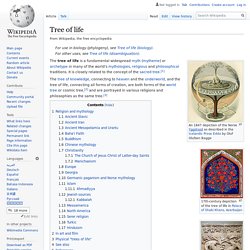
It is closely related to the concept of the sacred tree.[1] The tree of knowledge, connecting to heaven and the underworld, and the tree of life, connecting all forms of creation, are both forms of the world tree or cosmic tree,[2] and are portrayed in various religions and philosophies as the same tree.[3] Religion and mythology[edit] Various trees of life are recounted in folklore, culture and fiction, often relating to immortality or fertility. Ancient Slavic[edit] Ancient Iran[edit] Gaokerena is a large, sacred Haoma planted by Ahura Mazda. Haoma is another sacred plant due to the drink made from it. Haoma is the Avestan form of the Sanskrit soma. Another related issue in ancient mythology of Iran is the myth of Mashyа and Mashyane, two trees who were the ancestors of all living beings. Baha'i Faith[edit] Europe[edit]