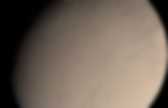
Enceladus. Enceladus [en-SELL-ah-dus] is one of the innermost moons of Saturn. It is quite similar in size to Mimas, but has a smoother, brighter surface. Enceladus reflects almost 100 percent of the sunlight that strikes it. Unlike Mimas, Enceladus displays at least five different types of terrain. Parts of Enceladus shows craters no larger than 35 km in diameter. Other areas show regions with no craters, indicating major resurfacing events in the geologically recent past.
There are fissures, plains, corrugated terrain and other crustal deformations. Because Enceladus reflects so much sunlight, the surface temperature is only -330 degrees Fahrenheit (-201degrees Celsius). Since early 2005, the Cassini-Huygens Mission to Saturn has uncovered many mysteries about Enceladus. February and March 2005 Enceladus has an atmosphere: The Cassini spacecraft makes two trips by Enceladus.
July 2005 Warm fractures on Enceladus: November 2005 Spray above Enceladus: Enceladus (moon) Natural satellite orbiting Saturn Cassini performed chemical analysis of Enceladus's plumes, finding evidence for hydrothermal activity,[32][33] possibly driving complex chemistry.[34] Ongoing research on Cassini data suggests that Enceladus's hydrothermal environment could be habitable to some of Earth's hydrothermal vent's microorganisms, and that plume-found methane could be produced by such organisms.[35][36] Enceladus was discovered by William Herschel on August 28, 1789, during the first use of his new 1.2 m (47 in) 40-foot telescope, then the largest in the world, at Observatory House in Slough, England.[19][37] Its faint apparent magnitude (HV = +11.7) and its proximity to the much brighter Saturn and Saturn's rings make Enceladus difficult to observe from Earth with smaller telescopes.
Like many satellites of Saturn discovered prior to the Space Age, Enceladus was first observed during a Saturnian equinox, when Earth is within the ring plane. ). Source of the E ring [edit] Images. Cassini to Make Closest Pass Yet over Enceladus South Pole. Is it Snowing Microbes on Enceladus? Is it Snowing Microbes on Enceladus? March 27, 2012: There's a tiny moon orbiting beyond Saturn's rings that's full of promise, and maybe -- just maybe -- microbes. In a series of tantalizingly close flybys to the moon, named "Enceladus," NASA's Cassini spacecraft has revealed watery jets erupting from what may be a vast underground sea. These jets, which spew through cracks in the moon's icy shell, could lead back to a habitable zone that is uniquely accessible in all the solar system.
"More than 90 jets of all sizes near Enceladus's south pole are spraying water vapor, icy particles, and organic compounds all over the place," says Carolyn Porco, an award-winning planetary scientist and leader of the Imaging Science team for NASA’s Cassini spacecraft. "Cassini has flown several times now through this spray and has tasted it. And we have found that aside from water and organic material, there is salt in the icy particles. The salinity is the same as that of Earth's oceans. " Enceladus. Enceladus [en-SELL-ah-dus] is one of the brightest objects in our solar system. Covered in water ice that reflects sunlight like freshly fallen snow, Enceladus reflects almost 100 percent of the sunlight that strikes it. Because Enceladus reflects so much sunlight, the surface temperature is extremely cold, about -201° C (-330° F). About as wide as Arizona, Enceladus is quite similar in size to Mimas but has a smoother, brighter surface.
Unlike Mimas, Enceladus displays at least five different types of terrain. Parts of the moon show craters no larger than 35 kilometers (about 22 miles) in diameter. Other areas show regions with no craters indicating major resurfacing events in the geologically recent past. There are fissures, plains, corrugated terrain and other crustal deformations. Enceladus.