
Zombie Infection Simulation - The Original. Falling Sand. Escher for Real. The work of M.C.
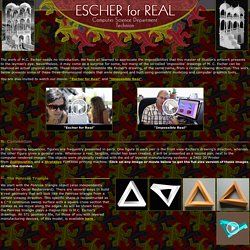
Escher needs no introduction. We have all learned to appreciate the impossibilities that this master of illusion's artwork presents to the layman's eye. Nevertheless, it may come as a surprise for some, but many of the so-called 'impossible' drawings of M. C. Computational complexity theory - Wikipedi. Computational complexity theory is a branch of the theory of computation in theoretical computer science and mathematics that focuses on classifying computational problems according to their inherent difficulty, and relating those classes to each other.
A computational problem is understood to be a task that is in principle amenable to being solved by a computer, which is equivalent to stating that the problem may be solved by mechanical application of mathematical steps, such as an algorithm. A problem is regarded as inherently difficult if its solution requires significant resources, whatever the algorithm used. The theory formalizes this intuition, by introducing mathematical models of computation to study these problems and quantifying the amount of resources needed to solve them, such as time and storage. Closely related fields in theoretical computer science are analysis of algorithms and computability theory. Computational problems[edit] Beyond Escher for Real. (C) Copyright 2002-2012 Gershon Elber, Computer Science Department, Technion This page looks at other art work of impossible illusions, beyond the artwork of M.C.

Escher.