
Artificial Intelligence: A Modern Approach. CCT General Information. General InformationMapping Great Debates: Can Computers Think?
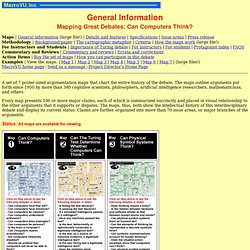
Maps | General information (large file!) | Details and features | Specifications | Issue areas | Press release Methodology | Background paper | The cartographic metaphor | Criteria | How the maps work (large file!) Fuzzy logic tutorial. Science news at the speed of thought. Recluze. Lisp is my favourite language.

I’ve spent more fun-time with it than any other language. I know very few people who’re actually interested in learning lisp but I also know that it’s one of the greatest tools for teaching newbies about computer programming and the structure of computer programs. I’m not alone in this thought either. MIT follows scheme (a dialect of lisp) in its famous course, Structure and Interpretation of Computer programs. Anyway, here are the resources. Legend [B]eginner [I]ntermediate [A]dvance Books. A Non-Mathematical Introduction to Using Neural Networks. The goal of this article is to help you understand what a neural network is, and how it is used.
Most people, even non-programmers, have heard of neural networks. There are many science fiction overtones associated with them. And like many things, sci-fi writers have created a vast, but somewhat inaccurate, public idea of what a neural network is. Most laypeople think of neural networks as a sort of artificial brain. Neural networks would be used to power robots or carry on intelligent conversations with human beings. OpenAi - - about us. The OpenAI site is centered around an Open Source project and community involving artificial intelligence.

The term "Open Source" means that the source code for the project is available for free and can be used by others free of charge. Artificial Intelligence refers to the general aim of intelligent computing, making machines think and learn. The project itself is the creation of a set of tools that are considered to be models of human intelligence. These tools are intended to be integrated into programs or used stand alone for research. We're looking for this site to be: a home for the OpenAI project a place for the community to connect an information repository for AI in general a showcase for the tools The project itself is geared toward developing a specification for AI related tools. OpenAI will also provide the details of the specification online as it develops so that the community can help in it's creation by giving insight and criticism.
Lotus Artificial Life - Hardware Artificial Life. This applet displays a cellular automata substrate capable of supporting evolving, self-reproducing which are capable of universal computation.

The applet is fully interactive, allowing you to apply selection based on organisms visual characteristics using a variety of implements. Selection may also applied automatically. Currently the built in selection methods are for size and shape only. The cellular automata uses a strict von-Neumann neighbourhood and is based on an innovative, multi-layered design. The whole architecture is designed to be implemented on massively parallel hardware. Note: if you're playing with wiping out organisms manually you'll probably want to have the 'No selection at all' checkbox ticked - this causes all cells to be born pregnant and removes some constraints which abort malformed offspring. Imagination Engines Inc. OVERVIEW OF NEURAL NETWORKS. This installment addresses the subject of computer-models of neural networks and the relevance of those models to the functioning brain.

The computer field of Artificial Intelligence is a vast bottomless pit which would lead this series too far from biological reality -- and too far into speculation -- to be included. Neural network theory will be the singular exception because the model is so persuasive and so important that it cannot be ignored. Neuro Evolving Robotic Operatives.
Neuro-Evolving Robotic Operatives, or NERO for short, is a unique computer game that lets you play with adapting intelligent agents hands-on. Evolve your own robot army by tuning their artificial brains for challenging tasks, then pit them against your friends' teams in online competitions! New features in NERO 2.0 include an interactive game mode called territory capture, as well as a new user interface and more extensive training tools. NERO is a result of an academic research project in artificial intelligence, based on the rtNEAT algorithm. Yuichan Artificial Intelligent Socratic Zen Conversationalist. Moravec's paradox. Moravec's paradox is the discovery by artificial intelligence and robotics researchers that, contrary to traditional assumptions, high-level reasoning requires very little computation, but low-level sensorimotor skills require enormous computational resources.
The principle was articulated by Hans Moravec, Rodney Brooks, Marvin Minsky and others in the 1980s. As Moravec writes, "it is comparatively easy to make computers exhibit adult level performance on intelligence tests or playing checkers, and difficult or impossible to give them the skills of a one-year-old when it comes to perception and mobility. " Linguist and cognitive scientist Steven Pinker considers this the most significant discovery uncovered by AI researchers. In his book The Language Instinct, he writes: The main lesson of thirty-five years of AI research is that the hard problems are easy and the easy problems are hard. The biological basis of human skills[edit] As Moravec writes: See also[edit]