
« Le pétrole, une histoire sans fin ? » LE MONDE TELEVISION | • Mis à jour le | Par Alain Constant Un monde sans pétrole ?

On a beau savoir que notre petite planète s’y dirige à grands pas, rares sont les responsables politiques d’envergure à l’envisager publiquement. Quant aux marchés financiers, ils préfèrent ignorer cette hypothèse. Pas étonnant lorsque l’on sait que l’industrie pétrolière est au cœur du système économique mondial, générant 3 500 milliards de dollars américains par an, soit cinquante fois plus que l’industrie automobile, par exemple. En 1973, certains experts prévoyaient la fin du pétrole aux alentours de 2010. Pétrole Une Histoire Sans Fin - Documentaire - 2014. Towards the end of oil - Content. The future of oil supply.
Dmirty Orlov - Résilience. Oil Supply and Demand to 2025. Yesterday, we took a look at what 7%ish growth in China's oil demand would do if continued to 2025 - adding about another 15 million barrels/day (mb/d) to global oil demand.
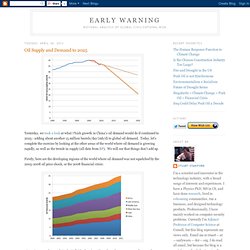
Today, let's complete the exercise by looking at the other areas of the world where oil demand is growing rapidly, as well as the trends in supply (all data from BP). We will see that things don't add up. Guillaume Duval et Naïri Nahapetian , HS sur lénergie Alternative économique. L'Europe_face_au_pic_petrolier_FR.pdf. - 15 November 2012. Peak_oil/Matthieu Auzanneau.odp %5BRepaired%5D.pdf. Peak_oil/Benoit_Thevard_Europe facing peak oil.pdf. Peak_oil/Xavier Desgain_121113 XAD NOTE pic de petrole Bxls GVPE.pdf.
T. Boone Pickens: Let's transform energy. Www.hubbertpeak.com/Hubbert/1956/1956.pdf. YOU ARE HERE: The Oil Journey (Narrated by Peter Coyote) Www.eia.gov/conference/2009/session3/Sweetnam.pdf. Washington envisage un déclin de la production de pétrole mondiale à partir de 2011. Des esclaves énergétiques: Réflexions sur le changement climatique: Amazon.fr: Jean-François Mouhot, Jean-Marc Jancovici. Ouvrage de J.-F. Mouhot. Et nos enfants nous appelleront "barbares" Si nous ne repensons pas rapidement notre manière de vivre, nos enfants paieront lourdement les conséquences de notre comportement irréfléchi.

BOOK REVIEW: 'Clean Energy Nation': The Facts on the End of Petro-Civilization As We Know It. (The wimpy storm made landfall at Baffin Bay, about 40 miles south of Corpus Christi, TX, late Friday night and then fizzled: Link: Maybe Don was angry at the storm-namers who didn't name him "Donaldo," or "The Donald," because his arrival left only a trace of rain, just enough to remove the dust on my PT Cruiser.
I've long been a semi-believer in climate change, blaming most of it on the People's Republic of China, by far the world's biggest polluter of air and water (for more about that see my upcoming review of a book called "Death by China") , but I'm told conservative Texans would dispute the loud and clear message on climate change presented in "Clean Energy Nation: Freeing America from the Tyranny of Fossil Fuels" (Amacom (American Management Association), 320 pages, $27.95) by Congressman Jerry McNerney, Ph.D, and Martin Cheek. Now that I've got your attention about that Texas politician, the envelope please: It's none other than former President George W. About the Authors REP. Clean Energy Nation: Freeing America from the Tyranny of Fossil Fuels: Amazon.fr: Gerald McNerney, Martin Cheek: Livres anglais et étrangers.
Daniel Yergin: What's Wrong With Peak Oil. When subsidies are not on the level. There Will Be Oil, But At What Price? - Chris Nelder and Gregor Macdonald. Peak oil is about price, not supply. Heading down to Washington to speak at the Association for Peak Oil-USA‘s Truth in Energy conference on Nov. 2, I sense a general malaise within the peak oil movement.
The pequists, as they have become known, appear to be on the defensive these days as they once again roll back their dating of the dreaded supply peak, confounded by the oil industry’s never ending ability to develop new extraction technologies and discover new sources of supply. While conventional production may have peaked long ago in the lower 48 U.S. states as predicted by the father of the peak oil movement, geophysicist M. King Hubbert, new sources of supply have been found in Alaska and under the Gulf of Mexico. Différence entre pic géologique et économique (Anglais) The current failure of most western economies to achieve anything more than minimal growth this year (2011) is most likely because oil prices are already at levels that severely inhibit growth.
Association for the Study of Peak Oil and Gas. Un article de Wikipédia, l'encyclopédie libre.
L'ASPO (Association for the Study of Peak Oil and Gas) est l'association pour l'étude du pic pétrolier et gazier. C'est un réseau, presque informel, d'ingénieurs, de géologues, de scientifiques de disciplines diverses et d'économistes, qui cherchent à déterminer le moment où le pic pétrolier va survenir, et ses conséquences sur l'économie. Composition[modifier | modifier le code] Elle comprend actuellement 24 membres de 14 pays d'Europe, dont : Prévisions[modifier | modifier le code]
ASPO - oil. Jean Laherrère - oil end. 300 Years of FOSSIL FUELS in 300 Seconds Rob Hopkins: Transition vers un monde sans pétrole. Martin G. Luling - L'avenir du pétrole. Les ERNEST - une vidéo High-tech et Science. What A Way To Go: Life at the end of Empire. Tim Bennett, middle-class white guy, started waking up to the global environmental nightmare in the mid-1980s.

But life was so busy with raising kids and pursuing the American dream that he never got around to acting on his concerns. Until now… Bennett journeys from complacency to consciousness in his feature-length documentary, What a Way To Go: Life at the End of Empire. He reviews his Midwestern roots, ruthlessly examines the stories he was raised with, and then details the grim realities humans now face: escalating climate change, resource shortages, degraded ecosystems, an exploding global population and teetering global economies.
Bennett identifies and calls into question the fundamental assumption that has led to this unprecedented crisis in human history: that humans were destined to dominate the rest of the community of life with the Culture of Empire. Watch the full documentary now. Richard Sears: Planning for the end of oil. Technological Trajectories and the Human Environment. Viewpoint: Richard A. Sears. Moderator: Hi Everyone. We will be getting started in just a few minutes. Richard Sears : I am looking forward to answering your questions. Peak Oil: The Basics of Oil Depletion in 5 minutes The Fuel Film - Biodiesel. Blind Spot. Blind Spot is a documentary film that illustrates the current oil and energy crisis that our world is facing.
Whatever measures of ignorance, greed, wishful thinking, we have put ourselves at a crossroads, which offer two paths with dire consequences. If we continue to burn fossil fuels we will choke the life out of the planet and if we don’t our way of life will collapse. According to one review, it makes An Inconvenient Truth look like a sitcom.
There’s a lot of environmental films out there that while not painting a rosy picture still want us to feel a sense of hey things will still be ok, not so with Blind Spot. Director Adolfo Doring has, along with many of the scientists, economists and other experts, wisely decided that the time for coddling us is past, perhaps even too long past. This absolutely beautifully shot ode to the end of our world as we have known it doesn’t even bother to try and convince us. This documentary is available for preview only - . Peak Oil Susan Krumdieck. Lisa Margonelli: The political chemistry of oil. Jeff Rubin : Demain, un tout petit monde - comment le pétrole entraînera la fin de la mondialisation.
J’ai beaucoup lu sur la théorie du pic pétrolier, sur la fin du pétrole, sur les spéculations entourant la fin prochaine de cette précieuse ressource à la base de notre civilisation moderne.

Le livre que je tiens entre les mains, loin de l’alarmisme gratuit, nous dit simplement que nous sommes déjà entrés dans l’après-pétrole. Ce livre est signé par Jeff Rubin, un économiste canadien de réputation internationale qui a été notamment entre 1992 et 2009, économiste en chef à Marchés mondiaux CIBC. Il est devenu célèbre après avoir prédit la crise financière de 2008. Enfin, il est connu dans les médias pour avoir commenté à plusieurs reprises les budgets fédéraux. Jeff Rubin. La Croissance Economique dépend toujours plus du Pétrole. Jeudi, 23 Juin 2011 00:00 La Croissance Economique dépend toujours plus du Pétrole. (3) Twitter / Accueil.
Peak Oil: Globalisation.
Richard Heinberg - oil end. Robert Hirsch - oil end. Discussions about Energy and Our Future. The Oil Drum (theoildrum) sur Twitter. Nate Hagens - oil end. Wikileaks on Peak Oil. How Limited Oil Supply can lead to a Continuing Financial Crisis. I recently wrote an article called Oil Supply Limits and the Continuing Financial Crisis, which has been accepted by the journal Energy. It is still in pre-publication status, but the corrected proof is available for purchase. Because of copyright limitations, I can’t reproduce the article, but I wanted to at least provide a summary. When I submitted the article, I was asked for five highlights. These are the ones I submitted: Reduced oil consumption leads to lower economic growth and less capacity for debt.Lower capacity for debt leads to debt defaults, reduced credit, falling home prices.Oil supply limits appear to be a primary cause of the 2008–09 recession.If world oil supply remains level, more recession can be expected in OECD countries.Inadequate demand for high-priced oil is likely to cause much oil to be left in place.
Historical oil shocks - 2011.pdf. Predicting the Future of Oil: Scientific American Podcast. The Real Story on Fuel Economy. The Price of Gas Documentaire: Le Secret des 7 Soeurs - Le Temps des Mensonges - une vidéo Actu et Politique. Prix Petrole. Fin du pétrole. Oil Man - Blog LeMonde.fr. Le jour où le plein de ma voiture me coûtera 200 euros. L'arrivée du "peak oil", du pic pétrolier, celui où la demande excédent définitivement l'offre, ne saurait tarder.
D'ic quelques années, malgré quelques tentatives de remplacement par les agrocarburants, nous allons être en manque de pétrole. Nous allons nous apercevoir en passant à la pompe : le prix du plein va monter atteignant 100 euros, puis dans les décennies à venir, deux cent puis trois cent euros. Il nous faudra nous adapter et trouver des solutions. Récit imaginaire de ce qui pourrait se passer et inventaire des différentes solutions dans le domaine de la mobilité des personnes. Pour rester réaliste, les hypothèses formulées dans cette article s'appuie sur deux postulats: Le pétrole fait-il de nous des esclavagistes modernes ? Colloque sur le pic pétrolier à l'Assemblée Nationale: Les vidéos ! C'est en janvier 2011 qu'a eu lieu ce colloque, organisé par le pôle écologique du Parti Socialiste.
Les effets d’un prix du pétrole élevé et volatil. Patrick Artus, Antoine d’Autume, Philippe Chalmin et Jean-Marie Chevalier Parution : 13.09.2010 Publié le jour anniversaire des cinquante ans de l’OPEP, ce rapport fait le point sur le rôle du pétrole dans l’économie française. Le prix du baril de pétrole a connu ces dernières années des évolutions heurtées : parti de 9 dollars en décembre 1998, il a culminé à 145 dollars en juillet 2008, pour redescendre à 32 dollars en décembre 2008 et remonter à 86 dollars début mai 2010. Confrontée à ce nouvel environnement énergétique, l’économie française doit-elle craindre un prix du pétrole élevé et volatil ?
Dans leur réponse à cette question, les auteurs de ce rapport délivrent quatre messages principaux : Www.cae.gouv.fr/IMG/pdf/093.pdf. {sciences²} Petrole salgado «Il y a moins de pétrole à extraire de la Terre que ce que croient beaucoup de gens». Encore un géologue grincheux? La Bundeswehr publie un rapport qui craint les conséquences de l'imminent pic pétrolier. Plus de pétrole dans 50 ans, prévient HSBC - Oil Man - Blog LeMonde.fr.
Branson warns of oil crunch within five years. L'Armée Américaine se Prépare à un Virage Energétique.