
Teaching English Tips to Stay in Control of a Large Class. What can we do to bring a rowdy class of children back into line?
Shelley Vernon shares some essential tips for controlling a large class... Teaching English with games is becoming standard through out ESL classrooms of the world. And this is good news, because children love to learn through games, and become much more motivated students as a result. However games often make children excited, and if you have a large class you need a few things up your sleeve to bring the class into line immediately if things get a little over-heated. Here are some tips and ideas to help you contain your pupils' enthusiasm and manage your large class. 1. Be consistent in applying your rules. Praise good behavior to generate love and self-esteem. If you are working in a school know the law and rules of your institution before you go into the classroom for the first time, and work in harmony with the school. Start out strict and fair - and stay that way! Www.cambridge.org/other_files/downloads/esl/booklets/Jones-Student-Centered.pdf. Animal vocabulary lesson for esl kinesthetic learners in one to one class.
Esl animal vocabulary activities for kinesthetic one to one lessons. ESL Games - How To Information. ESL Games to Teach Vocabulary on Animals. Animal Vocabulary - Learn English Basics. Learn about animals in the UK (requires Real Player).
Animals in Britain | Animals on the farm | Animals in the house (pets) | Animal sounds In Britain, we have a lot of wild animals; birds, fish, insects and mammals. We also have domesticated animals, and animals we keep as pets. Wild Animals in Britain Here are some of the most common ones. Animals on the Farm. Teach to Students' Learning Styles. It is always important for teachers to teach to their students’ learning styles but this becomes crucial when teaching English language learners.
ELLs may be highly literate in their own language but experience difficulties when acquiring English because they are accustomed to learning through a different style. In any case, most ELLs are visual or kinethetic learners when they first learn English. Most teachers, especially in the upper grades, teach to students with an auditory learning style. This can be very difficult for the ELLs in your class. Auditory Learners Students with this style will be able to recall what they hear and will prefer oral instructions. Interviewing, debating participating on a panel giving oral reports participating in oral discussions of written material Visual Learners. Www.onestopenglish.com/business/teaching-approaches/needs-analysis/pdf-content/business-needs-analysis-lesson-part-1/146829.article.
Needs Assessment. Needs Assessment Assessing students' language needs is a crucial part of planning an effective long-range lesson plan for the term. The course outline provides the basis for the course, but the amount of emphasis placed on certain competencies, topics, proficiencies and structures is determined by the needs and priorities of the students. Needs assessments should be administered during the first week of class. The process of administering the needs assessment and compiling the results can be turned into a classroom activity. For example, after filling out their forms individually, students could work in groups to compare their answers on a particular section related to one or more of the competency areas. As new students enter, they should complete a needs assessment as part of their orientation into the class.
Click on the following links for sample needs assessments from each ESL course outline. Print-Friendly Page. Print-Friendly Page Teaching Guide: ESL Volunteer Guide Volunteering in ESL is a rewarding service to the community.
This guide presents basic strategies for teaching ESL as well as further resources to facilitate positive experiences in the many types of ESL programs that utilize volunteers. Literacy centers, libraries, refugee agencies, universities, and religious organizations are only a few of the places volunteer-based ESL instruction may be found. This guide addresses the needs of volunteers without a background in education and especially those who may have received little or no training as volunteers, with a focus on adult ESL learners. Encouraging students to speak. By Paul Charles This article by Paul Charles aims to narrow the communicative approach into some practical steps towards successful speaking lessons.
Question: What would you suggest as a method of encouraging a student to speak, for example, when they are rather shy even in their native language? I remember GiddyGad once said that I can't make a student use the expressions and vocabulary they do not even use in their native language, and I agree. But what about when they usually answer: "I don't know," "Hmm?
" or only "Yes, I do," "No, I won't" etc... Taken from the onestopenglish Forum. Encouraging students to speak | The three Ts | Finding good topics | Ideas for speaking tasks | Providing the tools | Final thoughts | References. Teaching English One-on-One: Tips and Tricks for a Perfect Lesson. One to one teaching.
Printable English Intermediate Level Grammar Review Quiz - Printable Grammar Review Quiz for Intermediate Level ESL Classes. Teaching Telephone English - Telephone English Lesson Plan. Teaching telephone English can be frustrating as students really need to practice their skill as often as possible in order to improve their comprehension skills.
Once they have learned the basic phrases used in telephoning, the main difficulty lies in communicating without visual contact. Telephone English poses a special problem for English learners because of the lack of visual clues used when speaking. Www.in2english.com.cn/media_file/cms/2005-02-25/1109313200LessonPlantemplate.pdf. Lesson plan for a one on one student wanting to improve his grammar and speaking. Level: Pre-Intermediate Lesson Length: 45 minutes Objective: Past simple question forms and short answers Target Language: Did + subject + verb (simple form) Short answer yes/ no + Subject + did/ did not. were + subject + here short answer yes/ no + Subject + were/ were not + here Was + subject + here short answer yes/ no + Subject + was/ was not + here Assumed Knowledge: Student should have knowldge of Past simple regular/irregular verbs and negative form.
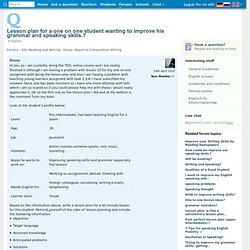
Anticipated Problems: My student will use a past form of the verb to make the question instead of using the simple form. Solutions: During the presentation stage you will draw attention to the verb tense in the question form did + subject + verb. Preparation and Aids: Handouts, flash cards, markers. Teaching One to One - Tips. Teaching one to one is something most English teachers will do sooner or later.
Teaching one to one can help improve your teaching salary, and give you some flexibility in scheduling. Of course, teaching one to one has its drawbacks as well. Here's a quick rundown on the art of teaching English one to one, as well as some strategies and tips to help you get started or improve your one to one teaching skills. Before you Get Started. TEFL Teaching beginners. Teaching beginners is one of the most interesting and ongoing training as a teacher will keep on discovering other techniques in order to capture the understanding of the beginner, rather to make the beginner understand.

The term ? Beginner? May not mean all the students are in one category, they are categorized as follows: Www.totalesl.com//uploads/lesson/z/127812422627556.pdf. Games to Teach English Grammar. While using games to teach English grammar is not the only way - there are many other excellent ESL grammar activities - it is a fun and interesting way to motivate your students.
ESL grammar games, when focussed, can provide a lot of grammar practice in a way that doesn't seem like work. The following ESL games are for children, adults or both. I have written information on the level and ages a game is suitable for in the descriptions of the games. Games to Teach English Grammar. Top 10 TEFL Games and Activities. TEFL games and other fun activities play an important part of the English class, and not only when teaching English to children. While a class based around tefl games would lack balance [and create certain problems], an English class without any games would also lose a lot. It is important to choose esl games which practice English intensively, and avoid 'empty' ESL games which, while fun, only involve minimal practice of English. Good games for teaching English should involve most of the students using English for most of the time.
By involve, I don't mean that students have to be talking nonstop. A silent student may be very actively listening and thinking in the language, and a very noisy student may not be thinking at all. Many of these TEFL games I've been shown by other teachers over the years I've been teaching. Patrick's Site. Patrick's Site. Patrick's Site. Lesson plans for teachers of English as a Foreign Language. Upper secondary adult Gill Johnson, Hastings, UK Comfort Food and drinks Level: elementary and upwards Cultural aim: to establish what foods ( drinks) are personally and culturally central. Preparation: be ready to talk about your "comfort foods, foods that give you a sense of Ok-ness, ease and "at homeness".
Choose some from before and some now. Www.onestopenglish.com/community/lesson-share/pdf-content/integrated-skills/animal-top-trumps-lesson-plan/156748.article. Lesson plan: Is this a satisfactory lesson plan ? ? Free Kids Song MP3 Download, It's a Dog, Animal song, cat, bird, fish! Lesson: Introduce the animals using either flashcards, stuffed animals, or pictures. At first I think it is best to say the words slowly, then a bit faster in a steady rhythm, and have the kids repeat. If they are really young students, don’t worry if they do not repeat the words at first. For older or more experienced students you can introduce the whole phrase, “It’s a dog”. Next, ask the students, “What sound does a dog make?” They may not understand the question, but they will probably catch on quickly and you can of course help them along. Sod.ids.czest.pl/publikacje/l834/l834.pdf. How to Create Animal Games.
Old MacDonald Had a Farm - Children's ESL Lesson. Fun English for Kids (English) 15 ways of starting a preschool English lesson. 1. Entrance drill Students line up outside the classroom and are asked questions or at least say hello to the teacher as they enter the room. This gives each student some personal attention, shows any parents waiting outside what their children can do in English and stops them rushing into the classroom together.
You can […] 1. Entrance drill Students line up outside the classroom and are asked questions or at least say hello to the teacher as they enter the room. Www.teachers.net.qa/Eng_lesson_plans/G1_part1.pdf. Www.onestopenglish.com/community/lesson-share/pdf-content/young/young-learners-the-fastest-animal-lesson-plan/149901.article. Lesson Plan : Animals - FamousWhy. Join the TEFL Debate on i-to-i Chalkboard. Hi, I'm doing the second attempt in checkpoint 5 and am struggling with a few of the questions. First of all when doing another attempt does anyone know whether you have to correct all questions or just the ones the tutor specifies in the end comment? Could someone please give me feedback on the following questions...
Q3 Target language. English worksheets: Train Travel. ESL Printables: English worksheets, lesson plans and other resources. English worksheets: Train Travel. Fun Interactive Flash Games for ESL Classrooms. Www.rospa.com/roadsafety/info/travel_training.pdf. Train Tickets. How do people find cheap or discount train tickets to get around your city in your country? What about train tickets for popular destinations like New York City, London, France, or Japan? Would foreigners visiting your country have a difficult time using public transportation in major cities? Why or why not? Listen to the conversation by pressing the "Play Audio" button and answer the questions. Press the "Final Score" button to check your quiz. Www.onestopenglish.com/grammar/pdf-content/vocabulary-british-english/british-english-travel-worksheet-1-and-teachers-notes-1/147122.article. Breaking News English ESL Lesson Plan on Eurostar. Paris-London train sets rail speed record A half-full passenger train has broken the rail speed record between London and Paris.
The 18-carriage Eurostar train sped through the English countryside along a new $11billion track, shaving 32 minutes off the regular time. The train reached speeds of 330kph to reach London in a time of two hours, three minutes and 39 seconds. British rail chiefs took delight in the achievement as for the very first time, the train was faster in England than it was in France. The traditional route went through the commuter rail networks south of London. Train Travel Lesson Plans Reviewed by Teachers. Why Select Other Criteria? Sometimes you only have 45 minutes to review participles before Tuesday's assembly, or you need curriculum you know was reviewed after a certain date. Travel Vocabulary Lesson Plan. Level: beginners Objectives: travel vocabulary, learners cooperation, writing a paragraph using travel vocabulary Materials: worksheets containing the task below.
Www.cimt.plymouth.ac.uk/projects/mepres/book7/y7s14lpd.pdf. Ok my last attempt at this if anyone can offer pointer please and thanks? Anonymous: I am taking the tefl class and was wondering if you could look it over and offer me any suggestions thanks since its my last attempt student age 20-24 Travelling by train To be able to understand a timetable, make enquiries at the Information Office and buy a train ticket Present simple question forms, numbers, times (4:30, 10:15, etc) Elementary. I-to-i Chalkboard « Keywords: checkpoint 5, help, 45MINS. Please I have looked at every point and angle. Train Travel: From Train Tickets to Subway Schedules. Being able to buy train tickets and understanding subways schedules and maps will make it easier to get around the world.