
Motor City: The Story of Detroit. Detroit's Staggering Murder And Violent Crime Rate Are 'A Public Health Issue' Following news that Detroit was exiting bankruptcy and officials talking with optimism about the road ahead, grim new statistics drive home how much there is to do before the city’s future truly appears bright.
Detroit has the highest murder and violent crime rate of any major city in the country, according to the FBI. FBI Uniform Crime Reporting statistics released Monday show that Detroit logged 316 murders and non-negligent manslaughters last year, with a rate of 45 per 100,000 people. That’s the highest of U.S. cities with more than 200,000 residents and 10 times the national rate. The city also had 14,500 total violent crimes in 2013. The report defines murder and non-negligent manslaughter as the “willful (non-negligent) killing of one human being by another.” However, violent crime is no stranger to residents — and youth — in the Motor City. According to 2010 data analyzed by the Detroit News, homicide is the leading killer of children over age 1 and under 18 in Detroit. 10. 19 shocking facts about Detroit's bankruptcy. Detroit police cars were 'probably the worst I had ever seen,' chief testifies.
■ Update:Insurer Syncora reaches bankruptcy deal with city in huge breakthrough When Detroit Police Chief James Craig assumed the top cop job last year, he encountered a host of problems he'd never seen before, including a fleet of cruisers that was "probably the worst I had ever seen.
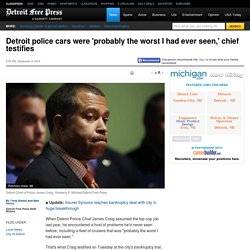
" That's what Craig testified on Tuesday at the city's bankruptcy trial, saying the police department was in rough shape on a number of fronts when he got there. ■ Related:Tigers pitcher Nathan to present $50,000 check to Detroit fire officials “It was very clear that morale was at the very bottom,” Craig said, referring to the state of affairs at the DPD when he took over in 2013. “It was also clear that the department lacked leadership and accountability … and the department had no credibility with the community it served.” U.S. Later Tuesday, a major opponent to the city’s bankruptcy filing, insurer Syncora, struck a deal with the city to settle its part of the case. Detroit police's nightly obstacles: Dangerous streets, broken equipment, dwindling ranks. Wind whipped through downed windows and the speedometer reached 90 m.p.h. as the police cruiser sped down the interstate.
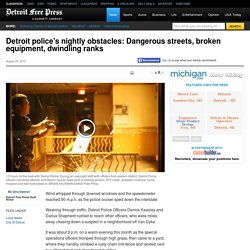
Weaving through traffic, Detroit Police Officers Derrick Keasley and Darius Shepherd rushed to reach other officers, who were miles away chasing down a suspect in a neighborhood off Van Dyke. It was about 9 p.m. on a warm evening this month as the special operations officers tromped through high grass, then came to a yard, where they handily climbed a rusty chain link fence and landed next to a dilapidated and abandoned building. This suspect was gone, but the shift was hours from over. Night after night, Detroit police officers are tasked with patrolling one of the most dangerous cities in America. Detroit, which regularly tops FBI lists ranking violent crime, logged 386 homicides in 2012, not including 25 deemed justifiable, officials have said. . ■ Related:Detroit police announce 'Heatwave Initiative' to prevent auto theft, carjackings A safe return 8:01p.m. 11:50p.m. Few feel Detroit's struggles like police officers; High crime, poor equipment challenge department.
By SHARON COHEN AP National Writer DETROIT (AP) - It has come to this: Even some criminals sympathize with Detroit's cops.
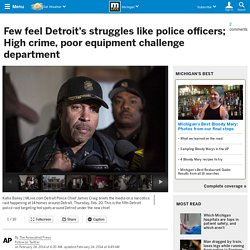
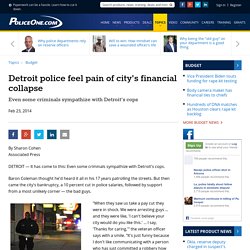
Baron Coleman thought he'd heard it all in his 17 years patrolling the streets. But then came the city's bankruptcy, a 10 percent cut in police salaries, followed by support from a most unlikely corner - the bad guys. "When they saw us take a pay cut they were in shock. We were arresting guys ... and they were like, 'I can't believe your city would do you like this.' ... Detroit police officers have long known adversity: They've worked in crumbling station houses with busted pipes, driven run-down cars, tangled with balky radios.
Detroit Police Department, Michigan - Ballotpedia. The Detroit Police Department is in Detroit, Michigan.
Detroit mayor proposes cutting police and fire department salaries Citing the Michigan state budget and finances shortfalls, Detroit Mayor Dave Bing proposed in 2011 that police and fire unions agree to a 10% salary cut, for a savings of $13 million during the fiscal year ending June 30. Bing said the police and fire department budgets comprise about 60% of the city’s overall budget.[1] Salaries Detroit police salaries begin at $30,137 once an applicant is successful and training at the Police Academy starts.[2] Basic training is 19 weeks at the Police Academy, plus on the job training once graduated. After two years pay increases to $37,761. Benefits Officers with the Detroit Police Department get shift differential pay (a slight increase in hourly wages when working afternoon/graveyard shifts), a $250 annual uniform cleaning allowance and college tuition reimbursement.
Salary records project 1. For comparison:[3] Corruption solution. Detroit police feel pain of city's financial collapse. Feb 23, 2014 By Sharon Cohen Associated Press.
Detroit's first post-bankruptcy budget: 'Balanced and modest' spending. Detroit’s first budget under bankruptcy has the city spending less than $1 billion from its general fund in each of the next three years, according to the spending plan released Friday by emergency manager Kevyn Orr’s office.
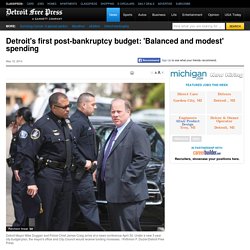
The budget is consistent with a restructuring blueprint the city filed in U.S. Bankruptcy Court, a spokesman for Orr said. So the city’s spending plan — typically worked out between the mayor and the City Council — will be subject to the outcome of the city’s bankruptcy case. ■ Full coverage:Detroit’s financial crisis “The budget presented is balanced and modest,” Orr spokesman Bill Nowling said. Many city departments will face moderate to slight budget cuts under Orr’s plan. But the mayor’s office would be getting a bump. Mayor Mike Duggan will not have to approve Orr’s budget, Duggan’s spokesman said. Detroit's Staggering Murder And Violent Crime Rate Are 'A Public Health Issue'