
Music and the Counter-Reformation. The early decades of the 16th century were fateful ones for the Roman Catholic Church.

With the threat of Lutheranism in and , the success of Calvinism in , and the formation of in independent Church of England with King Henry VIII as its head, Catholic officials realized that a reform of their church was timely and necessary. After much delay, the council which aimed at a “cleansing” of the Catholic Church finally met in December, 1545, at , an imperial city beyond the Italian frontier in the .
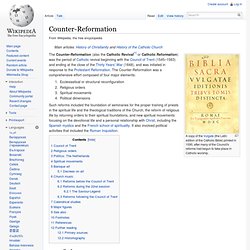
Among the many reforms which resulted from the decrees of the Council of Trent were concerned with the use of music in worship. Ignatius of Loyola. Counter-Reformation. A copy of the Vulgate (the Latin edition of the Catholic Bible) printed in 1590, after many of the Council's reforms had begun to take place in Catholic worship.
The Counter-Reformation (also the Catholic Revival[1] or Catholic Reformation) was the period of Catholic revival beginning with the Council of Trent (1545–1563) and ending at the close of the Thirty Years' War (1648), and was initiated in response to the Protestant Reformation. The Counter-Reformation was a comprehensive effort composed of four major elements: Ecclesiastical or structural reconfigurationReligious ordersSpiritual movementsPolitical dimensions Council of Trent[edit] A session of the Council of Trent, from an engraving.