
Euroaxaca. On November 5th, the final day of the Oaxacan Forum on Social Innovation, I was invited to speak at the first TEDx Oaxaca.

It was a strange thing, to stand up and talk about a project at such an early stage, but it was also a good opportunity to think through what "transformative culture" actually means to me. Here is a slightly-edited transcript of the talk I gave. 1. Once upon a time… Me llamo Dougald y soy narrador de historias. Every story begins as a journey. Sometimes my stories become words in a book. Let me tell you about two cases. At Brixton Village in south London, my friends and I told a story about how twenty empty shops in an indoor market could become a hub of social and cultural life, a space where people would start new independent businesses that grew out of their passions. School of Everything is a website, but also a dream: what if we could index the human library? 2. In modern societies, we tend to have a geological model of the role of culture. Futur_en_Seine: vidéos sur Dailymotion. Ben Davis on social media art. By Ben Davis "Art and social media" -- this topic is all anyone wants to talk about these days.
The discussion extends from the staid -- the National Endowment for the Arts released a report titled "Audience 2.0: How Technology Influences Arts Participation" -- to more spicy ruminations on what "social media art" offers as a new category, as in the artist An Xiao’s recent three-part series for Hyperallergic. On the one hand, this faddish obsession with "social media" is understandable. The Facebook Corp. has begun to wrap its fingers around every other aspect of life, so it is clearly logical to ask what effects social media might have on art-making. But at the same time, I find the chatter somehow sad, as if visual art’s power to inspire passion among a larger audience is so attenuated that it has to throw itself on whatever trendy thing is out there, to win some reflected glory for itself.
7 Social Media Marketing Tips for Artists and Galleries. This post originally appeared on the American Express OPEN Forum, where Mashable regularly contributes articles about leveraging social media and technology in small business.
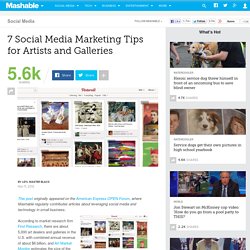
According to market research firm First Research, there are about 5,000 art dealers and galleries in the U.S. with combined annual revenue of about $6 billion, and Art Market Monitor estimates the size of the overall global art market to be around $15 billion annually. There are also more than 200,000 fine artists working in the U.S., according to recent research by the National Endowment for the Arts.
But while fine art is big business, there is often a wide chasm between the creative process that makes a great artist or a sophisticated gallery owner, and the marketing process that drives branding and sales. “For the majority of artists, success will ultimately come down to their effectiveness in marketing,” says Darius Himes, Assistant Director of fine art photography gallery Fraenkel Gallery in San Francisco. Week 3 Positive Examples Of Social Media In Fine Arts.
This discussion-based blog explores the intersection of arts management and online technology. Technology in the Arts is a service of Carnegie Mellon's Center. Chiropractic is a branch of health care profession that deals with problems of the nervous and muscle skeletal system and effects ofthese problems to the general health.

They may range from neck and back pain or joint pain occurring on the legs, arms and evenheadaches. Chiropractor chandler AZ. Is an alternative therapeutic practice that uses drug free hands on approach to your specificdisorder. Chiropractors have broad diagnostic skills and their training allows them to recommend therapeutic as well asrehabilitative solutions to your health problems. These may include dietary, nutritional, counseling or lifestyle changes so as tocomplement the physical process. Some of the common services of chiropractor Chandler AZ • Chiropractic adjustment/ spinal manipulation The chiropractor applies controlled pressure into the joints that have become immobile to restore joint mobility manually. . • Electrical Muscle Stimulation (EMS) • Ultra sound • Infrasonic Sound • Massage therapy.
Positive Examples of Social Media in Fine Arts: Operas « Operas are finding that social media can benefit their establishment in many ways.

Because Opera is such a traditional and long-established form of entertainment, it is important for it to remain relevant with today’s audiences. The mainstream traditional media arena is shrinking, and people are using “the third screen”, their cell phone, as their primary means of sharing information with the world. It is one thing to utilize this third screen from your nosebleed seats of a rap concert, but highly frowned upon in the mezzanine of a prestigious opera house. Staffing social media at the Vancouver Opera. The whole world is watching Vancouver right now.

Let’s hope the world also takes some time to check out the Vancouver Opera, which is celebrating its 50th anniversary this year. Social media advice for opera singers. Many a classical musician is active on Facebook or Twitter.

For the opera singer especially, these social media platforms and others offer unique and exciting opportunities for branding and audience engagement. Why the opera singer in particular? For starters, a gig for an opera singer usually involves at least a 3 week commitment in one city, a substantial amount of a time to connect with the local audience and media. Secondly, the rehearsal process for an opera is just that: a true process, with constant change and development. The move from stark rehearsal room to a stage with sets, costumes and make-up is ripe for interesting photos and backstage anecdotes.
Getting Started I’m assuming the average opera singer has a personal Facebook account. If possible, your Twitter handle should be your first and last name. If the speed and micro-scale of Twitter scare you, and you know you won’t update it regularly, then a blog is not a bad place to start.