
3. Стратегия развития системы e-learning. Elaz22-12-11-bogun Online Class by Vladimir Kukharenko. El-a-z-21-12-11-strat Online Class by Vladimir Kukharenko. Вебинары 3 неделя. Аналитика Неделя № 3. Так как Владимир Николаевич перешел на twillert, то с твитами стало полегче и посему даю небольшую статистику за неделю № 3 Вот ссылка на archivist там в принципе понятно.

Message from the Academy Director: Learning in a Project-Based Organization. MOOCs as ecologies - or - why i work on MOOCs. Open Education Is Transforming the Way We Learn: Ray Schroeder on Online Learning. By Education-Portal The higher education ‘bubble’ has grown quite large.

We are likely to see a growing number of students seeking more affordable options than the traditional path to a college degree. Elearning checklist: Evaluate your instructional design. Do you want a checklist you can use to evaluate your learning design?
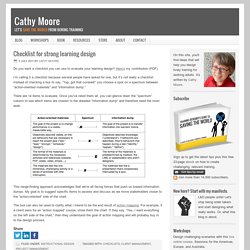
Here’s my contribution (PDF). I’m calling it a checklist because several people have asked for one, but it’s not really a checklist. Instead of checking a box to say, “Yup, got that covered!” You choose a spot on a spectrum between “action-oriented materials” and “information dump.” There are 14 items to evaluate. This range-finding approach acknowledges that we’re all facing forces that push us toward information dumps. The tool can also be used to clarify what I intend to be the end result of action mapping. This Month's #LCBQ - Fun. Best articles on working smarter. The Future of E-Learning is Crowdsourcing. Call me a skeptic, but the idea of having random people from around the Web collaborating in the creation of e-learning content for accredited online degree programs seems absurd.
I went to graduate school for years, read hundreds of books and thousands of articles, sat through countless hours in the classroom, participated in dozens of instructional design projects, created and taught several classes under the supervision of experienced professors, and worked with my classmates and people with real world experience solving actual problems in order to earn my Ph.D. and the right to be both a content area expert and an instructional design professional.
And along the way, I learned one lesson which surpasses all the others: good instructional design requires a collaborative effort. What is Crowdsourcing? Even ten years ago, the concept of crowdsourcing was completely alien to the average person. Image: fotographic1980 / FreeDigitalPhotos.net. The Pros and Cons of E-Learning and Education Technology. E-learning and ‘edtech’ are currently huge buzzwords in education, as the tidal wave of the internet and the digital revolution, already firmly ensconced in our homes and businesses, marches voraciously on into our classrooms and universities.

From class blogs and school e-twinning schemes to scholastic ‘apps’ and online courses, education is going electronic. For those who have yet to experience the e-learning revolution, there is a treasure trove of rich benefits and exciting advances just waiting to be discovered, but some believe that there are also major pitfalls that must be carefully avoided. Charles Jennings: The Real Power of eLearning is Social – Part 1. The first of a two part blog from guest poster and eLearning thought leader, Charles Jennings.
Learn more about Charles here: Homepage, Twitter, LinkedIn Some Background eLearning has been with us in one form or another for at least 50 years, maybe longer. Probably the first player on the enterprise eLearning block was the University of Illinois’ PLATO learning management system, built in 1960 to deliver training through user terminals (which, even then, had touch-screens). Charles Jennings: Real Power of eLearning is Social – Part 2. The second and final blog from guest poster and eLearning thought leader, Charles Jennings.
View part one here. Learn more about Charles here: Homepage, Twitter, LinkedIn The Changes Needed A major drive for us to re-think eLearning approaches is the move away from the 20th Century ‘push’ models of learning – with modules, courses, content and curricula being pushed at employees. We’re seeing a move towards a 21st Century ‘pull’ model – where workers people ‘pull’ the learning and performance resources they need when they need to improve their work performance. They may need a course, but are more likely just to need some ‘here-and-now’ support to solve a problem or overcome an obstacle.
Are MOOCs the Future of Online Learning? By Arienne McCracken, Mind/Shift In education, we often hear arguments in favor of smaller class sizes.
These arguments contend that students learn better when there are fewer of them in a class, because each one gets more individualized attention from the instructor. So it may seem counter-intuitive to support classes that can swell to several thousand participants. How can students learn in these sorts of settings? How can instructors handle the crowd? Are MOOCs the Future of Online Learning? Teaching Strategies Arienne McCracken In education, we often hear arguments in favor of smaller class sizes.
These arguments contend that students learn better when there are fewer of them in a class, because each one gets more individualized attention from the instructor. The Important Concept of eLearning. "By luck, I stumbled upon your site, and of course I wanted to try it out.

I went on to deposit $500 on OneTwoTrade, then opened 5 positions and won 4. Took out the $500 and still have the profit of $288 to trade with. This is a great system you got there Sir, I definitely owe you one. " Shelly Green - New York "I began with $200 on OneTwoTrade and I went down to $100 the first day. "Модернизация экономики невозможна без модернизации системы образования" Мысль правильная. Но фраза в заголовке принадлежит не мне. IJEP39. Toward Society 3.0: A New Paradigm for 21st century education. Overcoming Objections to eLearning by Judy Unrein. “In each case, if the method you’re trying to bring to the organization is suitable for the need, there will be a reason it’s suitable: there will be payoffs in terms of efficiency, effectiveness, scalability, consistency, or some combination of these.”
Did you know that eLearning is around 50 years old? Yes, you read that right. Teaching is one of the first uses that organizations found for computers: researchers at Stanford University experimented with using computers to teach children math and science back in the early 1960s. And yet, one of the situations I occasionally encounter is that, while one department may be starting an eLearning initiative, there is a strong resistance to this “new” model elsewhere within – or maybe throughout – the organization. Taking OER beyond the OER Community; my responses in the online discussions. Taking OER beyond the OER Community is a joint initiative of UNESCO and Commonwealth of Learning (COL). I am posting here my responses in the series of online discussions conducted as part of the above initiative. The responses in this blog are related to the queries on the following two themes:- (1) Policy and capacity & (2) What works, what does not and under what conditions?.
Discussions on the third theme Copyright and the development and re-use of OERs will commence from tomorrow (15/11/2010) (See the forum at Theme: Policy and capacity: Definitely Neil is right in his analysis of the economic changes taking place in the education content market and, in fact, I would say, it is a desired change also. When knowledge repositories are not open, so called reinventing the wheel will happen at the cost of invaluable natural recourses. Universities Refine Mobile Online Learning Strategy. By Tanya Roscorla, Converge As students demand more mobile services, universities shape and align their mobile strategies. Along the way, they hurdle obstacles, consider mobile apps and websites, and provide students with personalized information. The University of Wisconsin-Madison has developed a Web presence, a portal and mobile apps for the iPhone and Android platforms.
And the university may consider a mobile-optimized website. “I think the conversation we’re having is, ‘Ok, there’s a strategy, at least implicitly, behind all these efforts, but the strategy is not necessarily aligned,’” said Chris Holsman, director of enterprise Internet services. Best Practices in the Next Generation of eLearning. By Dean Hawkinson I recently listened in on a webinar presented by David Mallon, with Bersin & Associates, called 10 Best Practices in the Next Generation of eLearning. He began by challenging us to think about what makes our learning organizations relevant in today’s environment, and he stated five types of learning that organizations typically use. He polled the audience to see which ones organizations typically use to deliver training, and the percentages were as follows: Self-Paced (70%) Virtual Classrooms (52%) Video Based (43%) Sims/Games (17%) Digital Content Libraries (30%) I found this breakdown very interesting, but it did not surprise me that the majority use Self-Paced and Virtual Classrooms, with the lowest percentage using Sims/Games.
Trend: Some Community Management Activities to be Outsourced. As we continue to conduct research in the social business arena, it’s important to point out the trends in the space. In particular, a role that is so key to success for customer engagement (marketing and service) is the challenging (and often under-appreciated) community manager role. Lately, I’ve found a few trends that community managers (and their bosses) need to be aware of, as the space continues to grow. Third Party Community Management Specialists On The Rise: Here’s what we’ve been seeing based on a few briefings and interactions I’ve taken in the past few months: Recently, I spoke to a group of community managers at Weber Shandwick (invited by Stephanie Agresta) a communications agency, they work closely with their clients and are often representing the brand on behalf of the client who is unable to scale with limited resources. Top 5 eLearning Skills for 2011.
Posted by Eric Matas in eLearning Careers. Tags: eLearning, eLearning Job Skills, mLearning, Social Learning trackback What are the skills you need to land an elearning job? Working in elearning taps into many skill sets. Designing or developing elearning requires experience in training and project management as much as audio and video production. I focus here on what I think are the top skills for elearning now, in 2011. Pros and Cons of Online Classes. Kristy Korcz, GeekSugar There’s an increasing number of paid and free online classes you can take to learn a new trade, brush up on your calculus skills, and even learn a language, but are online classes the best way to go?
For some, it takes the edge off of the skyrocketing tuition costs in the US (since you can sometimes find online classes at a lower price). The Paradox of Openness: The High Costs of Giving Online. At this year’s ALT-C conference, I’ll be contributing to a symposium session along with Frances Bell, Josie Fraser and Richard Hall. In our session, The Paradox of Openness: The High Costs of Giving Online, we will pose a range of issues for debate, provoking participants to reconsider the costs of participation online, openness, and the sharing of resources.
The Online Future of Learning. The Future of Learning. ABC – The 21st Century Learning Model. For those that know me, I started out my career many moons ago as a K-12 educator. For some of you, I’m sure you’re thinking, “what a lunatic”. I only lasted three years but I look back on those years, nevertheless, with the fondest of memories.
The future of learning is ... social. Why You Should Root for College to Go Online - Clayton Christensen and Henry Eyring - Business. If tuition costs slow their fierce rise, it will be because we figure out how to take some elements of college and put them online. Правило 10000 часов. Постоянный автор журнала New Yorker Малкольм Гладуэлл опубликовал прошлой осенью свою третью книгу. Как и две предыдущие («Озарение» и «Переломный момент»), она сразу вошла в список бестселлеров New York Times. Ажиотаж публики объясним: на этот раз Гладуэлл взялся доказать, что гениями не рождаются, а становятся в результате упорных занятий любимым делом. 'Open Courses, Open Teaching, This Is Dangerous'
What if teaching tools were no longer packaged and sold, but digitally created together for free use? Though it is a muggy late-spring day in Edmonton, it is comfortable inside the conference room of the Mayfield Inn. How data and analytics can improve education. Schools have long amassed data: tracking grades, attendance, textbook purchases, test scores, cafeteria meals, and the like. Школа web 3.0. Mobile Learning: A Quick SWOT Analysis. 28 Creative Ideas for Teaching with Twitter. Good Skills for Online Learning. Are you ready for the second wave of social media? University of the future is here. Online way of learning sees success. Report from EduBloggerCon at ISTE11: Trends and Tools.
Do open online courses have a role in educational reform? STUDY SAYS TECHNOLOGY COULD TRANSFORM SOCIETY. Good Skills for Taking Online Classes. Blended Learning Product Dependencies. eLearn Magazine. Terry Anderson's blog: Quality in Open Educational Resources (OERs) The cost of online learning: $12.50 an hour? The future of education will be open and distributed. 2. How to do an e-learning plan. Australia’s national strategy for e-learning in vocational and educational training (VET)
4. How to implement an e-learning plan. 20 вопросов про стратегию внедрения e-learning. Social Media for Learning: A Balanced Approach. Social Media Revolution 2011. 8 Reasons to Focus on Informal & Social Learning. Mobile and Informal Learning: Trends for 2012. The Future of Online Learning. Week 6 – Tony Bates. Change management strategies for institutional projects. Week 6 – Tips by T.Bates. 6 Ways Digital Learning is Changing Teaching. Building a Learning Network for Students.
#Change11 A reflection on MOOC. If you don’t like messy learning, don’t play in the snow « Connecting the dots. Taking OER beyond the OER Community; my responses in the online discussions. Где же будущее электронного обучения? 5 Big Trends for Education in 2012-13. Firms of the future – business inspired by nature. Open strategy: News Limited shares its inspirations on the future of paid content. 12 Themes for 2012: what we can expect in the year ahead.
» Reactions to the non-training approach to workplace learning Learning in the Social Workplace. Can Technology Revolutionize Education? The Future of E-Learning is Crowdsourcing. Connectivism – a Learning Theory for the Future - CHECK.point-elearning.com. Five Big Changes to the Future of Teacher Education. Университет будущего. In the 21st-Century University, Let's Ban (Paper) Books - Commentary. 10 Reasons Students Say They Prefer Learning Online. 5 Ways Higher Education Is Leveraging Mobile Tech. Enterprise 2.0 maturing with a focus on how we manage, measure, and motivate. Interview: Director of Virtual Learning Illustrates Vision of the Future - Social Learning Blog. 4 Big Ideas That Will Change The World Of Training. A Social Network Can Be a Learning Network - Online Learning. The Best Web 2.0 Applications For Education In 2011. The new learning architect at DevLearn 2011. From Gutenberg to Zuckerberg – scale matters.
Social contexts for formal learning. 7 Things you should know about MOOCs. TeachingwithTechnology.final_