
Неделя 1 Персональная учебная среда. Заметки про e-learning: Коннективизм, как теория обучения. Мы очень много говорим о соцсетях и соцмедиа в контексте обучения, года 2 назад, помню, слово "web 2.0", в контексте обучения, не говорил только ленивый.
Сейчас как мне кажется у многих есть понимание, но мало у кого есть реальный опыт. Но... Задумайтесь! Опыт то вот он, перед глазами... Вы читаете этот пост, значит вы получаете знания (нужные/ненужные, актуальные/устаревшие, интересные/скучные), которые вы можете отфильтровать (прочитав пару строк вначале, можно отказаться от прочтения или продолжить). Есть такая теория обучения Коннективизм (Connectivism), разработанная George Siemens (автор книги Knowing Knowledge) и Stephen Downes. По сути, как мне кажется, коннективизм является выражением, или лицом онлайн обучения. Вот несколько МЕГАхитовых принципов этой теории: Обучение и знания лежат в многообразии мнений. 90 Tips To Make Your Blog Rock. Материалы вебинара "Коннективизм как теория обучения" LMS, PLE, VLE, ILS & SCORM – Navigate the Acronym Minefield.
InShare15 We’ve always been a little acronym happy in the world of online learning.
The inevitable explosion of web technologies has led to a mangled pile of nearly incomprehensible acronyms swimming around in many of today’s trendiest headlines and articles. So what is all this stuff about, and why all the hype / excitement etc. around the latest wave of acronyms? Below is a simple summary, along with a little context. Is the LMS Dead? Web-based learning and collaboration tools are driving a new breed of learning management.
Web-based learning and collaboration tools are driving a new breed of learning management. Social networking, Web 2.0 tools, online collaboration — these are all concepts that have forever changed the technology world and the way we interact with each other online. These solutions also represent a significant milestone in the evolution of learning management. Механизм поведения в социальных сетях. The role of open educational resources in personal learning environ... Technology I Use Everyday as an Educator.
Recently, a colleague asked me what technology I use each day and how does it help me or my students.
So, here is my answer: (all of them are free) 1. Email - I use email for communication. All of my students have my school email address, and I give it out to parents also. I can send messages to my students, communicate with parents, and communicate with other educators. Free eBook and some Twitter talk, do you have a PLN? Building a Personal Learning Network (PLN) by Jane Bozarth. “Simply showing up is not enough.
As with most things in life, you get back what you put in. 5 points about PLEs PLNs for PLENK10. The concept of the Personal Learning Environment in all of its wondrous forms has been one that I’ve struggled with over the last four or five years that I’ve been familiar with it.
I’m very excited to be taking part in the PLENK10 course in order to take the time to focus on these ideas and get a clearer sense of what I mean by the word. I would add, that I think this is one of the central values of an open course… it provides the opportunity to bring clarity to a subject in a field… even if we end up with different clarities The PLE related to the LMS (LCMS, VLE etc…) I came to the idea of the PLE as an alternative to the LMS (learning management system, blackboard, moodle, desire2learn etc). There is a sense in which it is the opponent of the institutional sponsored and controlled LMS and as that I am quite fond of it as a student controlled alternative. POINT 1. Personal Learning Environment vs. Anatomy of a PLE. Personal learning environments 3 years on. I’m enrolled on PLENK 2010 and look forward to seeing how the debate on personal learning environments has developed over the last 3 years.

In 2007 I was interested in the relationship between the emerging PLE and the traditional LMS / VLE (that is, if a technology only 15 years old can be called ‘traditional’) and gave a presentation at the NZ Moodle Moot on the topic ‘Can MOODLE become more SUPPLE ?’ Since then I’ve had to explore the limitations of Blackboard in relation to the same question – to what extent is it possible to develop a PLE space for learners in an institutional context dominated by the lecture as the default mode of on-campus teaching, with the corresponding mirroring of transmission-pedagogy in the default use of the LMS ? I think that while the PLE debates (and diagrams !
Have become a lot more nuanced and complex, we haven’t really seen a shift away from the LMS into a setting where the PLE becomes the default mode of online engagement for learners. A Free Learning Tool for Every Learning Problem? I get it, it's about the P, it's personal. I don't really think in terms of personal learning environments and personal learning networks but more in terms of personal knowledge management plan, which I see as more action oriented and focused.
To implement my personal knowledge management plan, I use a number of tools and techniques (my Personal Learning Environment) and I draw upon the people within my network (Personal Learning Network). I'm still trying to figure this out but I don't want to spend too much time on terminology. It's personal in the sense that it is uniquely my creation and my responsibility. It's what works for me and what works for me is continually changing so I'd rather go with the flow rather than spent too much time defining what it is right now or what it has been in the past. Bridge to Learning - Educational Research. Before Christmas I did an interview over Skype with Janine Schmidt, Dennis Brüntje, Franz Büchl, Oliver Härtel from the University of Ilmenau in Germany. the title of the interview was ‘Identität 2.0 durch E-Portfolios’ – Indentity 2.0 through e-Portfolios.
They have very kindly sent be a transcriot of the interview. A slighly edited versiona appears below. You can also see n more of teh project work on the students’ web site . Mapping my PLE/PLN for PLENK2010. I started out mapping out all the tools and doing a real diagram but that's like trying to understand how my brain works and I don't care that much about the details.
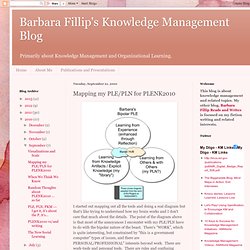
The point of the diagram above is that most of the annoyances I encounter with my PLE/PLN have to do with the bipolar nature of the beast. There's "WORK", which is quite interesting, but constrained by "this is a government computer" types of issues, and there are PERSONAL/PROFESSIONAL" interests beyond work.
#PLENK2010 Thoughts on Fiedler and Väljataga’s Paper, Personal learning environments: concept or technology? I agree with Sebastian and Terje’s paper on this point: “The development of Personal Learning Environments represents a significant shift in pedagogic approaches to how we support learning processes” . . . “(and it) is not a separate space on the internet, it is an essential part of the users’ workspace”. As S&T point out, many people are already experiencing a self-directed life in the digital realm, often with an essential PLE workspace, and they are finding that traditional institutional power and pedagogical relationships are incompatible with this new world.
Just from a practical point of view, PLEs are usually embedded in users workflow and daily routine. Classroom activities are not and can seem contrastingly irrelevant to one’s daily activities. Welcome to My PLE! RSA Animate - Changing Education Paradigms. Federal Consortium for Virtual Worlds. School-5-PLE Online Class by Vladimir Kukharenko. Why Academics Should Blog: A College of One’s Own. Every now and then I make the mistake of confessing to a colleague that I blog. They usually greet this confession with an uneasy smile and follow it with a look that says: “do you really have time for that?”
I understand what they really mean: a serious tenure track assistant professor does not have time for blogging. With respect to my colleagues, they’re wrong: graduate students, post-docs, young faculty, and senior faculty too, should do more blogging not less. And, moreover, institutions of high education ought to start recognizing such work as an important component of a scholar’s profile.
An amazing teacher taught me the form, mechanics and sweat of composition in high school. It’s probably worth pointing out that in most fields (math and physics might be exceptions) when a young academic departs this earth prematurely the loss is one of potential. Young academics often mistake this attitude for complacency, conservativism, or, at worst, cynicism. These were good changes.
Untitled. Building a Personal Learning Network. Осознание E-Learning 2.0 - Дистанционное обучение, e-learning, СДО. HiScool-c59-64_08-2008.pdf (объект «application/pdf») Новое образование и Веб 2.0 — KM-Wiki. Материал из KM-Wiki. Веб 2.0 - термин, обозначающий второе поколение сетевых сервисов, которые позволяют пользователям не только найти и скачать информацию, как это было в Веб 1.0, но и совместно работать и размещать в сети текстовую и медиа информацию значительных объемов.
Веб 2.0 - среда, предполагающая использование передовых коммуникационных технологий и средств взаимодействия пользователей, таких как, например, блоги и Wiki-платформы, на базе которых и происходит общение с другими людьми, используется все богатство цифрового языка с его множеством мультимедийных форматов. E-flections - 5 C’s of Building a PLE?
Jump to Comments This is a draft of a position paper I’m writing for my university, the University of the Arts London, on digital literacy and PLE’s, any thoughts or comments welcome, especially on how useful the 5 ‘c” idea is as a way to simplify the attributes needed #PLENK2010 Summary A UAL graduate should be digitally mature learner, equipped with the critical faculties to create their own Personal Learning Environment (PLE) that will assist them to take advantage of the affordances of technology in their professional, personal and creative lives after UAL. The best way to develop this is through a culture of collaborative inquiry that explores the potential of digital scholarship through a range of authentic situated learning experiences that are relevant to the individuals’ area of practice.
They should be able to engage in 5 core competencies of curation, critique, creation, collaboration, and communication • Lead by example Developing digitally mature learners. The Role of Educator in a PLE World. [All Presentations] The Role of Educator in a PLE World November 17, 2010 Seminar presentation delivered to EC&I 831: Social Media & Open Education, Online, via Elluminate. In this presentation I argue that the role of the educator has become unbundled and is now a wide variety of different roles, usually performed by different people. [Slides] [Audio] The Role of the Educator in a PLE WorldView more presentations from Stephen Downes. [Conference Link] Modelling PLE based learning. InWednesday's #PLENK2010 session Sebastian Fiedler gave us his thoughts and ideas on Personal Learning Environments. He moved the discussion from the technology to the concept and made us think about the personal learning, rather than the learning environment in PLE.
Bridge to Learning - Educational Research. We will broadcast on Friday, Saturday and Sunday (3rd, 4th and 5th of August) from San Marino. Guidance on eBooks The UK JISC Observatory have launched the draft version of a new report on eBooks in Education . They say: “This report updates previous work researching the usage and adoption of ebooks within academic institutions and examines recent developments that are shaping how academic institutions can respond to growing interest in ebooks: As ebooks become mainstream and the percentage of academic publications delivered as ebooks rises steadily, this report explains the importance of preparing for the increasing adoption and usage of ebooks in academic institutions. What My PLN Means To Me: now at #converge10 - Cat's Pyjamas.
Gidday! 15 Time Management Gadgets You Never Knew Existed — Almost Organized. Time management isn’t anything new. Since mankind conceptualized the idea of “time”, we have been taking steps towards prioritizing and coordinating our efforts. Even Stonehenge, a structure used by ancient farmers to track when to plant crops, is basically a huge (and very cool) time management tool. Six Social Media Trends for 2011 - Social Learning Blog. You know that social media is here to stay (if not, check out Is Social Media a Fad?). At Interactyx, we are constantly reviewing how businesses, schools and individuals are securely using social media technology to enhance the eLearning & training process. We have listened to our customers (TOPYX testimonials) and incorporated many new features to TOPYX, our social eLearning software.
As technology improves and adoption of social media continues to expand, TOPYX will continue to deliver a cutting-edge, affordable eLearning solution for any sized business, school or eCommerce initiative. We are always looking to the future of social media and eLearning. Below is an interesting article by David Armano discussing the trends of 2011.
Social Networking: The Future. Editor’s note: This is the third of a three-part guest post by venture capitalist Mark Suster of GRP Partners on “Social Networking: The Past, Present, And Future.” 10 Principles for the Future of Learning. Learning Technology Trends To Watch In 2011. Sharebar Artificial as the year’s end might be, I can’t help but look back in amazement at the technology trends and changes we’ve seen and speculate about how we will learn and enable learning experiences in 2011. PLEs and PLNs for Lifelong Competencies. Return to the EVO Call for Participation. #PLENK2010 Personal Learning Networks and Legitimate Peripheral Participation. My Personal Learning Network is the most awesomest thing ever!!
Edtechpost - PLE Diagrams. The Best Guides For Helping Teachers Develop Personal Learning Networks. 100 Ways Google Can Make You a Better Educator. Web20.pdf (объект «application/pdf») Virtual Class: Блог : Концепции: коннективизм. Веб 2.0. Коннективизм — Letopisi.ru. Google sites. Персональная среда обучения - PLE. eFront Learning: eLearning Glossaries. Personal Learning Networks for Educators. PLE Vs. VLE.wmv. Персональная учебная среда. ELI7049.pdf (объект «application/pdf») Personal learning environment.
History of personal learning environments. Personal learning environment. Physiology of a PLE. 6 Tips for Starting an Online Community. 14 Reasons Why Social Media Happened. Социальные сети могут лишить памяти.