
ElCep
Étudiant, géographie et informatique, réseau et logiciel libre ... Viticulture territoire et modélisation. Rien d'antinomique. ;-)
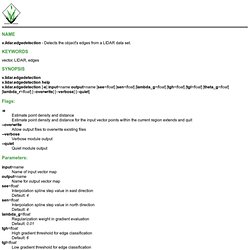
GRASS GIS - The World Leading Free Software GIS. GRASS GIS manual: v.lidar.edgedetection. V.lidar.edgedetection - Detects the object's edges from a LIDAR data set. vector, LIDAR, edges v.lidar.edgedetectionv.lidar.edgedetection helpv.lidar.edgedetection [-e] input=name output=name [see=float] [sen=float] [lambda_g=float] [tgh=float] [tgl=float] [theta_g=float] [lambda_r=float] [--overwrite] [--verbose] [--quiet] Flags: -e Estimate point density and distance Estimate point density and distance for the input vector points within the current region extends and quit --overwrite Allow output files to overwrite existing files --verbose Verbose module output --quiet Quiet module output Parameters: input=name Name of input vector map output=name Name for output vector map see=float Interpolation spline step value in east direction Default: 4 sen=float Interpolation spline step value in north direction lambda_g=float Regularization weight in gradient evaluation Default: 0.01 tgh=float High gradient threshold for edge classification.
OpenStreetMap. Plugins Repository. GFOSS - Free Software GIS at your fingertips. PostGIS.fr - Le site de la communauté des utilisateurs francophones de PostGIS – PostGIS.fr. Project — Open Source Routing Library. PgRouting 1.02: Test de la fonctionnalité shortest_path_shooting_star() - Le blog de Jean David TECHER, un Réunionnais à Saint-Priest/Lyon. Le descriptif de cette fonctionnalité est fournie à Cette fonctionnalité permet notamment de prendre en compte les sens de parcours.
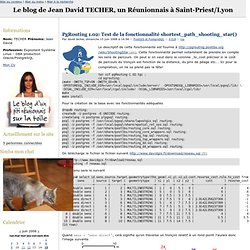
On peut si on veut dans la colonne _to_cost préciser si le coût de parcours du tronçon est fonction de la distance, du prix de péage etc... Ici pour la compilation, on ne se prend pas la tête! Tar xzf pgRouting-1.02.tgz ; cd pgrouting; cmake -DWITH_TSP=ON -DWITH_DD=ON \ -DPOSTGRESQL_INCLUDE_DIR=/usr/local/pgsql/include/server/ -DPOSTGRESQL_LIBRARIES=/usr/local/pgsql/lib/ \ -DCGAL_INCLUDE_DIR=/usr/local/cgal/include/ -DCGAL_LIBRARIES=/usr/local/cgal/lib/ make make install Pour la création de la base avec les fonctionnalités adéquates On télécharge le fichier le fichier suivant wget psql routing -f reseau.sql Le contenu sera le suivant.
Installation on Ubuntu — Open Source Routing Library. Install required packages sudo apt-get install build-essential git-core cmake sudo apt-get install postgresql-8.3-postgis postgresql-server-dev-8.3 If you’re not planning to install CGAL from Ubuntu multiverse, you can use default Boost library from the repository.
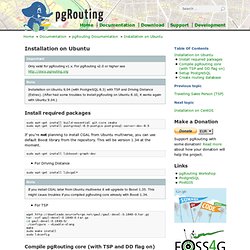
This will be version 1.34 at the moment. Drive Time Isochrones – An Example Using Finnish Airports. Site analyses can benefit greatly from using “drive-time” isochrones to define the study area.
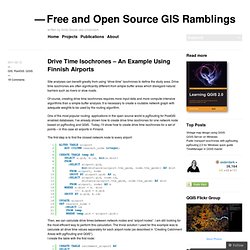
Drive time isochrones are often significantly different from simple buffer areas which disregard natural barriers such as rivers or slow roads. Of course, creating drive time isochrones requires more input data and more compute-intensive algorithms than a simple buffer analysis. It is necessary to create a routable network graph with adequate weights to be used by the routing algorithm. One of the most popular routing applications in the open source world is pgRouting for PostGIS enabled databases. I’ve already shown how to create drive time isochrones for one network node based on pgRouting and QGIS. The first step is to find the closest network node to every airport: Then, we can calculate drive times between network nodes and “airport nodes”. Every following node is done with an INSERT: Afterwards, I combined the values to find the minimum drive time for each network node: Like this: Drive Time Isochrones – An Example Using Finnish Airports. A Beginner’s Guide to pgRouting.
Please read the new instructions for pgRouting 2.0.
The aim of this post is to describe the steps necessary to calculate routes with pgRouting. In the end, we’ll visualize the results in QGIS. This guide assumes that you have the following installed and running: Postgres with PostGIS and pgAdminQGIS with PostGIS Manager and RT Sql Layer plugins Installing pgRouting pgRouting can be downloaded from www.pgrouting.org. Building from source is covered by pgRouting documentation. Start pgAdmin and create a new database based on your PostGIS template. Creating a routable road network The following description is based on the free road network published by National Land Survey of Finland (NLS) (Update January 2013: Sorry, this dataset has been removed). First step is to load roads.shp into PostGIS. PgRouting requires each road entry to have a start and an end node id. Next, we create start and end point geometries. (This can take a while.)
I recommend adding a spatial index to the resulting table.