
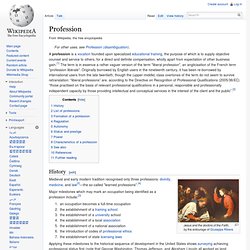
10 African Millionaires To Watch. Profession. A profession is a vocation founded upon specialized educational training, the purpose of which is to supply objective counsel and service to others, for a direct and definite compensation, wholly apart from expectation of other business gain.[1] The term is in essence a rather vaguer version of the term "liberal profession", an anglicisation of the French term "profession libérale".
Originally borrowed by English users in the nineteenth century, it has been re-borrowed by international users from the late twentieth, though the (upper-middle) class overtones of the term do not seem to survive retranslation: “liberal professions” are, according to the Directive on Recognition of Professional Qualifications (2005/36/EC) “those practised on the basis of relevant professional qualifications in a personal, responsible and professionally independent capacity by those providing intellectual and conceptual services in the interest of the client and the public”.[2] History[edit] Regulation[edit]
Career. Careers Career describes an individuals' journey through learning, work and other aspects of life. There are a number of ways to define a career and the term is used in a variety of ways. Definitions and etymology[edit] Career is defined by the Oxford English Dictionary as a person's "course or progress through life (or a distinct portion of life)". In this definition career is understood to relate to a range of aspects of an individual's life, learning and work. The etymology of the term comes from the m. Historic changes in careers[edit] For a pre-modernist notion of "career", compare cursus honorum.
By the late 20th century, a wide range of choices (especially in the range of potential professions) and more widespread education had allowed it to become possible to plan (or design) a career: in this respect the careers of the career counselor and of the career advisor have grown up. Personality Plus. Florence Littauer is a Christian self-help author and public speaker. Littauer is best known for her series of books based upon the Personality Plus personality system.[1] She was listed as one of Helen K. Hosier's "100 Christian Women Who Changed the Twentieth Century" and has received the National Speakers Association's Council of Peers Award for Excellence and has been designated by them as a Certified Speaking Professional.[2][3] Background[edit] Personality Plus[edit] Littauer, along with her husband, developed the personality profile system Personality Plus. Personality groups[edit] Cholerics are considered to be leader and commander types, being dominant, strong, decisive, and occasionally arrogant.This is the dominant, strong, decisive, stubborn and even arrogant type of person.
To be good leaders because they are driven to get things done, however they might offend some people along the way. Four temperaments. Choleric, melancholic, sanguine, and phlegmatic temperaments Four temperaments is a proto-psychological theory that suggests that there are four fundamental personality types, sanguine (pleasure-seeking and sociable), choleric (ambitious and leader-like), melancholic (analytical and quiet), and phlegmatic (relaxed and peaceful).

Most formulations include the possibility of mixtures of the types. The Greek physician Hippocrates (460–370 BC) incorporated the four temperaments into his medical theories as part of the ancient medical concept of humorism, that four bodily fluids affect human personality traits and behaviors. Later discoveries in biochemistry have led modern medicine science to reject the theory of the four temperaments, although some personality type systems of varying scientific acceptance continue to use four or more categories of a similar nature.
John Holland's Theory of Career Choice. Choosing an Occupation, Training Program, Major, Career Cluster or Pathway The Career Key is based on John Holland's theory of career choice.
The theory explains work-related behavior – such as, which career choices are likely to lead to job success and satisfaction. It also explains other human actions, like success and satisfaction in school and training programs. It is the best known and most widely researched theory on this topic and is used by most career counselors. Understanding Holland’s theory will help you make good choices – decisions about which occupations, careers, majors, or training programs best fit you. When you take the Career Key test, you receive an accurate assessment of your Holland personality types and a booklet What Your Test Scores Means that explains Holland's theory and how your test scores are related to it and career choice. Holland's theory can be summarized in six statements: How is this related to the scores you receive on the Career Key? John Holland's Theory of Career Choice. Choosing an Occupation, Training Program, Major, Career Cluster or Pathway The Career Key is based on John Holland's theory of career choice.

The theory explains work-related behavior – such as, which career choices are likely to lead to job success and satisfaction. It also explains other human actions, like success and satisfaction in school and training programs. It is the best known and most widely researched theory on this topic and is used by most career counselors. Understanding Holland’s theory will help you make good choices – decisions about which occupations, careers, majors, or training programs best fit you.