
Do you need a chart to tell your story? Today, Penelope Trunk blogged about the value and importance of the visual.

She explains in her post, Next phase of your career: Design,”This means that you will be more valuable and more relevant if you can think in terms of visuals.” This topic has been on my mind for the past several days, especially, as I have been reviewing Visualize.me, the same infographic tool Penelope highlights in her post. What I’ve been grappling with is the disconnect between what is “cool” and “new” — even cutting edge — and what is actually useful for job seekers. Remember VisualCV? (Maybe not?) What UX Methods to Use and When to Use Them.
Prototyping. Ethnio Review: How I Used it to Interview My Visitors. Web analytics tools often only give you a limited understanding of your visitors.

Design Staff — Get better data from user studies: 16 interviewing tips. One of my favorite parts of my job is interviewing a huge variety of people about their habits, needs, attitudes, and reactions to designs.
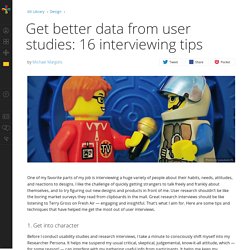
I like the challenge of quickly getting strangers to talk freely and frankly about themselves, and to try figuring out new designs and products in front of me.
Personas. QualitativeAnalysis. Coding_module_tutorial_022309 - stustu12. Brand/Customer Experience - ATG. Help - Privacy Patterns. UI Prototyping Tool Made Beautiful - Create Interactive Wireframes & High Fidelity Prototypes. Cognition & The Intrinsic User Experience. Direct Line Ideas Lab on Facebook. Usability. Daniel read intertemporal choice. Whitney Hess: Design Principles — The Philosophy of UX.
The second speaker at this mornings An Event Apart in Boston is Whitney Hess. Here goes with the liveblogging… Accessibility. Tools. Interviewing Tips and Techniques for IT Professionals. How to Interview Stakeholders, Part 2. In the first part of this series I explored what makes a good stakeholder interview in general.

In this article, I will write about how to use open questions, sketches and thinking out loud during stakeholder interviews. How to create personas your design team will believe in. Assumption personas are fake personas.

20 things you can do this year to improve your user's experience. Run a usability test I put this one first for those people who don’t scroll — because it’s the single most powerful weapon in the user experience arsenal.

Conducting Successful Interviews With Project Stakeholders. By Steve Baty Published: September 10, 2007 “A simple, semi-structured, one-on-one interview can provide a very rich source of insights.”

If you’ve read some of my previous columns on UXmatters, you could be forgiven for thinking my entire working life is spent largely surrounded in a sea of quantitative data. This is, rather surprisingly even to me, not nearly close to the truth. Looking back over recent months, by far the most common form of research I’ve carried out is that stalwart of qualitative studies—the interview. A simple, semi-structured, one-on-one interview can provide a very rich source of insights. Ten Guidelines for Stakeholder Interviews Here are ten general guidelines I follow when conducting stakeholder interviews: Setting Up Business Stakeholder Interviews, Part 1.
For those who build websites and applications for a living, it is important to understand the realities of how clients work in order to guide effective strategy, IA, and user research aligned with business goals.

Interviewing different people who deal with a company’s website will help you simplify complex strategic directions, create appropriate research plans, develop information architecture, and design interactions for great user experiences. Interviewing is both art and science, and it is something that any UE practitioner with a little additional time and moderation skills can employ to extract clear business requirements. Without this foundation, business requirements can be unclear and deadlines for launching new sites, features, and content can be unrealistic. Worse, companies may launch features that users do not really want. Early and effectively gathered stakeholder input is also valuable for determining directions for user research during new site and product design. Wireframe and Mockups Software - Build Mockup , Wireframes and quick prototypes.
Contextual Enquiry – A Primer. Designers who don’t understand their users frequently develop products that are difficult to use and understand, do not meet real-world requirements, or provide irrelevant functionality.
Norwich Research Network (1) An Extensive Guide To Web Form Usability - Smashing UX Design. Advertisement Contrary to what you may read, peppering your form with nice buttons, color and typography and plenty of jQuery plugins will not make it usable.
Indeed, in doing so, you would be addressing (in an unstructured way) only one third of what constitutes form usability. In this article, we’ll provide practical guidelines that you can easily follow. These guidelines have been crafted from usability testing, field testing, website tracking, eye tracking, Web analytics and actual complaints made to customer support personnel by disgruntled users.
Why Web Form Usability Is Important The ISO 9241 standard defines website usability as the “effectiveness, efficiency and satisfaction with which specified users achieve specified goals in particular environments.” The User Experience Wheel. I have used this model for some time now, time to reveal it to the critical eyes of fellow practitioners. It is a model that tries to explain “what is user experience?”
PDF Version The Model should be explained from the inside. 12 Creative Design Elements Inspiring the Next Generation of UX. It's been a long time since I've written about design here at Moz, but I spent my morning in a great meeting with Derric, and was inspired by a lot of his ideas and what we reviewed to revisit some of the emerging trends and outlier creatives that are opening our eyes to what's possible. Below, you'll find some truly exceptional, unique elements of creative layout and artistry, as well as simple tweaks to best practices that are pushing the field forward.
Hopefully, a few will inspire your design directions, too! #1 - Products Floating on the Background. Experience Maps Identify Inefficiencies and Opportunities. An experience map is a holistic view of all of the touchpoints or interactions people have with a brand. It enables you to determine a number of key factors: Permission Marketing. Permission marketing is the privilege (not the right) of delivering anticipated, personal and relevant messages to people who actually want to get them. It recognizes the new power of the best consumers to ignore marketing.
Gradual Engagement Boosts Twitter Sign-Ups by 29% Twitter recently redesigned their sign-up process to boost new user engagement. Though the new sign-up process added one more screen, conversions went up 29%. How? How Cognitive Fluency Affects Decision Making. By Colleen Roller Published: July 4, 2011. Why some social network services work and others don’t — Or: the case for object-centered sociality.
Brian Solis Defining the convergence of media and influence. Consider Use and Usability When Designing Tablet Apps. When designing applications for the Web or mobile, usability is always paramount. But we do well to consider use context as well as user experience. Tablet computers have larger screens that allow for more flexibility in design and features, but tablet devices are also more likely to be used by multiple people: 1) the novelty and coolness of tablets make owners eager to show off the device and content to friends, and 2) unlike mobile phones, tablets may have shared ownership, e.g. one per household.
In a recent post we looked at the use context of cellphones, ereaders and tablets based on research by Nielsen. You may recall that 58% of mobile phone users vs. 44% of tablet users operate their gadgets whilst among friends and family. The UX of Learning. While many desk-shackled students may wish they were napping rather than enduring yet another monotonous lecture, learning is by no means confined within the classroom. In fact, we engage in focused learning activities every day. Difference & Relationship Between Usability & User Experience. After web site accessibility, “user experience” (abbreviated as UX) is probably the phrase that most people tend to confuse usability with. While the topic of the difference between usability and user experience has been discussed by various experts in the respective fields, I feel the need to write about it for two main reasons.
The first reason is that several posts I have encountered emphasize the distinction between these two terms, yet they fail to highlight the relationship that exists between usability and user experience. The second reason is that whilst most of the posts are similar in nature, I have found some minor, albeit very valid points scattered in various posts I have read.