
Www.nhccosmeticos.com.br/paulobhz/Genetica_1_lei_mendel.pdf.
Media. Okazaki Fragments. Genetica mendeliana.pdf. Genetic Linkage and Genetic Maps. The Background Gregor Mendel analyzed the pattern of inheritance of seven pairs of contrasting traits in the domestic pea plant.
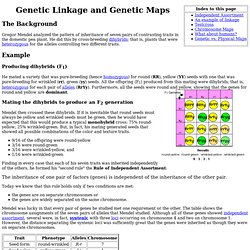
He did this by cross-breeding dihybrids; that is, plants that were heterozygous for the alleles controlling two different traits. Example Producing dihybrids (F1) He mated a variety that was pure-breeding (hence homozygous) for round (RR), yellow (YY) seeds with one that was pure-breeding for wrinkled (rr), green (yy) seeds. Mating the dihybrids to produce an F2 generation Mendel then crossed these dihybrids. The inheritance of one pair of factors (genes) is independent of the inheritance of the other pair. Today we know that this rule holds only if two conditions are met: the genes are on separate chromosomes or the genes are widely separated on the same chromosome.
Mendel was lucky in that every pair of genes he studied met one requirement or the other. An example of linkage To simplify the analysis, mate the dihybrid with a homozygous recessive strain (ccshsh). Accurate calculation of large map distances - An Introduction to Genetic Analysis - NCBI Bookshelf. Meiosis Biologia Celular Atlas Digital. Gymnosperm (Pine) Life Cycle. Polytene chromosome. Polytene chromosomes in a Chironomus salivary gland cell Polytene chromosome Function[edit] In addition to increasing the volume of the cells' nuclei and causing cell expansion, polytene cells may also have a metabolic advantage as multiple copies of genes permits a high level of gene expression.

In Drosophila melanogaster, for example, the chromosomes of the larval salivary glands undergo many rounds of endoreduplication, to produce large amounts of glue before pupation. Another example, within the organism itself is the tandem duplication of various polytene bands located near the centromere of the X chromosome which results in the Bar phenotype of kidney-shaped eyes.[1] Structure[edit] History[edit] Polytene chromosomes are also used to identify the species of Chironomid larvae that are notoriously difficult to identify. References[edit] Other References[edit] Baudisch W (1977).
External links[edit] Green Fluorescent Protein - The GFP Site. Green Fluorescent Protein (GFP) has existed for more than one hundred and sixty million years in one species of jellyfish, Aequorea victoria.

The protein is found in the photoorgans of Aequorea, see picture below right. GFP is not responsible for the glow often seen in pictures of jellyfish - that "fluorescence" is actually due to the reflection of the flash used to photograph the jellies. In Aequorea victoria a protein called aequorin releases blue light upon binding with calcium. This blue light is then totally absorbed by the GFP, which in turn gives off the green light as in the animation below. In 1994 GFP was cloned. The importance of GFP was recognized in 2008 when the Nobel Committee awarded Osamu Shimomura, Marty Chalfie and Roger Tsien the Chemistry Nobel Prize "for the discovery and development of the green fluorescent protein, GFP. " Why is it so popular? Check out some of the visually arresting photographs, shown below, that have been taken of fluorescently labeled proteins. DNA microarray.