background preloader

Social studies

Facebook Twitter

Walt disney

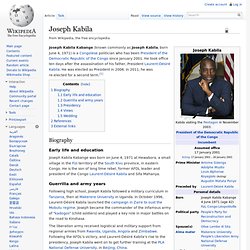
Joseph Kabila. Joseph Kabila Kabange (known commonly as Joseph Kabila, born June 4, 1971) is a Congolese politician who has been President of the Democratic Republic of the Congo since January 2001. He took office ten days after the assassination of his father, President Laurent-Désiré Kabila. He was elected as President in 2006. In 2011, he was re-elected for a second term.[1] Biography Early life and education Joseph Kabila Kabange was born on June 4, 1971 at Hewabora, a small village in the Fizi territory of the South Kivu province, in eastern Congo.
Guerrilla and army years Following high school, Joseph Kabila followed a military curriculum in Tanzania, then at Makerere University in Uganda. The liberation army received logistical and military support from regional armies from Rwanda, Uganda, Angola and Zimbabwe. When he returned from China, Kabila was awarded the rank of Major-General, and appointed Deputy Chief of Staff of the Armed Forces of the Democratic Republic of the Congo, in 1998. Views. African trypanosomiasis. African trypanosomiasis or sleeping sickness[1] is a parasitic disease of humans and other animals. It is caused by protozoa of the species Trypanosoma brucei.[2] There are two types that infect humans, Trypanosoma brucei gambiense (T.b.g) and Trypanosoma brucei rhodesiense (T.b.r.).[1] T.b.g causes over 98% of reported cases.[1] Both are usually transmitted by the bite of an infected tsetse fly and are most common in rural areas.[1] Initially, in the first stage of the disease, there are fevers, headaches, itchiness, and joint pains.[1] This begins one to three weeks after the bite.[3] Weeks to months later the second stage begins with confusion, poor coordination, numbness and trouble sleeping.[1][3] Diagnosis is via finding the parasite in a blood smear or in the fluid of a lymph node.[3] A lumbar puncture is often needed to tell the difference between first and second stage disease.[3] Signs and symptoms[edit] African trypanosomiasis symptoms occur in two stages.
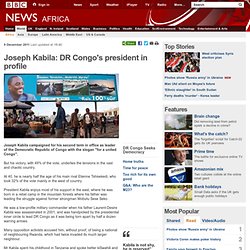
Cause[edit] An Interview With Joseph Kabila - Interview. Joseph Kabila: DR Congo's president in profile. 9 December 2011Last updated at 18:40 Joseph Kabila campaigned for his second term in office as leader of the Democratic Republic of Congo with the slogan "for a united Congo". But his victory, with 49% of the vote, underlies the tensions in the vast and chaotic country. At 40, he is nearly half the age of his main rival Etienne Tshisekedi, who took 32% of the vote mainly in the west of country. President Kabila enjoys most of his support in the east, where he was born in a rebel camp in the mountain forests where his father was leading the struggle against former strongman Mobutu Sese Seko. He was a low-profile military commander when his father Laurent-Desire Kabila was assassinated in 2001, and was handpicked by the presidential inner circle to lead DR Congo as it was being torn apart by half a dozen warring armies.

Many opposition activists accused him, without proof, of being a national of neighbouring Rwanda, which had twice invaded its much larger neighbour. 'Debt to pay' 'War bus' Rita's International Recipes: Congo - Chicken Moambe. Chicken Moambe Chicken moambe (also known as "mwambe", "mwamba", "mouamba" or "muamba") is the national dish of the both the Republic of the Congo and the Democratic Republic of the Congo, and is enjoyed throughout Central Africa as well.
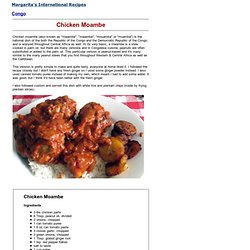
At its very basic, a mwambe is a stew cooked in palm oil, but there are many versions and in Congolese cuisine, peanuts are often substituted or added to the palm oil. This particular version is peanut-based and it's many similar to the many peanut stews that you find throughout Western & Central Africa as well as the Caribbean. This version is pretty simple to make and quite tasty, everyone at home liked it. I followed the recipe closely but I didn't have any fresh ginger so I used some ginger powder instead. I also followed custom and served this dish with white rice and plantain chips (made by frying plantain slices). Adapted from a recipe at Cyberpages International. Congolese Recipes | Margarita's International Recipes | E-mail.

Democratic republic of congo. Democratic republic of congo caterpillar. Nature's Strongholds Democratic Republic of Congo - GARAMBA NATIONAL PARK. In a vast undulating plateau of papyrus marshes, gallery forest, and stream-laced grasslands, some so high only tall Congo giraffes can see over them, is the last wild population of northern white rhinoceros in Garamba National Park and World Heritage Site. Surrounded on three sides of its 1,968 square miles (5,097 km2) by hunting reserves totaling more than 6,250 square miles (10,000 km2), it’s an enormous protected area in DRC’s northeast corner bordering Sudan, 47 miles (75 km) west of Uganda.
Once Garamba, established in 1938, had thousands of white rhinos, elephants, and others, but poaching by helicopters, automatic weapons, even light cannon, reduced these to remnants. Only 15 rhinos remained in 1984, making it one of the world’s most endangered species. Conservation groups around the world, including the Frankfurt Zoological Society (FZS), WWF, and the U.N., joined in efforts to save these magnificent beasts. Nat geo magazines layout. Democratic Republic of the Congo travel guide. The Democratic Republic of the Congo (French: République Démocratique du Congo (or RDC); often shortened to DRC or D.R. Congo) is the largest and most populous country in Central Africa. It straddles the Equator and is surrounded by Angola to the southwest; Angola's Cabinda exclave and the Republic of the Congo to the northwest; the Central African Republic to the north; South Sudan to the northeast; Uganda, Rwanda, Burundi, and Tanzania in the east from north to south; and Zambia to the southeast.
The country is also frequently called Congo-Kinshasa to distinguish it from its northwestern neighbor, the Republic of Congo (also known as "Congo-Brazzaville"). In the past, the DRC has been known as the Congo Free State, Belgian Congo, the Republic of the Congo, Congo-Leopoldville, or Zaire. Note: On this and other Wikitravel pages within the DRC, "Congo" refers to the Democratic Republic of the Congo.

Understand[edit] The country has faced a tragic, tumultuous history since colonization. Maiko National Park. Maiko National Park is a national park in the Democratic Republic of the Congo. It lies in one of the most remote forest areas of the country and covers 10,885 km2 (4,203 sq mi). The park is divided into three sectors, straddling the states of Nord Kivu, Province Orientale and Maniema. Three of the country's spectacular endemic animals occur here: the Grauer's gorilla, the Okapi, and the Congo Peafowl. Maiko is also an important site for the conservation of the African forest elephant, eastern chimpanzee and the endemic aquatic genet.

Creation[edit] In 1949, the Belgian colonial administration created the Bakumu Hunting Reserve (Bakumu, meaning "The Kumus", the native tribe in the region) on an area that would later encompass the boundaries of the Park as we know it today. The original plans for the area is believed to have aimed at preventing the exploitation of mineral resources rather the protection of the nature and the wildlife.

The rebel problem[edit] References[edit] The Democratic Republic of Congo. Author and Page information Described by some as Africa’s first World War, the conflict in the DRC (formerly known as Zaire) has involved seven nations. There have been a number of complex reasons, including conflicts over basic resources such as water, access and control over rich minerals and other resources as well as various political agendas. This has been fueled and supported by various national and international corporations and other regimes which have an interest in the outcome of the conflict.
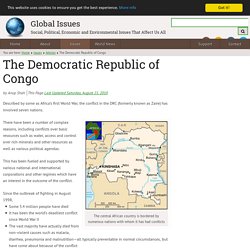
Since the outbreak of fighting in August 1998, These shocking figures would usually be more than enough to get media attention the world over, especially if it were to threaten influential nations in some way. On this page: Brief Background As with most conflicts in Africa, the current situation has much to do with the legacy of colonialism. After 75 years of colonial rule, the Belgians left very abruptly, relinquishing the political rights to the people of Congo in 1960. Back to top. The World Factbook. Culture of the Democratic Republic of the Congo.

The culture of the Democratic Republic of Congo is extremely diverse, reflecting the great diversity and different customs which exist in the country. Congolese culture has combines the influence of traditional to the region, but also has combined influences from abroad which arrived during the era of colonization and have continued to have a strong influence, without destroying the individuality of many tribes' customs.
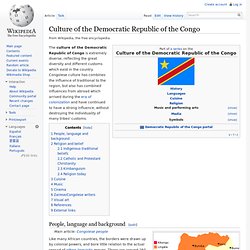
People, language and background[edit] Like many African countries, the borders were drawn up by colonial powers, and bore little relation to the actual spread of ethno-linguistic groups. There are around 250 languages spoken in the country, with perhaps a similar number of ethnic groups. Pygmies, the earliest inhabitants of the Congo, are generally hunter-gatherers. The above descriptions are by necessity simplified. Mixed marriages between ethnic groups are common, particularly in urban areas where many different groups live side by side. Religion and belief[edit]

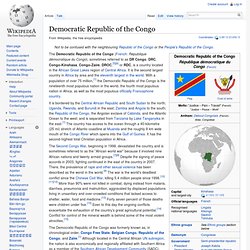
Democratic Republic of the Congo. Coordinates: The Democratic Republic of the Congo (French: République démocratique du Congo), sometimes referred to as DR Congo, DRC, Congo-Kinshasa, Congo-Zaire, DROC,[5][6] or RDC, is a country located in the African Great Lakes region of Central Africa. It is the second largest country in Africa by area and the eleventh largest in the world. With a population of over 75 million,[1] the Democratic Republic of the Congo is the nineteenth most populous nation in the world, the fourth most populous nation in Africa, as well as the most populous officially Francophone country.
The Second Congo War, beginning in 1998, devastated the country and is sometimes referred to as the "African world war" because it involved nine African nations and twenty armed groups.[7][8] Despite the signing of peace accords in 2003, fighting continued in the east of the country in 2007. Etymology[edit] The name "Democratic Republic of the Congo" was the official name of the country from 1964–71. History[edit]