
Deepwater Horizon oil spill. The Deepwater Horizon oil spill (also referred to as the BP oil spill, the BP oil disaster, the Gulf of Mexico oil spill, and the Macondo blowout) began on 20 April 2010 in the Gulf of Mexico on the BP-operated Macondo Prospect.
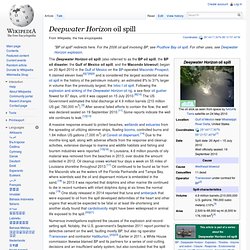
It claimed eleven lives[6][7][8][9] and is considered the largest accidental marine oil spill in the history of the petroleum industry, an estimated 8% to 31% larger in volume than the previously largest, the Ixtoc I oil spill. Following the explosion and sinking of the Deepwater Horizon oil rig, a sea-floor oil gusher flowed for 87 days, until it was capped on 15 July 2010.[8][10] The US Government estimated the total discharge at 4.9 million barrels (210 million US gal; 780,000 m3).[3] After several failed efforts to contain the flow, the well was declared sealed on 19 September 2010.[11] Some reports indicate the well site continues to leak.[12][13] Numerous investigations explored the causes of the explosion and record-setting spill. Background[edit] Rocky Kistner: Sea Turtle Deaths Mount in the Gulf. Sea turtles continue to wash ashore along the Gulf, forcing the National Marine Fisheries Service (NMFS) to scramble and figure out what is causing the spike.

Last week, the Natural Resources Defense Council and The Huffington Post were first to publish blogs about the sea turtle deaths in Mississippi. Since then, the national media picked up the story. Last Friday, NMFS released a statement with some details about its investigation: In the past few weeks, we've seen an increase in turtle strandings in the northern Gulf, primarily in Mississippi.
The spring time is the typical time when turtle strandings in this region begin to increase, but the sharp increases in recent days are of concern to us….NOAA Fisheries is in contact with the states of MS and LA regarding current trawl and other fishery activity that can result in turtle by catch and mortality. Like the dolphin strandings this year, it’s likely that many more turtles have died and will never be found.
Dolphin Deaths Remain A Mystery Due To Federal Gag Order. About a month ago, I reported that researchers on the Gulf Coast were baffled by a sudden increase in the number of baby dolphin deaths occuring near Louisiana, Mississippi and Alabama coastlines.

From the original post: “According to the SunHerald.com, researchers from the Institute for Marine Mammal Studies (IMMS) are investigating a total of 28 adult and infant dolphin carcases since the first of the year. Of the 28, 18 were infant dolphins.” At the time, dolphin birthing season had just begun, so it was somewhat normal for researchers to see stillborn calves–just not in such high numbers. Research agenices involved in the investigation weren’t sure what could be killing these young dolphins. Now it seems that the public may never know. Apparently, the government considers the dophin die-off, classified as an “unusual mortality event (UME),” as part of the federal criminal investigation into last summer’s catastrophic BP oil spill in the Gulf of Mexico.
Too bad, BP.