
House Plants That Reduce Humidity Levels. Dracaena reflexa. Dracaena reflexa, commonly called Pleomele or the Song of India, is a species of Dracaena which is a tropical tree native to Madagascar, Mauritius, and other nearby islands of the Indian Ocean.

It is widely grown as an ornamental plant and houseplant, valued for its richly coloured, evergreen leaves, and thick, irregular stems. While it may reach a height of 4–5 m, rarely 6 m in ideal, protected locations, D. reflexa is usually much smaller, especially when grown as a houseplant. It is slow-growing and upright in habit, tending to an oval shape with an open crown. The lanceolate leaves are simple, spirally arranged, 5–20 cm long and 1.5–5 cm broad at the base, with a parallel venation and entire margin; they grow in tight whorls and are a uniform dark green.[1][2]
Aglaonema. Aglaonema is a genus of flowering plants in the arum family, Araceae.

They are native to tropical and subtropical regions of Asia.[1] They are known commonly as Chinese evergreens.[2] Description[edit] These are evergreen perennial herbs with stems growing erect or decumbent and creeping. Stems that grow along the ground may root at the nodes. There is generally a crown of wide leaf blades which in wild species are often variegated with silver and green coloration.
Plants of the genus are native to humid, shady tropical forest habitat.[2] Cultivation and uses[edit] This mainly tropical genus is known for its intolerance of cold temperatures. Cultivars have been selected for their shape and size, and especially for the color and pattern of the leaves. Most propagation of Aglaonema is done with cuttings and by dividing the basal shoots. Aglaonema plants are poisonous due to calcium oxalate crystals. Diversity[edit] There are about 21 described species in the genus.[1][2] Species include:[9]
Spathiphyllum. Spathiphyllum is a genus of about 40 species of monocotyledonous flowering plants in the family Araceae, native to tropical regions of the Americas and southeastern Asia.
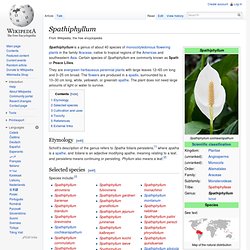
Certain species of Spathiphyllum are commonly known as Spath or Peace Lilies. They are evergreen herbaceous perennial plants with large leaves 12–65 cm long and 3–25 cm broad. The flowers are produced in a spadix, surrounded by a 10–30 cm long, white, yellowish, or greenish spathe. The plant does not need large amounts of light or water to survive. Nephrolepis exaltata. The Sword Fern (Nephrolepis exaltata) is a species of fern in the family Lomariopsidaceae (sometimes treated in the families Davalliaceae or Oleandraceae, or in its own family, Nephrolepidaceae), native to tropical regions throughout the world.

It is common in humid forests and swamps, especially in northern South America, Mexico, Central America, Florida, the West Indies, Polynesia and Africa. Also known as the Wild Boston fern, Tuber ladder fern or Fishbone fern is in the broader family of sword fern. The fronds are 50–250 cm long and 6–15 cm broad, with alternate pinnae (the small "leaflets" on either side of the midrib), each pinna being 2–8 cm long. The pinnae are generally deltoid, as seen in the picture to the right. The pinnate vein pattern is also visible on these highly compound leaves. Cultivation and uses[edit] The Boston fern is a very popular house plant, often grown in hanging baskets or similar conditions. This Plant is safe for cats to eat. References[edit] Tillandsia. Flowering Tillandsia and daughter plant The thinner-leafed varieties grow in rainy areas and the thick-leafed varieties in areas more subject to drought.
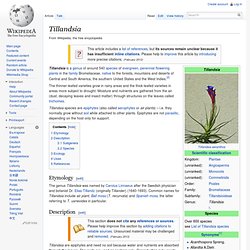
Moisture and nutrients are gathered from the air (dust, decaying leaves and insect matter) through structures on the leaves called trichomes. Tillandsia species are epiphytes (also called aerophytes or air plants) – i.e. they normally grow without soil while attached to other plants. Epiphytes are not parasitic, depending on the host only for support. Etymology[edit] The genus Tillandsia was named by Carolus Linnaeus after the Swedish physician and botanist Dr. Description[edit] Tillandsia plants mounted on the bark of a cork oak.
Tillandsia are epiphytes and need no soil because water and nutrients are absorbed through the leaves. Indoor arrangement of six Tillandsia plants mounted on a log section.