
Jorge Luis Borges. Jorge Francisco Isidoro Luis Borges, KBE (Spanish: [ˈxorxe ˈlwis ˈβorxes] In 1914 his family moved to Switzerland, where he studied at the Collège de Genève.
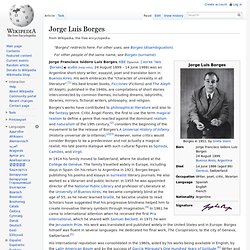
The family travelled widely in Europe, including stays in Spain. On his return to Argentina in 1921, Borges began publishing his poems and essays in surrealist literary journals. He also worked as a librarian and public lecturer. In 1955 he was appointed director of the National Public Library and professor of Literature at the University of Buenos Aires. His international reputation was consolidated in the 1960s, aided by his works being available in English, by the Latin American Boom and by the success of García Márquez's One Hundred Years of Solitude.[6] Writer and essayist J. Life and career[edit] Early life and education[edit] Jorge Luis Borges in 1921 At nine, Jorge Luis Borges translated Oscar Wilde's The Happy Prince into Spanish.
Early writing career[edit] Later career[edit] Bibliography: Jorge Luis Borges: Selected Study Materials on the Web. Compiled by Ralph Dumain On other sites Google Doodle 24 August 2011: Jorge Luis Borges (24 August 1899 – 14 June 1986) (Click on image for links) Jorge Luis Borges - Wikipedia, the free encyclopedia Celestial Emporium of Benevolent Recognition - Wikipedia, the free encyclopedia Borges: Garden of Forking Paths Borges - Quotations Borges Center A Dictionary of Borges by Evelyn Fishburn & Psiche Hughes (270-page book) Borges, a Writer on the Edge by Beatriz Sarlo.
The Garden of Jorge Luis Borges Site of Paul M. Other Inquisitions: 1937-1952 by Jorge Luis Borges, translated by Ruth L. “On the Cult of Books” by Jorge Luis Borges Stories and Summaries The Circular Ruins (Full Text) The Library of Babel (Full Text) Jorge Luis Borges Poems @ PoemHunter.com Poems about Borges Jorge Luis Borges: MENÚ DE POEMAS Everness by Jorge Luis Borges, translated by A.Z. Nostalgia for the Present by Jorge Luis Borges Before Esperanto..., Jeremy's journal (READIN blog), 2 November 2009 “The Aleph” (
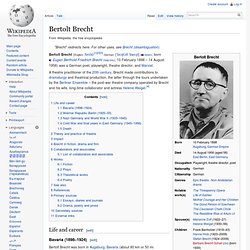
Some others on the squad. Bertolt Brecht. Bertolt Brecht (English: /brɛkt/[1][2][3] German: [ˈbɛɐ̯tɔlt ˈbʁɛçt] ( ); born Eugen Berthold Friedrich Brecht ; 10 February 1898 – 14 August 1956) was a German poet, playwright, theatre director, and Marxist.
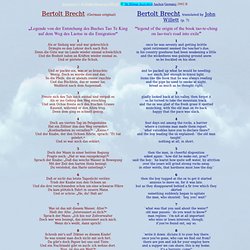
Brecht. Impressum © All Rights Reserved 2002-ff.
. © Dr. Hannah Arendt. Life and career[edit] Arendt was born into a secular family of German Jews in Linden (present-day Hanover), the daughter of Martha (born Cohn) and Paul Arendt.[7] She grew up in Königsberg (renamed Kaliningrad and annexed to the Soviet Union in 1946) and Berlin.
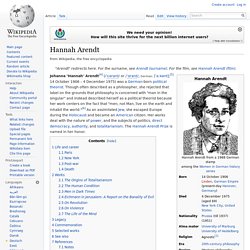
At the University of Marburg, she studied philosophy with Martin Heidegger. According to Hans Jonas, her only German-Jewish classmate, Arendt embarked on a long and stormy romantic relationship with Heidegger, for which she later was criticized because of Heidegger's support for the Nazi Party when he was rector at the University of Freiburg. In the wake of one of their breakups, Arendt moved to Heidelberg, where she wrote her dissertation under the existentialist philosopher-psychologist Karl Jaspers on the concept of love in the thought of Saint Augustine.
Terms, Ideas, Havehadhappenings. The I Ching or Book of Changes.