
Dup2(2) Mac OS X Developer Tools Manual Page. Dup2 (C System Call) - Code Wiki. Dup2 is a system call similar to dup in that it duplicates one file descriptor, making them aliases, and then deleting the old file descriptor.

This becomes very useful when attempting to redirect output, as it automatically takes care of closing the old file descriptor, performing the redirection in one elegant command. For example, if you wanted to redirect standard output to a file, then you would simply call dup2, providing the open file descriptor for the file as the first command and 1 (standard output) as the second command. Required Include Files Function Definition int dup2(int fildes, int fildes2); Code Snippet Using dup2(), we can redirect standard output to a file, as follows: #include <iostream>#include <unistd.h>#include <fcntl.h> using namespace std; int main(){ int file = open("myfile.txt", O_APPEND | O_WRONLY); if(file < 0) return 1; if(dup2(file,1) < 0) return 1; cout << "This will print in myfile.txt" << endl; return 0; } Using static and shared libraries across platforms. I produced hereafter some information about shared libraries on different systems.
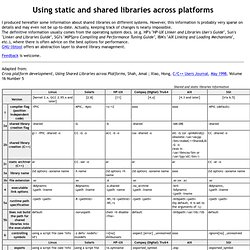
However, this information is probably very sparse on details and may even not be up-to-date. Actually, keeping track of changes is nearly impossible. The definitive information usually comes from the operating system docs. (e.g. HP's "HP-UX Linker and Libraries User's Guide", Sun's "Linker and Libraries Guide", SGI's "MIPSpro Compiling and Performance Tuning Guide", IBM's "AIX Linking and Loading Mechanisms", etc.), where there is often advice on the best options for performance. Feedback is welcome. Adapted from: Cross platform development, Using Shared Libraries across Platforms, Shah, Amal ; Xiao, Hong, C/C++ Users Journal, May 1998, Volume 16 Number 5 Notes: cells with xxxx implies that the OS does not support that particular feature. ??
Juan Altmayer Pizzorno, Wolfgang Haefelinger, Per Losenborg, Anil E. Manpage of LD.SO. Section : Manuel de l'administrateur Linux (8)Mise à jour de la version anglaise : 18 avril 2008IndexMenu principal ld.so, ld-linux.so* - Chargeur et éditeur de liens dynamique L'éditeur de lien dynamique peut être lançé indirectement en démarrant un programme lié dynamiquement ou une bibliothèque (dans ce cas, aucune option en ligne de commande ne peut être transmise, et avec ELF, l'éditeur indiqué dans la section .interp du programme est exécuté), ou directement en lançant : /lib/ld-linux.so.* [OPTIONS] [PROGRAMME [ARGUMENTS]]

Tuxedo (logiciel) Un article de Wikipédia, l'encyclopédie libre. Pour les articles homonymes, voir Tuxedo. Tuxedo est un logiciel middleware destiné à gérer les transactions dans un environnement distribué : c'est un moniteur transactionnel pour systèmes Unix dont le nom signifie Transactions for Unix, Extended for Distributed Operations.
Il a été développé à l'origine par AT&T en 1983 pour la création et l'administration de systèmes d'aide opérationnelle incluant un processus de transaction en ligne OLTP, repris par BEA Systems en 1996 puis racheté en 2008, par Oracle Corporation qui a intégré Tuxedo dans son offre. La version 10gR3 a été publiée en janvier 2009 en tant que composant de Oracle Fusion Middleware[1]. Le concept de Tuxedo a été conçu par le groupe de travail du programme informatique LMOS dont provenaient de manière saisonnière les membres de l'équipe Tuxedo. Avec en 2008 le rachat de BEA Systems par Oracle, le produit continue son évolution. Le site officiel Tuxedo Portail du logiciel. Introducing ATMI Security. This script outputs the google search parameters required for search on edocs documentation.

The following sections describe the various security capabilities available with the BEA Tuxedo system for ATMI applications: What Security Means Security refers to techniques for ensuring that data stored in a computer or passed between computers is not compromised. Most security measures involve passwords and data encryption, where a password is a secret word or phrase that gives a user access to a particular program or system, and data encryption is the translation of data into a form that is unintelligible without a deciphering mechanism.
Distributed applications such as those used for electronic commerce (e-commerce) offer many access points for malicious people to intercept data, disrupt operations, or generate fraudulent input; the more distributed a business becomes, the more vulnerable it is to attack. See Also Security Plug-ins Figure 1-1 BEA Tuxedo ATMI Plug-in Security Architecture.