
Signing an XML document using XMLDSIG (Part 1) This page demonstrates how to create a digital signature in XML.

This is a simple [sic] example of an enveloping signature where we sign a straightforward text string inside an XML document. 2012-05-09: For an example of a enveloped signature, see Part 2. To make a digital signature, you need a private key. Our example uses the 1024-bit RSA private key for Alice from RFC 4134 [SMIME-EX]. We use our CryptoSys PKI Toolkit to carry out the necessary computations. We give full details of the exact data to be processed at each stage in order to produce the final signed XML document. For advanced users: If this is too simple for you, see our page on XML-Dsig and the Chile SII where we look in detail at creating digital signatures in XML documents using the standards for electronic invoices set by the Servicio de Impuestos Internos (SII) of Chile.
Oops. Java XML Digital Signatures. Oracle Technology Network > Java Software Downloads View All Downloads Top Downloads New Downloads What's New Java in the Cloud: Rapidly develop and deploy Java business applications in the cloud.

Essential Links Developer Spotlight Java EE—the Most Lightweight Enterprise Framework? Blogs Technologies Contact Us About Oracle Cloud Events Top Actions News Key Topics Oracle Integrated Cloud Applications & Platform Services. Java XML Digital Signatures. Contents Extensible Markup Language (XML) technology is now an integral part of web-based business applications.
These applications require a fundamentally sound and secure infrastructure to meet the security requirements of confidentiality, endpoint authentication, message integrity, and nonrepudiation. XML signature, XML encryption, XML Key Management Specification (XKMS), Security Assertion Markup Language (SAML), and XML Access Control Markup Language (XACML) are the XML security standards that define XML vocabularies and processing rules to meet these security requirements. This article will provide the following: This section will provide a brief introduction to public key cryptography (PKC) and digital signatures.
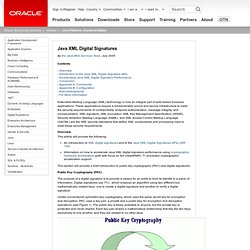
Public Key Cryptography (PKC) The purpose of a digital signature is to provide a means for an entity to bind its identity to a piece of information. A cryptographic transformation encoded with one key can be reversed only with the other key. Confidentiality. XML Signature with JSR-105 in Java SE 6. XML Signature technology, specified in the W3C recommendation XML-Signature Syntax and Processing , is at the foundation for solutions of message-level security in SOA. The universally adopted OASIS standard WS-Security. Using JSR 105 with JDK 1.4 or 1.5. Posted by mullan on February 27, 2008 at 8:20 AM PST JSR 105 (XML Digital Signature API) is included with JDK 6, but is also available separately, for example as part of the Apache XML Security Project.

This allows you to use the JSR with earlier JDK/JREs such as JDK 1.4 or JDK 5. If you do this, however, be aware that the JSR 105 service provider implementation is not included by default with JDK 1.4 or JDK 1.5, so you may get some exceptions when instantiating an XMLSignatureFactory: Extending JSR 105 to support more URI reference types. Posted by mullan on June 28, 2006 at 10:24 AM PDT In XML Signatures, Reference elements use URIs to describe the data that is to be digested and signed. Adding support for your own URI dereferencing implementation is pretty straightforward in JSR 105 . First you need to create a concrete implementation of the javax.xml.crypto.URIDereferencer interface, ex: public class MyURIDereferencer implements URIDereferencer {
XML Signature with JSR-105 in Java SE 6. XML Signature Syntax and Processing (Second Edition) Abstract This document specifies XML digital signature processing rules and syntax. XML Signatures provide integrity, message authentication, and/or signer authentication services for data of any type, whether located within the XML that includes the signature or elsewhere. Status of this document This section describes the status of this document at the time of its publication. Other documents may supersede this document.
Table of Contents 1.0 Introduction This document specifies XML syntax and processing rules for creating and representing digital signatures. The XML Signature is a method of associating a key with referenced data (octets); it does not normatively specify how keys are associated with persons or institutions, nor the meaning of the data being referenced and signed. 1.1 Editorial and Conformance Conventions For readability, brevity, and historic reasons this document uses the term "signature" to generally refer to digital authentication values of all types. Xmlns=" <? URIDereferencer (Java Platform SE 7 ) Exemple Sourec code. The Advantages of @NotNull and JSR 305 - Java Wiki.
JSR 305 proposes adding anotations for defect detections, One enhancements proposed in this JSR is a null check annotation, Find Bugs and IntelliJ already provides support for this.

When you use the @NotNull annotation you are defining that your code will not except a null parameter, if you were to provide a null parameter, the annotation would throw a RuntimeException. IntelliJ has integrated its use into the IDE, hence at compile time you you can be warned when you are about to assign NULL to a field that has been annotated as @NotNull.
The argument against using anotiations is that they should not to be used for language features. Also using the @NotNull annotation does reduce code clarity. Personally, once I got used to reading code littered with annotations, I did not find this an issue. Example method using the @NotNull annotation. public void MyMethodNotExceptingNull(@NotNull String param) { param.length()} XML Security and JSRs 105-106.