
It's Time for a Real Code of Ethics in Teaching - Noah Berlatsky. Yes, the Atlanta schools scandal happened because of high-stakes testing.
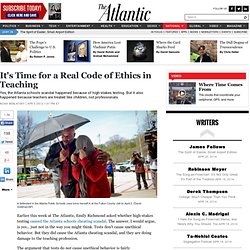
But it also happened because teachers are treated like children, not professionals. A defendant in the Atlanta Public Schools case turns herself in at the Fulton County Jail on April 2. (David Goldman/AP) Earlier this week at The Atlantic, Emily Richmond asked whether high-stakes testing caused the Atlanta schools cheating scandal. The answer, I would argue, is yes... just not in the way you might think. The argument that tests do not cause unethical behavior is fairly straightforward, and has been articulated by a number of writers.
Incentivizing any field increases the impetus to cheat. For Chait, then, teaching has just been made more like journalism or baseball; it has gone from an incentiveless occupation to one with incentives. There's an interesting slippage here, though. This is an important distinction. Using "cheating" as an ethical lens tends to both trivialize and infantilize teacher's work. For Whom the Bell Tolls - Megan Garber. Nishant Choksi Whom, I am thrilled to inform you, is dying.

But its death, I am less thrilled to inform you, has been slow. According to Google’s expansive collection of digitized books, the word has been on a steady decline since 1826. The 400-million-word Corpus of Historical American English records a similar slump. Articles in Time magazine included 3,352 instances of whom in the 1930s, 1,492 in the 1990s, and 902 in the 2000s. Whom, in other words, is doomed.
But why? In a culture that values collegiality above so much else, the ability to communicate casually and convivially and non-twerpily is its own kind of capital. Technology seems to be speeding the demise. We break the old rules, then, because new rules are, effectively, replacing them. Megan Garber is an Atlantic staff writer. Why Parents Need to Let Their Children Fail - Jessica Lahey. A new study explores what happens to students who aren't allowed to suffer through setbacks.
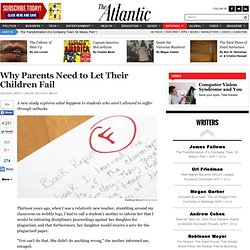
Matthew Benoit/Shutterstock Thirteen years ago, when I was a relatively new teacher, stumbling around my classroom on wobbly legs, I had to call a student's mother to inform her that I would be initiating disciplinary proceedings against her daughter for plagiarism, and that furthermore, her daughter would receive a zero for the plagiarized paper. "You can't do that. She didn't do anything wrong," the mother informed me, enraged. "But she did. "No, I mean she didn't do it. I don't remember what I said in response, but I'm fairly confident I had to take a moment to digest what I had just heard. In the end, my student received a zero and I made sure she re-wrote the paper. While I am not sure what the mother gained from the experience, the daughter gained an understanding of consequences, and I gained a war story. I'm done fantasizing about ways to make that mom from 13 years ago see the light.
Why Don't They Apply What They've Learned, Part I - Do Your Job Better. By James M.

Lang For two years I taught in a special program in which the same cohort of students took two consecutive courses with me: freshman composition in the fall and introduction to literature in the spring. In the composition courses, I worked hard to help students move beyond the standard strategies they had learned in high school for writing introductory paragraphs: Start with a broad statement about life ("Since the beginning of time, people have been fighting wars ...
") and narrow down to a specific topic. In both years that I taught the two-course sequence, I was startled to see many students come back from winter break and—on their very first papers in the spring class—revert directly back to those tired strategies that I had worked so hard to help them unlearn in the fall. One such student came into my office early in the spring semester to show me a draft of her paper, and it included a lame reverse-pyramid (i.e., general to specific) introduction.
D'oh!