
Lunar Exploration. Lunar Exploration Module. The Apollo LM was designed and built by the Grumman Aircraft Engineering Corporation.
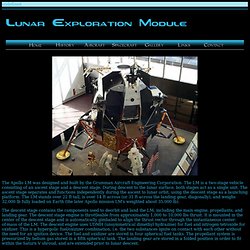
The LM is a two-stage vehicle consisting of an ascent stage and a descent stage. During descent to the lunar surface, both stages act as a single unit. The ascent stage separates and functions independently during the ascent to lunar orbit, using the descent stage as a launching platform. The LM stands over 22 ft tall, is over 14 ft across (or 31 ft across the landing gear, diagonally), and weighs 32,000 lb fully loaded on Earth (the later Apollo mission LM's weighted about 35,000 lb). Lunar Science and Exploration. Lunar Exploration is 'in' Decadal Survey. Lunar Exploration - Missions to the Moon. Lunar Exploration Program|JAXA Space Exploration Center. Euroluna.dk. NASA 360: 21st Century Lunar Exploration - Watch the full episode now.
Lunar Prospector Home Page. . Lunar Reconnaissance Orbiter . Astrogeology: Apollo Mission Media Gallery. Lunar Geologic Map Lunar Topography Mosaic of Io The Astrogeology Science Center's mission includes producing planetary maps and cartographic products which reveal topography, geology, topology, image mosaics and more, all made available to the international scientific community and the general public as a national resource.
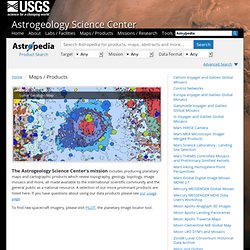
A selection of our more prominant products are listed here. If you have questions about using our data products please see our usage page. To find raw spacecraft imagery, please visit PILOT, the planetary image locator tool. International Atlas of Lunar Exploration. Bringing together a wealth of information from many sources, including some material never before published, this atlas is a comprehensive reference on lunar exploration.
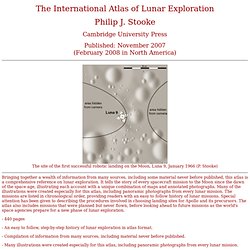
It tells the story of every spacecraft mission to the Moon since the dawn of the space age, illustrating each account with a unique combination of maps and annotated photographs. Many of the illustrations were created especially for this atlas, including panoramic photographs from every lunar mission. The missions are listed in chronological order, providing readers with an easy to follow history of lunar missions. Special attention has been given to describing the procedures involved in choosing landing sites for Apollo and its precursors. The atlas also includes missions that were planned but never flown, before looking ahead to future missions as the world's space agencies prepare for a new phase of lunar exploration. - 440 pages - An easy to follow, step-by-step history of lunar exploration in atlas format. Kennedy 2 Lunar Exploration Project - K2LX. Chinese Lunar Exploration Program.
Program insignia: a lunar crescent with two footprints at its center.
Ouyang Ziyuan, a prominent Chinese geologist and chemical cosmologist, was among the first to advocate the exploitation not only of known lunar reserves of metals such as titanium, but also of helium-3, an ideal fuel for future nuclear fusion power plants. He is currently serving as the chief scientist of the Chinese Lunar Exploration Program. Another prominent Chinese scientist, Sun Jiadong, was assigned as the general designer, while scientist Sun Zezhou was assigned as the deputy general designer. The leading program manager is Luan Enjie. On Lunar Exporation. MoonViews - Providing Imagery and Data For Lunar Exploration. Taking Lunar Exploration Online. Lunar Exploration Vehicles -National Air and Space Museum Exhibition Home Page. Sci.esa. Lunar Exploration Analysis Group (LEAG) Untitled. ESMD. <center><div class="site_errors"><div class="floatType_site_error_top"></div><div class="floatType_site_error"><table summary="layout table"><tr><td bgcolor="#000000"><font color="#ffffff"><h2><img src="/templateimages/redesign/modules/overlay/site_error.gif" title="Site Error" alt="Site Error"/>There's a problem with your browser or settings.
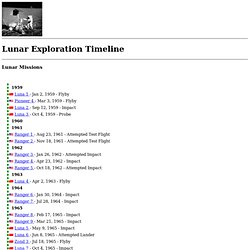
</h2></font><font color="#ffffff"><p>Your browser or your browser's settings are not supported. To get the best experience possible, please download a compatible browser. If you know your browser is up to date, you should check to ensure that javascript is enabled. Lunar Exploration Timeline. Lunar Missions Luna 1 - Jan 2, 1959 - Flyby Pioneer 4 - Mar 3, 1959 - Flyby Luna 2 - Sep 12, 1959 - Impact.
Lunar Exploration. On July 20, 1969, Neil Armstrong became the first human being to set foot on the Moon.
The first step onto the Lunar surface from the Apollo 11 Lunar Module, the Eagle, fulfilled the promise of President John F. Kennedy that the U.S. would land a man on the Moon before the end of the decade. It was the highlight of an extended U.S. program to study and map the Moon, beginning with Ranger 7 impacting the Moon on July 31, 1964 and culminating with Apollo 17, which left the Moon on December 14, 1972. Earth's Moon: Formation, Composition, Orbit & Exploration.
The moon is the easiest celestial object to find in the night sky — when it's there.
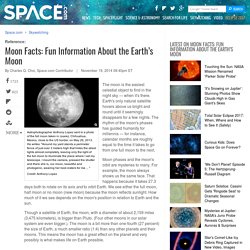
Earth's only natural satellite hovers above us bright and round until it seemingly disappears for a few nights. The rhythm of the moon's phases has guided humanity for millennia — for instance, calendar months are roughly equal to the time it takes to go from one full moon to the next. Moon phases and the moon's orbit are mysteries to many. For example, the moon always shows us the same face. That happens because it takes 27.3 days both to rotate on its axis and to orbit Earth. Though a satellite of Earth, the moon, with a diameter of about 2,159 miles (3,475 kilometers), is bigger than Pluto. There are various theories about how the moon was created, but recent evidence indicates it formed when a huge collision tore a chunk of Earth away. Travel Books: Guidebooks to International and U.S. Destinations.
The Moon. The Moon General Information Missions to the Moon Current and Past Missions.
Moon Phase Images. Moon Phases. Moon Phases Free Daily Moon Phases Website Module Software for Past & Future Moon Phases The free moon module shown above is pretty useful.
But if you'd like additional features like monthly calendars, upcoming full moon / new moon info, and other details, you will need dedicated moon software. I recommend trying a copy of QuickPhase Pro for use anytime on your personal computer. I created it, so I couldn't be biased :-) ... but it's a big time-saver if you're looking at the moon phases regularly. Here are a few core features: Moon Phases. Why does the Moon have phases? At the new Moon phase, the Moon is so close to the Sun in the sky that none of the side facing Earth is illuminated (position 1 in illustration). In other words, the Moon is between Earth and Sun. Moon. Lunar Reconnaissance Orbiter Camera.