
One Big Family: Exoplanet System Hosts at Least 5, and Possibly 7, New Worlds. A team of European astronomers has located what may be the largest collection of planets discovered to date outside our own solar system.

At least five extrasolar planets, and possibly two more, orbit the sunlike star HD 10180 some 125 light-years away, according to a new study that has been submitted to the journal Astronomy & Astrophysics. (A PDF of the paper is available here.) One other planetary system, encircling the star 55 Cnc, hosts five planets, but a six-world system would be unprecedented. The study, led by Christophe Lovis of the Observatory of Geneva, relies on a type of observation called radial velocity measurements, which track Doppler shifts in a star's light spectrum as it moves closer to or farther away from an observer.
Those stellar motions can reveal the presence of unseen planets whose gravitational influence produces periodic patterns of motion in the host star's position. Le premier transit multiple d'exoplanètes découvert par Kepler. Une vue d'artiste de Kepler en plein travail, enregistrant la courbe de luminosité d'un étoile et y découvrant un transit planétaire.

Crédit : Nasa Le premier transit multiple d'exoplanètes découvert par Kepler - 5 Photos Kepler 9, c’est le nom de la première étoile devant laquelle on observe plusieurs planètes « en transit », ce qui se traduit par de légères diminutions périodiques de la luminosité de l’étoile quand l'un de ces corps passe entre elle et nous. C'est une étoile de type solaire, légèrement plus massive et plus grande que le Soleil, située à près de 2.200 années-lumière dans la constellation de la Lyre. Comme son nom l'indique, elle a été découverte par le satellite de la Nasa, Kepler. Du potassium dans l'atmosphère d'une exoplanète. Avec sa mosaïque de miroirs de 10,40 mètres de diamètre, le Gran Tecan a été utilisé pour découvrir du potassium dans l'atmosphère de deux exoplanètes.

Crédit J. -B. Feldmann Du potassium dans l'atmosphère d'une exoplanète - 2 Photos HD 80606 b est une exoplanète géante gazeuse dont la taille est légèrement inférieure à celle de Jupiter. L'orbite de HD 80606 b, parcourue en 110 jours, est la plus excentrique connue de toutes les exoplanètes ; la distance entre la planète et son étoile peut varier de 0,03 à 0,88 unité astronomique, ce qui implique des variations de température à la fois fortes et très rapides. Rich exoplanet system discovered. 24 August 2010Last updated at 14:03 By Victoria Gill Science reporter, BBC News The researchers say the finding marks a new phase in the hunt for exoplanets Astronomers have discovered a planetary system containing at least five planets that orbit a star called HD 10180, which is much like our own Sun.
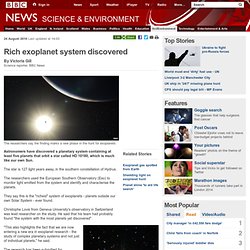
The star is 127 light years away, in the southern constellation of Hydrus. The researchers used the European Southern Observatory (Eso) to monitor light emitted from the system and identify and characterise the planets. They say this is the "richest" system of exoplanets - planets outside our own Solar System - ever found. Christophe Lovis from Geneva University's observatory in Switzerland was lead researcher on the study. The discovery could provide insight into the formation of our own Solar System "This also highlights the fact that we are now entering a new era in exoplanet research - the study of complex planetary systems and not just of individual planets," he said. “Start Quote. Alien oceans could be detected by telescopes. 9 September 2010Last updated at 22:48 By Pamela Rutherford Reporter, BBC News The reflection of light or "glint" could reveal the existence of Earth-like planets.

The next generation of telescopes could reveal the presence of oceans on planets outside our Solar System. Detecting water on Earth-like planets offers the tantalising prospect they could sustain life. Scientists hope the reflection of light, or "glint", from mirror-like ocean surfaces could be picked up by a US space telescope set for launch in 2014. The research by US astronomers has been published in Astrophysical Journal Letters. Tyler Robinson at the University of Washington in Seattle is hoping this new technique could be used in the quest to find the Holy Grail for exoplanet astronomers - a possible sister to planet Earth. The goal is to find something Earth-like in almost every sense of the world so we can even prove it has liquid oceans on its surface.
"