
Looking Up Symptoms Online? These Companies Are Tracking You. the Pew Internet Project In April 2014, Tim Libert, a researcher at the University of Pennsylvania, custom-built software called webXray to analyze the top 50 search results for nearly 2,000 common diseases (over 80,000 pages total).
He found the results startling: a full 91 percent of the pages made what are known as third-party requests to outside companies. That means when you search for “cold sores,” for instance, and click the highly ranked “Cold Sores Topic Overview WebMD” link, the website is passing your request for information about the disease along to one or more (and often many, many more) other corporations. The Turn-Verizon Zombie Cookie. Verizon Wireless injects a unique header into customer web traffic.
Which Apps Protect Against Verizon and Turn's Invasive User Tracking? The Internet With A Human Face - Beyond Tellerrand 2014 Conference Talk. Anyone who works with computers learns to fear their capacity to forget.
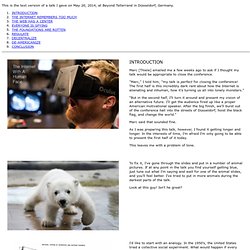
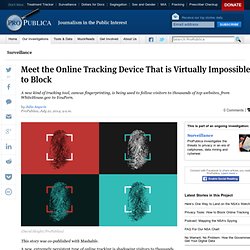
Like so many things with computers, memory is strictly binary. There is either perfect recall or total oblivion, with nothing in between. It doesn't matter how important or trivial the information is. The computer can forget anything in an instant. The Internet's Original Sin. Meet the Online Tracking Device That is Virtually Impossible to Block. This story was co-published with Mashable.
Ligthbeam for Firefox. Tracking & privacy Not all tracking is bad.
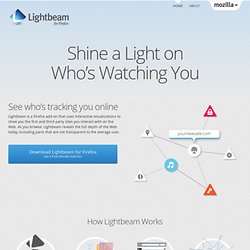
Identity at Mozilla. Eye catchers / The Evidon TrackerMap displays all of the invisible third party tracking activity on a single page of a publisher’s website, how those third party tracking companies got there and the overall impact their presence may have on general site p. Ghostery Ad Blocker Also Helps the Ad Industry. Browser Add-On Shows Exactly Who's Watching You Surf. I've not been a major user of Firefox for the past year or so, since I discovered the wonderful Google Chrome.

But over the past couple of days I've been an avid Firefoxer, solely because of an absolutely wonderful (and extremely concerning) add-in called Collusion. You probably know about cookies. Amazon Launches Ad Network - Peter Kafka. You can buy just about anything on Amazon.com, including advertising.

Now Amazon is selling ads on other people’s sites, too. The e-commerce giant has started what is effectively an ad network* where it buys Web advertising inventory and resells it to marketers at a premium. Cookies, Supercookies and Ubercookies: Stealing the Identity of Web Visitors « 33 Bits of Entropy - February 18, 2010 at 7:49 am Synopsis.
Highly sticky techniques called supercookies for tracking web visitors are becoming well known. But the state of the art has in fact advanced beyond tracking, allowing a website to learn the identity of a visitor. I will call these techniques ubercookies; this article describes one such recently discovered technique. Future articles in this series will describe even more powerful variants and discuss the implications. Researchers Expose Cunning Online Tracking Service That Can’t Be Dodged. Researchers at U.C.
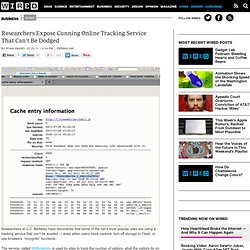
Berkeley have discovered that some of the net’s most popular sites are using a tracking service that can’t be evaded — even when users block cookies, turn off storage in Flash, or use browsers’ “incognito” functions. The service, called KISSmetrics, is used by sites to track the number of visitors, what the visitors do on the site, and where they come to the site from — and the company says it does a more comprehensive job than its competitors such as Google Analytics. But the researchers say the site is using sneaky techniques to prevent users from opting out of being tracked on popular sites, including the TV streaming site Hulu.com. The discovery of KISSmetrics tracking techniques comes as federal regulators, browser makers, privacy activists and ad tracking companies are trying to define what tracking actually is.
Respawn_redux. Ubercookies Part 2: History Stealing meets the Social Web. February 19, 2010 at 8:02 am Recap. In the previous article I introduced ubercookies — techniques that websites can use to de-anonymize visitors. It is possible to kill the evercookie? Browser cookies can provide everyone from advertisers to malware authors with useful information on things like unique identifiers and the sites a user has visited.

But they're also fragile, and can be deleted with a click of the mouse. So, in recent years, there has been a rash of cookies that are much harder to get rid of, that burrow into persistent files and continue to propagate even after the browser is reset. Eventually, in a proof of principle, security researcher Samy Kamkar developed evercookie, an especially persistent example. It turns out that it is possible to delete evercookie from most browsers, but the methods range from simple to positively baroque. The first persistent cookies used Adobe's Flash to store their data. Apple Plots Non-Optional End of Privacy for iPhone Users.
Insurers Test Data Profiles to Identify Risky Clients. Feds tracking credit cards, store purchases without warrant: report. By Daniel TencerThursday, December 2, 2010 21:13 EDT Federal law enforcement routinely tracks individuals through their credit cards, cell phones, car rentals and even store customer loyalty programs without obtaining a warrant, an online privacy activist has discovered.
According to a document (PDF) obtained from the Department of Justice by online privacy activist Christopher Soghoian, federal agents working on a criminal investigation can draw up their own paperwork requesting that credit companies and retailers give the agents real-time access to purchases made by a particular person. FTC Releases Promising Report Urging Improved Internet Privacy Policies.
December 1, 2010 WASHINGTON – The Federal Trade Commission (FTC) issued a promising report today on consumer privacy advocating for the implementation of strong protections for Americans’ online activity and urging Internet companies and other industries that handle personal information to create better privacy protections. The FTC’s report describes how browsers and websites can employ improved privacy features such as simplified privacy notices, and endorses an important privacy feature known as a “do not track” list.
A “do not track” list would allow consumers to opt out of having their online activity tracked, stored and shared with private companies for targeted advertising use. Blog of Rights: Official Blog of the American Civil Liberties Union » The Single Greatest Chart Ever (At Least if You Want to Know Where Your Personal Information Goes) - www.aclu.org. The Federal Trade Commission (FTC) released a report (PDF) on Wednesday that provides an outstanding start on describing the problems of data collection both on and offline. History Sniffing: How YouPorn Checks What Other Porn Sites You’ve Visited and Ad Networks Test The Quality of Their Data - Kashmir Hill - The Not-So Private Parts.
Do Not Track - Universal Web Tracking Opt-Out. Tracking the Trackers: Early Results. Over the past several months researchers at the Stanford Security Lab have been developing a platform for measuring dynamic web content. What Does the "Track" in "Do Not Track" Mean? The History of the Do Not Track Header - paranoia.dubfire.net. Last month, both the FTC and Commerce Department published privacy reports that mentioned the possibility of a Do Not Track mechanism. Tracking Protection Lists: A privacy enhancing technology that complements Do Not Track. Yesterday, Microsoft released version 9 of Internet Explorer, which includes two significant new privacy features: Tracking Protection Lists (TPLs) and a Do Not Track (DNT) header that allows users to request that websites not track them. Opting out of Rapleaf. Spokeo, personal data aggregators, and your privacy rights: Xeni on The Madeleine Brand Show.
Online identity management. Online identity management (OIM) also known as online image management or online personal branding or personal reputation management (PRM) is a set of methods for generating a distinguished Web presence of a person on the Internet. The Long View of Identity.
5 Ways to Share Your Social Media Identity.