
Chemistry. Chemistry is a branch of physical science that studies the composition, structure, properties and change of matter.[1][2] Chemistry is chiefly concerned with atoms and molecules and their interactions and transformations, for example, the properties of the chemical bonds formed between atoms to create chemical compounds.
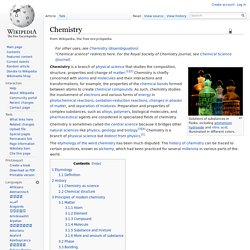
As such, chemistry studies the involvement of electrons and various forms of energy in photochemical reactions, oxidation-reduction reactions, changes in phases of matter, and separation of mixtures. Preparation and properties of complex substances, such as alloys, polymers, biological molecules, and pharmaceutical agents are considered in specialized fields of chemistry. Chemistry is sometimes called the central science because it bridges other natural sciences like physics, geology and biology.[3][4] Chemistry is a branch of physical science but distinct from physics.[5] Etymology The word alchemy in turn is derived from the Arabic word al-kīmīā (الکیمیاء).
Inorganic chemistry. Inorganic chemistry is the study of the synthesis and behavior of inorganic and organometallic compounds.

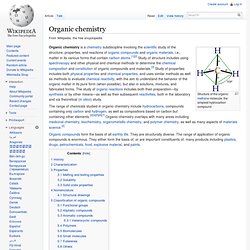
This field covers all chemical compounds except the myriad organic compounds (carbon based compounds, usually containing C-H bonds), which are the subjects of organic chemistry. The distinction between the two disciplines is far from absolute, and there is much overlap, most importantly in the sub-discipline of organometallic chemistry. It has applications in every aspect of the chemical industry–including catalysis, materials science, pigments, surfactants, coatings, medicine, fuel, and agriculture. [1] Organic chemistry. Structure of the organic methane molecule, the simplest hydrocarbon compound Organic chemistry is a chemistry subdiscipline involving the scientific study of the structure, properties, and reactions of organic compounds and organic materials, i.e., matter in its various forms that contain carbon atoms.[1][2] Study of structure includes using spectroscopy and other physical and chemical methods to determine the chemical composition and constitution of organic compounds and materials.[3] Study of properties includes both physical properties and chemical properties, and uses similar methods as well as methods to evaluate chemical reactivity, with the aim to understand the behavior of the organic matter in its pure form (when possible), but also in solutions, mixtures, and fabricated forms.
The study of organic reactions includes both their preparation—by synthesis or by other means—as well as their subsequent reactivities, both in the laboratory and via theoretical (in silico) study.