
Music From Outer Space. Guitar pedals - Stompboxes. Rack Studio effects DIY. Amp Terms Glossary. There are many terms commonly seen in literature describing guitar amplifier circuitry which can be somewhat confusing to a person with no prior background in electronics.

This page will attempt to shed some light on these mysteries, and provide descriptions of common electronic terms, components, and circuitry in somewhat easy-to-understand form, although some terms represent concepts that are difficult to explain in simple language, so you may have to do some additional side reading to fully comprehend them. The material is presented in an alphabetical, glossary-style form, so there is some overlap in the definitions. - Alternating Current.
This is electric current that periodically changes the direction in which it flows. The most common form of an alternating current supply is the sinusoidal current that comes out of a wall outlet. . - a component that needs a power source to function, as opposed to a passive component. . - the reciprocal of impedance.
. - the symbol for capacitance. Multimeter Help. A multimeter is an electronics testing device that, um, tests multiple things, including resistance, voltage, and current.

Using certain multimeter models, you can test to be sure that components — such as diodes, capacitors, and transistors — function properly. You can also troubleshoot your circuit to see where current is failing and pinpoint the problem spots. You don't have to break into your piggy bank to buy a multimeter. You can find them for about if you want fancy features, you can spend over $100. Find a model whose price you like and then splurge on the next higher-priced model.
Multimeter Help 2. Mike690003, What is your background?

How deep an understanding are you looking for? A practical understanding of DC circuits is not difficult and learning to use the multimeter with DC will make perfect sense. Just through simple experimentation, after reading the accompanying manual, you'll learn a lot. AC circuits are a different creature and you'll need additional stuff and either a formal course or a good tutor to do serious work with AC. DIYstompboxes Forum. Schematics Guide. You can see that there are various bits represented by symbols, all connected in various ways.
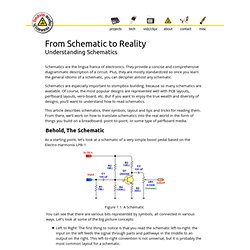
Let’s look at some of the big picture concepts: Left to Right: The first thing to notice is that you read the schematic left-to-right: the input on the left feeds the signal through parts and pathways in the middle to an output on the right. This left-to-right convention is not universal, but it is probably the most common layout for a schematic. Power and Ground: The top area of the schematic shows some type of power (in our case, 9 volts Direct Current, the same thing that comes out of a 9 volt battery). The bottom of the schematic shows grounds. Each symbol shows a part number and a part value or type.
Connections: The connections between components are shown by lines. Figure 1.2: Various Ways of Depicting Connected Lines In the first example on the left, a dot shows interconnecting lines. Inputs and Outputs For stompbox designs, you almost always have an input and an output. Switches Guide. Poles and Throws Switches are defined by ‘poles’ and ‘throws’: The poles is number of switch contact sets.

The throws are the number of conducting positions, which can be single or double. Switch types usually are abbreviated so a Single Pole Double Throw switch would be a SPDT. Other Switch Families This article talks about “mechanical” switches—the kind you use your finger, foot, or some other type of physical thing to activate. Single Throw Switches This is about the simplest switch--it makes or breaks a contacts between two lugs. You would typically use this for a power switch. Dual Throw Switches This is the most common family of the mechanical switches, dual throw means you are switching one or more lugs between two positions. Rotary Switches Rotary switches are characterized by rotational actuation, instead of flipping a switch, you turn it. These switches are great if you need to switch more than two values.