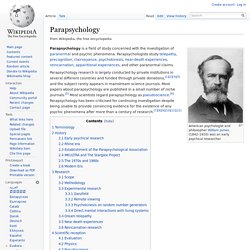
Parapsychology. American psychologist and philosopher William James (1842–1910) was an early psychical researcher.
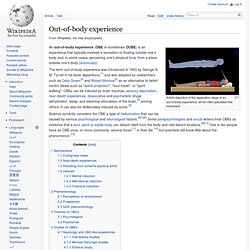
Parapsychology is a field of study concerned with the investigation of paranormal and psychic phenomena. Parapsychologists study telepathy, precognition, clairvoyance, psychokinesis, near-death experiences, reincarnation, apparitional experiences, and other paranormal claims. Parapsychology research is largely conducted by private institutions in several different countries and funded through private donations,[1][2][3][4] and the subject rarely appears in mainstream science journals. Most papers about parapsychology are published in a small number of niche journals.[5] Most scientists regard parapsychology as pseudoscience.[6] Parapsychology has been criticised for continuing investigation despite being unable to provide convincing evidence for the existence of any psychic phenomena after more than a century of research.[7][8][9][10][11][12] Out-of-body experience. Artist's depiction of the separation stage of an out-of-body experience, which often precedes free movement An out-of-body experience (OBE or sometimes OOBE) is an experience that typically involves a sensation of floating outside one's body and, in some cases, perceiving one's physical body from a place outside one's body (autoscopy).
The term out-of-body experience was introduced in 1943 by George N. M. Tyrrell in his book Apparitions,[1] and was adopted by researchers such as Celia Green[2] and Robert Monroe[3] as an alternative to belief-centric labels such as "astral projection", "soul travel", or "spirit walking". OBEs can be induced by brain traumas, sensory deprivation, near-death experiences, dissociative and psychedelic drugs, dehydration, sleep, and electrical stimulation of the brain,[4] among others. Spontaneous[edit] During/near sleep[edit] Near-death experiences[edit] Another form of spontaneous OBE is the near-death experience (NDE).
Pseudoscience. The demarcation problem between science and pseudoscience has ethical political implications, as well as philosophical and scientific issues.[6] Differentiating science from pseudoscience has practical implications in the case of health care, expert testimony, environmental policies, and science education.[7] Distinguishing scientific facts and theories from pseudoscientific beliefs such as those found in astrology, alchemy, medical quackery, and occult beliefs combined with scientific concepts, is part of science education and scientific literacy.[8] The term pseudoscience is often considered inherently pejorative, because it suggests something is being inaccurately or even deceptively portrayed as science.[9] Accordingly, those labeled as practicing or advocating pseudoscience usually dispute the characterization.[9] Overview[edit] Scientific methodology[edit] Falsifiability[edit] Merton's norms[edit] In 1942, Robert K.
Refusal to acknowledge problems[edit] Criticism of the term[edit] Pseudoscience News, Videos, Gossip. Ghost hunting. "Paranormal investigation" and "paranormal investigator" redirect here.

For other uses, see paranormal. "Ghost hunt" redirects here. For the light novel series and its adaptations, see Ghost Hunt. A ghost hunter taking a reading with an EMF meter Ghost hunting is the process of investigating locations that are reported to be haunted by ghosts. Traditional techniques such as conducting interviews and researching the history of a site are also employed.
Popularity[edit] The Internet, films (like Ghostbusters) and television programs (like Most Haunted, Ghost Hunters, The Othersiders and Ghost Adventures), along with the increasing availability of high-tech equipment are thought to be partly responsible for the boom in ghost hunting. Small businesses offering ghost-hunting equipment and paranormal investigation services have increased in the last decade.
One ghost-hunting group reports that the number of people taking their tours has tripled, jumping from about 600 in 2006 to 1,800 in 2008.