
Scotland's Rural Past. Sgioba Luaidh Inbhirchluaidh. Who are we?
... Có sinne? We are a group specialising in Gaelic work songs, particularly those sung by women while waulking the tweed. We are based in Greenock, Inverclyde, on the west coast of Scotland. Our name, Sgioba Luaidh Inbhirchluaidh, means "Inverclyde Waulking Group". Click here to see us in action. My name is Frances Dunlop. Bers of Greenock Gaelic Choir. We hope you will find our website informative and enjoyable. The News and Calendar pages are updated regularly. You're the best thing we've seen in Scotland! It was a brilliant evening. It was a meeting with a difference and so very informative … you all sang so sweetly and with a real lilt in your voices …. we shall remember your group for a long time. Your talk and demonstration was most interesting and informative and your songs were entertaining and sometimes very amusing.
Chòrd an “stint” agaibh ruinn glan fhéin, agus dh’éisdinn fad na h-oidhche ris na sgeulachdan agad. Bha e math agus chòrd e rium. Highland Cattle in 1919. Old Roads of Scotland. The opportunity afforded by Google Books to quote extracts from books on their site has been taken here, so that the text below contains some original text as well as summaries - the summaries are given in italics.
Links are given to relevant parishes. The old photographs of Inverness, Fort William and Ben Nevis are from the Detroit Publishing Company's Views of Landscape and Architecture in Scotland - see thumbnails on Library of Congress site here. Additional information about parishes can be found on the Vision of Britain site and on Scotland's Places. Overview At the time of the OSA, the road sysytem in Inverness-shire was just starting to be developed. The Wade roads were still in use giving a communication to the south and along the Great Glen to Fort Augustus and Fort William, although the Bernera road had deteriorated badly.
Cattle droving is mentioned frequently and stretched as far as the Hebrides and Skye. Abernethy & Kinchardine OSA (vol.13, p.129) Turf Houses in the Viking Age. Turf Houses in the Viking Age The photos on this page were taken at three different turf house reconstructions: at L'Anse aux Meadows in Newfoundland, Canada; at Þjóðveldisbær in Þjórsárdalur, Iceland; and at Eiríksstaðir in Haukadalur, Iceland.
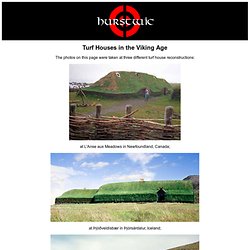
The Stöng farm was large and rich, and after the eruption, it may not have been abandoned completely until the climate changes that occurred in the 13th century. The L'Anse aux Meadows site was probably a way station for Norse exploration in North America one thousand years ago. The houses are similar in overall construction, but differ remarkably in details, primarily because the houses were built for different purposes, at different times in the Norse era, by families with differing resources. Enviro Earthbag Dome Plan.
An ideal starter home, this plan is easy to extend or even create large dome clusters.
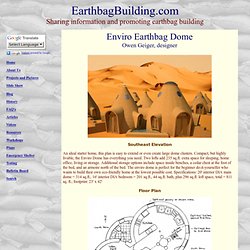
Compact, but highly livable, the Enviro Dome has everything you need. Two lofts add 235 sq.ft. extra space for sleeping, home office, living or storage. Additional storage options include space inside benches, a cedar chest at the foot of the bed, and an armoire north of the bed. The enviro dome is perfect for the beginner do-it-yourselfer who wants to build their own eco-friendly home at the lowest possible cost. Specifications: 20' interior DIA main dome = 314 sq.ft., 16' interior DIA bedroom = 201 sq.ft., 44 sq.ft. bath, plus 296 sq.ft. loft space, total = 811 sq. ft.; footprint: 23' x 42' My main goal has been to reduce the cost of housing, while also making the designs sustainable, easy to build and livable. Cost: How much do earthbag houses cost? Kitchens: A great deal of thought has gone into the kitchens I design. Baths: Most baths are standard 5 feet wide. The Megalithic Portal and Megalith Map.
The Fish Eaters of Viking Age Orkney. Daphne's Salmon I first met Daphne Lorimer and her husband Ian in the summer of 1990, while participating in Colleen Batey and Christopher Morris' excavations at the Earl's Bu, Orphir.
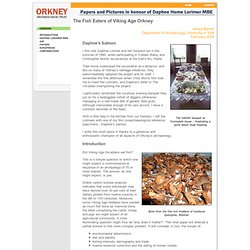
Their home overlooked the excavation at a distance, and like so many of Orkney's heritage initiatives, they warm-heartedly adopted the project and its staff. I remember the fine afternoon when Chris Morris first took me to meet the Lorimers, and Daphne's letter to The Orcadian championing the project. I particularly remember the luxurious evening banquet they put on for a bedraggled cohort of diggers (otherwise managing on a self-made diet of generic field grub). Although memorable enough of its own accord, I have a constant reminder of the feast. With a little help in the kitchen from our hostess, I left the Lorimers with one of my first zooarchaeological reference specimens - Daphne's salmon.
I write this short piece in thanks to a generous and enthusiastic champion of all aspects of Orkney's archaeology. Ploughing. Scottish Crofting Federation.