
Screen-Shot-2012-09-11-at-4.42.16-PM.png (1251×702) Human Memory: Atkinson-Shiffrin Model. Atkinson-Shiffrin Model In 1968 Atkinson and Shiffrin proposed a model of human memory which posited two distinct memory stores: short-term memory, and long-term memory.
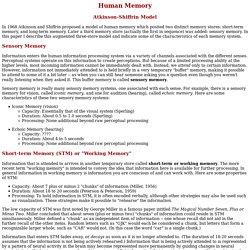
Later a third memory store (actually the first in sequence) was added: sensory memory. In this paper I describe this augmented three-store model and indicate some of the characteristics of each memory system. Sensory Memory Information enters the human information processing system via a variety of channels associated with the different senses. Sensory memory is really many sensory memory systems, one associated with each sense. Iconic Memory (vision) Capacity: Essentially that of the visual system (Sperling) Duration: About 0.5 to 1.0 seconds (Sperling) Processing: None additional beyond raw perceptual processing Echoic Memory (hearing} Capacity: ????
Short-term Memory (STM) or "Working Memory" Information that is attended to arrives in another temporary store called short-term or working memory. Long-term Memory (LTM) The Golden Age of the Animated GIF. We are in the golden age of the animated .GIF.

What was once a MySpace eyesore has become part of the internet lexicon, a delightful way to convey memes, punchlines, and sometimes even art. The animated .GIF (Graphics Interchange Format) has been around since the early 1990s, when Netscape created a code to allow for the display of successive images within a single frame. GIFs were initially popular in corners of the internet like 4Chan and Fark, message boards where extremely dedicated users developed their own language and inside jokes around the format. As they become increasingly mainstream, they offer a whole new medium in the formerly flat and one-note world of online communication. The emoticon was once our best method of conveying feelings in a digital space where facial expressions and inflection weren’t possible. Human memory is intimately tied to isolated moments in time. So get GIFing. How to Get Early Customers to Respond to Your Cold Emails. Fringe Benefits: Why startups mustn’t appeal to the masses by.
In a two-party political system like we have in America, the fight is always over the middle.

The hard-lefts vote Democratic, the hard-rights Republican, even if they don’t know the candidate, even if they don’t like the candidate, because it can’t be as bad as that other guy who is even further removed from their ideology. No sense in either party trying to battle over those extremes. But fighting for the middle is murky — without a strong affiliation and a consistent set of beliefs, how do you convince all of the centrists you’re the best candidate? The answer is political safe-talk: saying the right thing to the crowd in front of you while leaving enough wiggle room to say something different to the next. Frolic at the intersection of ambiguity and generality.
Of course this sort of behavior is why we distrust and dislike politicians, and why most Americans prefer voting for “none of the above.” A startup must be the opposite of a politician. You’ll need to be honest too. 3 Rules for Building Features in a Lean Startup. 20 Flares370010--×20 Flares x Access to videos, talks, and worksheetsInvitation to private Google Plus CommunityJoin in on live Q&A webinars and fireside chats.

How We Build Features. X Access to videos, talks, and worksheetsInvitation to private Google Plus CommunityJoin in on live Q&A webinars and fireside chats.

The Lean Stack – Part 2. 18 Flares07506--×18 Flares x Access to videos, talks, and worksheetsInvitation to private Google Plus CommunityJoin in on live Q&A webinars and fireside chats.
Courses.washington.edu/ie337/Value_Stream_Mapping.pdf. The Lean Stack – Part 1.