
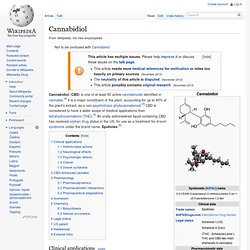
C21H30O2. Cannabidiol. Cannabidiol (CBD) is one of at least 60 active cannabinoids identified in cannabis.[4] It is a major constituent of the plant, accounting for up to 40% of the plant's extract, as a non-psychotropic phytocannabinoid.[5] CBD is considered to have a wider scope of medical applications than tetrahydrocannabinol (THC).[5] An orally-administered liquid containing CBD has received orphan drug status in the US, for use as a treatment for dravet syndrome under the brand name, Epidiolex.[6] Clinical applications[edit] The bud of a Cannabis sativa flower coated with trichomes Antimicrobial actions[edit] CBD absorbed transcutaneously may attenuate the increased sebum production at the root of acne.[7] Neurological effects[edit] A 2010 study found that strains of cannabis containing higher concentrations of cannabidiol did not produce short-term memory impairment vs. strains with similar concentrations of THC, but lower concentrations of CBD.
Parkinson's disease Psychotropic effects[edit] Cancer[edit] Tetrahydrocannabinol. Tetrahydrocannabinol (THC), or more precisely its main isomer (−)-trans-Δ9-tetrahydrocannabinol ( (6aR,10aR)-delta-9-tetrahydrocannabinol), is the principal psychoactive constituent (or cannabinoid) of the cannabis plant.
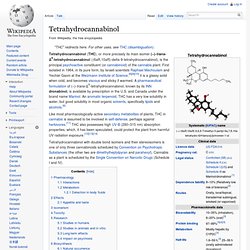
First isolated in 1964, in its pure form, by Israeli scientists Raphael Mechoulam and Yechiel Gaoni at the Weizmann Institute of Science,[8][9][10] it is a glassy solid when cold, and becomes viscous and sticky if warmed. A pharmaceutical formulation of (−)-trans-Δ9-tetrahydrocannabinol, known by its INN dronabinol, is available by prescription in the U.S. and Canada under the brand name Marinol. An aromatic terpenoid, THC has a very low solubility in water, but good solubility in most organic solvents, specifically lipids and alcohols.[6] Tetrahydrocannabinol with double bond isomers and their stereoisomers is one of only three cannabinoids scheduled by Convention on Psychotropic Substances (the other two are dimethylheptylpyran and parahexyl). Pharmacology[edit] Marijuana. 232492.jpg (JPEG Image, 640x640 pixels) - Scaled (81%) 2.jpg (JPEG Image, 1024x666 pixels) - Scaled (74%) #Happy420: The Funniest '420' Tweets Of 2011.
420 Pearls. The Cannabible. Cannabis (etymology) The plant name cannabis is from Greek κάνναβις (kánnabis), via Latin cannabis, originally a Scythian or Thracian word, also loaned into Persian as kanab.

English hemp (Old English hænep) may be an early loan (predating Grimm's Law) from the same Scythian source. The Oxford English Dictionary records the earliest usages of cannabis meaning the plant "common hemp, Cannabis sativa" in 1548 and meaning parts of the plant "smoked, chewed, or drunk for their intoxicating or hallucinogenic properties" in 1848.[1] The OED traces the etymology to the New Latin botanical term cannabis – proposed in 1728 and standardized in Carolus Linnaeus's (1753) Species Plantarum – from an earlier Latin cannabis, coming from Greek kánnabis. The historian and linguist Douglas Harper gives an etymology of English cannabis from Greek kannabis, from a Scythian or Thracian word, which is also the source for English canvas (viz., hempen fabric) and possibly hemp.[3] "Dealing With Drugs In European Drug Control", Dr.