
101 Reasons Why Evolution is True. The 11 Most Beautiful Mathematical Equations. Mathematical equations aren't just useful — many are quite beautiful.
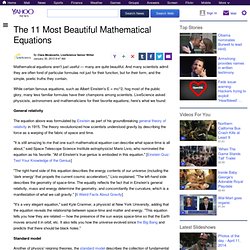
And many scientists admit they are often fond of particular formulas not just for their function, but for their form, and the simple, poetic truths they contain. While certain famous equations, such as Albert Einstein's E = mc^2, hog most of the public glory, many less familiar formulas have their champions among scientists. LiveScience asked physicists, astronomers and mathematicians for their favorite equations; here's what we found: General relativity The equation above was formulated by Einstein as part of his groundbreaking general theory of relativity in 1915. "It is still amazing to me that one such mathematical equation can describe what space-time is all about," said Space Telescope Science Institute astrophysicist Mario Livio, who nominated the equation as his favorite. Standard model The standard model theory has not yet, however, been united with general relativity, which is why it cannot describe gravity.
The Evolution of Crowdsourcing: Open Innovation. Back around the time TopCoder was being founded, Henry Chesbrough coined the term “Open Innovation” in the book Open Innovation: The new imperative for creating and profiting from technology.
We weren’t aware of the term at the time or, for that matter, the term “Crowdsourcing”, because neither had been invented yet. It is quite clear to me in hindsight that these terms were bound to be related and that TopCoder is a superset of them. It is also quite clear to me that both of these concepts are mega-concepts in their own right: Crowdsourcing quickly becoming so and, I believe, to be followed – likely with larger implications – by Open Innovation. Finding a way to do something new through access to external people is a loaded statement.
I believe this will have a much larger impact than simply Crowdsourcing tasks. Here is the short version: Finding implies the result of a search process. Computer Science PhD trends. One of the most under-rated gems in professional computer science is the Taulbee Survey put out every year by the Computing Research Association.
It is a treasure trove of statistics, hard data and trends about both the input (enrollment) and output (graduation and employment) of the computing education pipeline. The latest one has data for the 2011–2012 time period. You could spend hours diving into the data and drawing your own conclusions, but these are some of the things that jumped out at me: 7% of new PhDs got into tenure-track faculty positions.47% of new PhDs went to industry.57% of PhD enrollments were nonresident aliens (an all-time high), as were nearly 50% of PhD graduates. Advice to (prospective) grad students. In my final year of college, when I was applying to graduate schools, I spent a lot of time reading “advice to graduate students” pages.
Some of them helped shape my thinking about the decision of whether to do a PhD, and I feel indebted to them. (And by “grad students”, I really mean “PhD students.”) Now that I’ve been through that experience, here is my humble contribution to the genre. The category representative of the genre is Ronald Azuma’s timeless classic “So Long, and Thanks for the PhD.”
Much of what I wanted to say has already been said there, and although the piece is more than a decade old, it holds up remarkably well. Computer Science Teacher. Five More Principles to Radically Transform How We Teach Computer Programming. Following the previous post about teaching programming languages to kids, here are five more strategies which we are using in our trials at feynlabs.
Our goal is to maintain young people's interest in learning programming so that the participants will acquire enough depth to take independent steps beyond what they learn. As usual, I welcome comments and feedback 6. Use Hacking as a Fundamental Teaching Tool We often start teaching new students about code by writing new programs. Here is an example. w3schools Code for Shutdown Alert Credit: Ajit Jaokar 7. To teach programming, you have to start with a specific programming language -- but you need not confine yourself to only one programming language. Five Principles to Radically Transform How We Teach Computer Programming.
Today, there is a grassroots movement for teaching programming languages to kids.
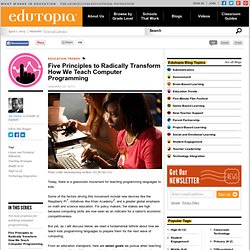
Some of the factors driving this movement include new devices like the Raspberry Pi1, initiatives like Khan Academy2, and a greater global emphasis on math and science education. For policy makers, the stakes are high because computing skills are now seen as an indicator for a nation's economic competitiveness. But yet, as I will discuss below, we need a fundamental rethink about how we teach kids programming languages to prepare them for the next wave of computing. From an education standpoint, here are seven goals we pursue when teaching programming. Many of these are not being addressed by current education techniques widely used in this field: Based on our work in trials with schools and educational institutions for the feynlabs methodology, here are the first five of our ten principles for transforming how to teach programming languages to kids.
Do We Need Radical Change in Computer Science Education? Communications of the ACM. Data Scientist Insights. An idea that changed the world. The Russian Revolution of 1917 was called the “Ten Days That Shook the World,” the title of a book by foreign correspondent Jack Reed, Class of 1910.
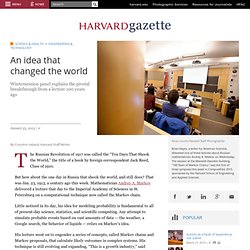
But how about the one day in Russia that shook the world, and still does? That was Jan. 23, 1913, a century ago this week. Mathematician Andrey A. Web Developer Checklist.