
Does Background TV Make Kids Lose Focus? Having Television On in the Background Can Disrupt Playtime, Study Shows Why do I need to register or sign in for WebMD to save?
We will provide you with a dropdown of all your saved articles when you are registered and signed in. July 15, 2008 -- Parents often watch their favorite television show while young ones play nearby. But is that background TV affecting your child as he or she plays with toys, even if they don't seem to be interested in the program? A new study shows that even having the television on in the background can disrupt toddlers as they play with toys, causing them to lose focus during play. © 2008 WebMD, LLC. Researchers at the University of Massachusetts looked at 50 children, aged 1 to 3 years. Children came to a laboratory playroom with a parent. Continue reading below... During the other half hour, the television was turned off. Each child was videotaped and observed by researchers during the study period.
Here is what researchers found: How can I stop my child from biting? Internist, WebMD Medical ExpertMedical Editor, WebMD Rather than having to stop a biting incident, practice prevention so that your child will be less likely to bite in the first place.

If your baby is teething, make sure to always have a cool teething ring or washcloth on hand so he or she will be less likely to sink teeth into someone's arm. Avoid situations in which your child can get irritable enough to bite. Make sure that all of your child's needs -- including eating and nap time -- are taken care of before you go out to play. Bring along a snack to soothe the savage beast if your child gets cranky from being hungry. Give your child enough of your time throughout the day (for example, by reading or playing together), so he or she doesn't bite just to get attention. Even with your best prevention efforts, biting incidents might still occur. You might have heard from other parents that if your child bites you, bite your child back! ZERO TO THREE: Homepage. The Web's most visited site about children's health. Centers for Disease Control and Prevention.
A-Z Index - A. Affordable Health Insurance & Healthcare Coalition. The Children's Office.
Feeding. Infant and toddler health. Healthy Children. AMERICAN ACADEMY OF PEDIATRICS WEB SITE. Berkeley Parents Network: Pediatrics. Pediatrics (also spelled paediatrics or pædiatrics) is the branch of medicine that deals with the medical care of infants, children, and adolescents, and the age limit usually ranges from birth up to 18 (in some places until completion of secondary education, and until age 21 in the United States).
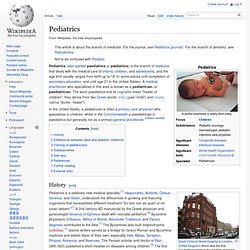
A medical practitioner who specializes in this area is known as a pediatrician, or paediatrician. The word paediatrics and its cognates mean "healer of children"; they derive from two Greek words: παῖς (pais "child") and ἰατρός (iatros "doctor, healer"). In the United States, a pediatrician is often a primary care physician who specializes in children, whilst in the Commonwealth a paediatrician in paediatrics but generally not as a primary general practitioner.
[citation needed] History[edit] This example was only gradually followed in other European countries. Differences between adult and pediatric medicine[edit] The body size differences are paralleled by maturational changes. See also[edit]