
Google's Rich Snippets and the Semantic Web. There’s a long-time debate between those who advocate for semantic markup, and those who believe that machine learning will eventually get us to the holy grail of a Semantic Web, one in which computer programs actually understand the meaning of what they see and read.

Google has of course been the great proof point of the power of machine learning algorithms. Earlier this week, Google made a nod to the other side of the debate, introducing a feature that they call “Rich Snippets.” Basically, if you mark up pages with certain microformats ( and soon, with RDFa), Google will take this data into account, and will provide enhanced snippets in the search results. Supported microformats in the first release include those for people and for reviews. So, for example, consider the snippet for the Yelp review page on the Slanted Door restaurant in San Francisco: The snippet is enhanced to show the number of reviews and the average star rating, with a snippet actually taken from one of the reviews. Introducing Rich Snippets. Webmaster Level: All As a webmaster, you have a unique understanding of your web pages and the content they represent.
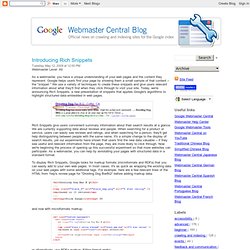
Google helps users find your page by showing them a small sample of that content -- the "snippet. " We use a variety of techniques to create these snippets and give users relevant information about what they'll find when they click through to visit your site. Today, we're announcing Rich Snippets, a new presentation of snippets that applies Google's algorithms to highlight structured data embedded in web pages. Rich Snippets give users convenient summary information about their search results at a glance. To display Rich Snippets, Google looks for markup formats (microformats and RDFa) that you can easily add to your own web pages. And now with microformats markup: or alternatively, use RDFa markup. To prepare your site for Rich Snippets and other benefits of structured data on the web, please see our documentation on structured data annotations. No. Interactive iPhone Kiosk Lets You Play with Semantic Web Technol.
Two German researchers, Simon Bergweiler and Matthieu Deru, came up with a way to explain the heady concept of the semantic web, aka "Web 3.0," to everyday people who aren't as steeped in technology advancements and lingo as perhaps we are.

To do this, the researchers set up an experimental kiosk that lets you use semantic web capabilities with only an iPhone and a swish of your finger. The kiosk, or "shared interaction space" as they prefer calling it, uses MP3 files to demonstrate semantic web technologies. MP3 files were chosen because they are easy to understand as being "things" that can have additional data attached to them ("artist," "album," "year," etc.). This additional data in MP3 files is stored in "ID3 tags," which are basically the portion of the file that tells the computer about that extra information. An MP3 file on an iPhone then is already a semantically annotated object which can be read by a computer. Wait, What's the Semantic Web Again? The Semantic iPhone Kiosks. Two new semantic engines: Cognition and EeggiPosted.
Two companies recently pitched me on their semantic engines.

These are not search engines, which is what most people think. Rather, they are databases and algorithms that hold the structure of language (in both cases, the English language). At the most basic level semantic engines tell you what's synonymous with what. At the advanced end of the spectrum they know how grammatically similar phrases like "take a seat," "take a stand," and "take a lollipop," mean completely different things. These engines can be used by search products to greatly improve results. Cognition recently announced its "world's largest semantic map of the English language," sporting more than "10 million semantic connections. " The much smaller and newer company, Eeggi, which I was introduced to at Web 2.0 Expo in New York, is also building an engine for discerning meaning.
Bandach says that he's got most of the English language in his system, and that he did English first, "because it's hard. See also: Cycorp.